How to Calculate Impedance and Current in a Parallel RLC Circuit
TL;DR
To calculate the impedance in a parallel RLC circuit, use the formula involving resistance and the inductive and capacitive reactances. The current through each component can be found by dividing the source voltage by the relevant resistance or reactance. The resonant frequency occurs when the inductive reactance equals the capacitive reactance, calculated with the formula 1/(2π√(L*C)).
Transcript
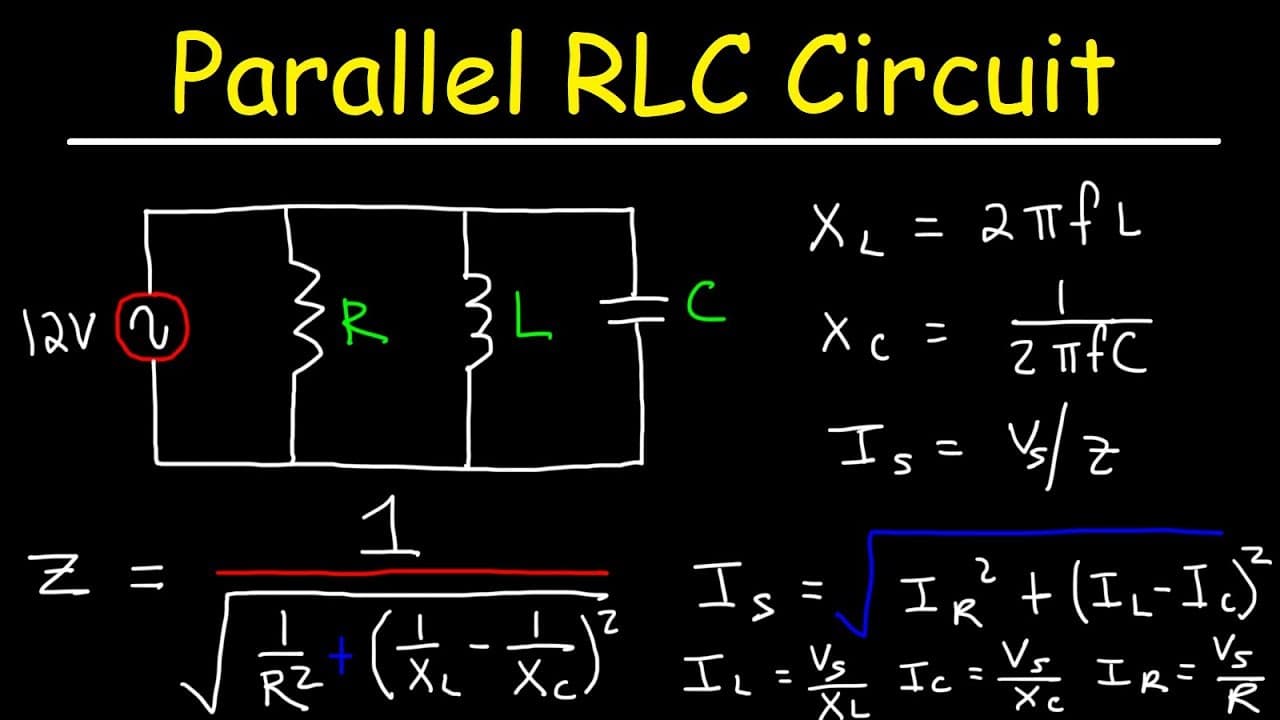
in this video we're going to focus on calculating the impedance in the circuit shown below as well as the current flowing in each element so the first thing we need to do is calculate the inductive reactants which is equal to 2 pi times the frequency of the signal times the inductance so the frequency of our voltage source is 60 hertz as we could s... Read More
Key Insights
- ⌛ The inductive reactance in a parallel RLC circuit is calculated using 2π times the frequency of the signal and the inductance value.
- ⌛ The capacitive reactance in a parallel RLC circuit is calculated by dividing 1 by 2π times the frequency of the signal and the capacitance value.
- ❓ The impedance in a parallel RLC circuit can be calculated using a formula that includes resistance, inductive reactance, and capacitive reactance.
- 💐 The current flowing through each element in a parallel RLC circuit can be determined by dividing the source voltage by the impedance, resistance, inductive reactance, and capacitive reactance, respectively.
- 🟰 The resonant frequency in a parallel RLC circuit occurs when the inductive reactance equals the capacitive reactance.
Install to Summarize YouTube Videos and Get Transcripts
Explore YouTube Video Summarizer or Get YouTube Transcript Extractor
Questions & Answers
Q: How do you calculate the inductive reactance in a parallel RLC circuit?
To calculate the inductive reactance, multiply 2π by the frequency of the signal and the inductance value. In this circuit, it is 2π(60)(80 × 10^-3), resulting in an inductive reactance of 30.16 ohms.
Q: How do you calculate the capacitive reactance in a parallel RLC circuit?
The capacitive reactance is calculated by dividing 1 by 2π times the frequency of the signal and the capacitance value. In this case, it's 1 / [2π(60)(30 × 10^-6)], which equals 88.42 ohms.
Q: What is the formula for calculating the impedance in a parallel RLC circuit?
The formula for impedance in a parallel RLC circuit is 1 divided by the square root of [1 / (R^2) + 1 / (XL - XC)^2], where R is the resistance and XL and XC are the inductive and capacitive reactances, respectively.
Q: How do you calculate the current flowing through each element in a parallel RLC circuit?
The current flowing into the circuit, the current through the resistor, the inductor, and the capacitor can be calculated by dividing the source voltage by the impedance, resistance, inductive reactance, and capacitive reactance, respectively.
Summary & Key Takeaways
-
The video provides step-by-step instructions for calculating the inductive reactance and capacitive reactance in the circuit.
-
It demonstrates how to use these values to calculate the impedance using the formula for a parallel RLC circuit.
-
The video also shows how to calculate the current flowing through each element of the circuit, including the resistor, inductor, and capacitor.
-
Finally, it explains how to determine the resonant frequency at which the inductive reactance equals the capacitive reactance.
Read in Other Languages (beta)
Share This Summary 📚
Summarize YouTube Videos and Get Video Transcripts with 1-Click
Try YouTube Summary with ChatGPT & Claude or YouTube Transcript Generator
Explore More Summaries from The Organic Chemistry Tutor 📚




Summarize YouTube Videos and Get Video Transcripts with 1-Click
Try YouTube Summary with ChatGPT & Claude or YouTube Transcript Generator