What Is the Role of Electrophysiology in Human Memory?
TL;DR
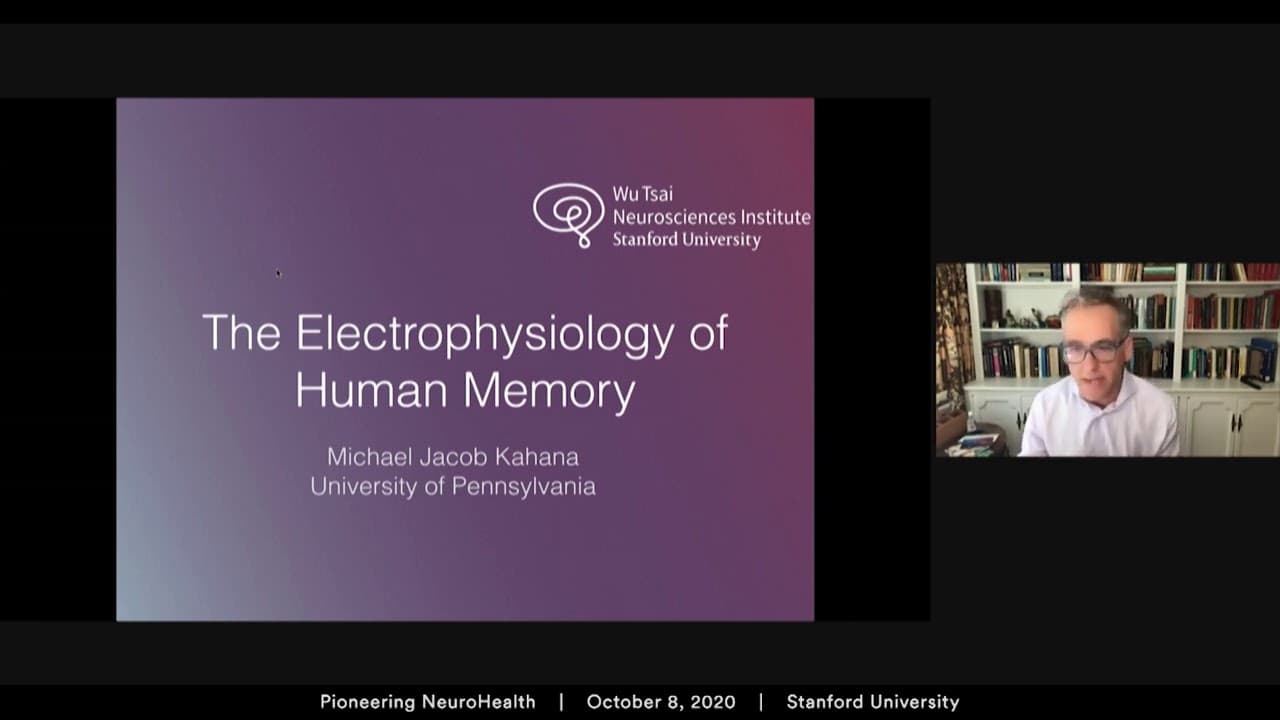
Electrophysiology in human memory studies uses electrical brain activity measurements to identify biomarkers like theta oscillations and high-frequency activity, which correlate with memory performance. Research shows that machine learning can predict memory states based on these signals, and targeted brain stimulation may enhance memory function, though individual variability presents challenges.
Transcript
(bright tune) - So, good morning, I'm Brian Wandell. I'm also a Deputy Director of the Institute and thank you for joining our annual Symposium. It's my pleasure and honor today to introduce our next speaker, Professor Michael Kahana, who's the Edmund and Louise Kahn Professor of Psychology at the University of Pennsylvania. Professor Kahana will b... Read More
Key Insights
- 🧠 Professor Kahana's research involves measuring electrical brain activity in neurosurgical patients to understand the principles of human memory function.
- ✋ Biomarkers, such as theta oscillations and high-frequency activity, have been identified as indicators of memory performance.
- 🧠 Machine learning techniques can be used to predict memory performance based on brain activity patterns.
- 🧠 Brain stimulation has the potential to modulate memory function, but more research is needed to develop effective and safe stimulation methods.
- 🖐️ Individual variability plays a significant role in memory function and response to brain stimulation.
Install to Summarize YouTube Videos and Get Transcripts
Explore YouTube Video Summarizer or Get YouTube Transcript Extractor
Questions & Answers
Q: How does Professor Kahana measure electrical brain activity in his research?
Professor Kahana records intracranial EEG signals from neurosurgical patients, who have implanted electrodes, to directly measure brain activity.
Q: What are the biomarkers identified in Professor Kahana's research?
Professor Kahana has identified several biomarkers, including theta oscillations, high-frequency activity, and connectivity patterns, that are associated with memory function.
Q: How does brain stimulation impact memory function?
Professor Kahana's research has shown that brain stimulation can both impair and enhance memory function, with the effects depending on the timing, region stimulated, and individual variability.
Q: What is the goal of Professor Kahana's research on brain stimulation?
The goal is to develop a therapy for individuals with memory impairments by using biomarker-guided brain stimulation to modulate brain activity and enhance memory performance.
Summary & Key Takeaways
-
Professor Kahana's research focuses on understanding human memory function through the measurement of electrical brain activity.
-
His work involves recording intracranial EEG signals from neurosurgical patients and analyzing the data to identify biomarkers of memory function.
-
Using machine learning techniques, Professor Kahana has developed decoders that can predict memory performance and has explored the use of brain stimulation to modulate memory.
Read in Other Languages (beta)
Share This Summary 📚
Summarize YouTube Videos and Get Video Transcripts with 1-Click
Try YouTube Summary with ChatGPT & Claude or YouTube Transcript Generator
Explore More Summaries from Stanford 📚
Summarize YouTube Videos and Get Video Transcripts with 1-Click
Try YouTube Summary with ChatGPT & Claude or YouTube Transcript Generator