Lecture 2 | The Theoretical Minimum
TL;DR
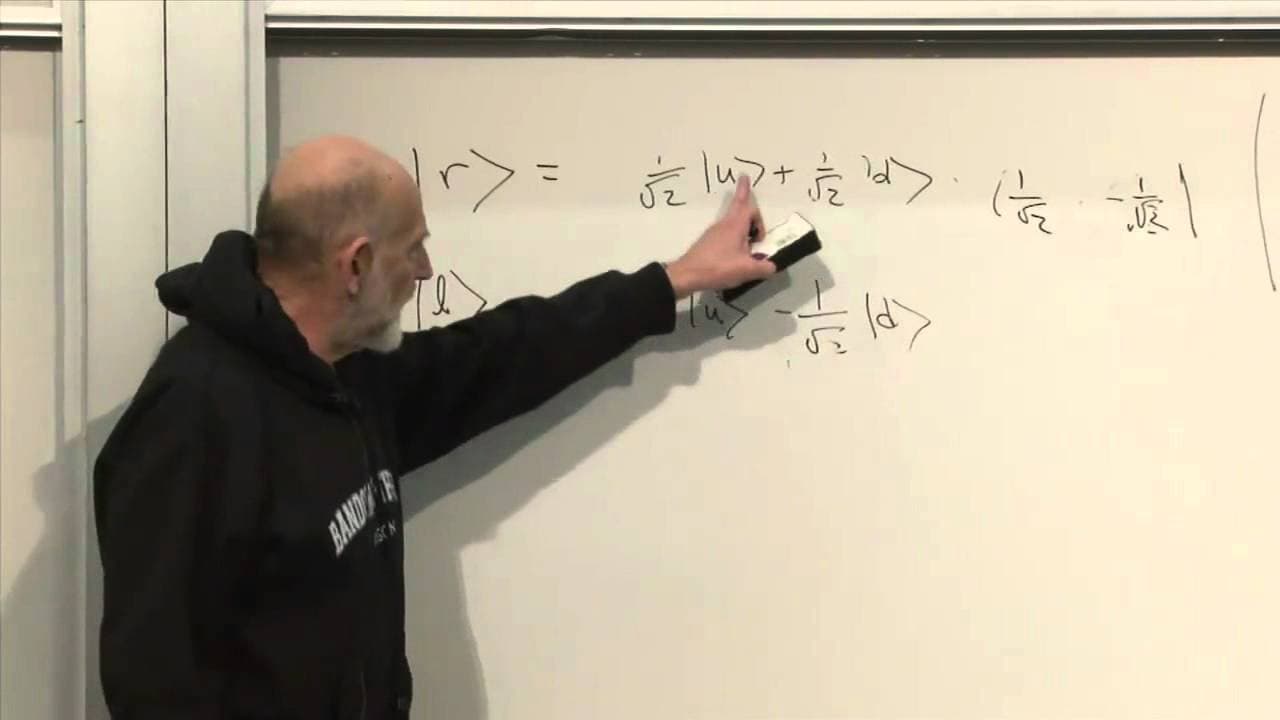
Quantum states are represented as vectors in a vector space, uniquely defined by properties such as orthogonality and normalization. These properties ensure the distinguishability of quantum states and maintain consistent probabilities in measurements. Understanding these concepts is crucial for grasping the foundational aspects of quantum mechanics.
Transcript
stanford university so let's begin i'm going to review very quickly i hope quickly we described a simple system consisting of one qubit i'm going to change my terminology a little bit i'm going to start calling that cubit a spin don't worry about what it has to do with spinning at the moment of course more important is that it's a little pointer no... Read More
Key Insights
- 👻 Quantum states can be represented as vectors in a vector space, allowing for mathematical operations and calculations.
- ❓ Orthogonality between states ensures their distinguishability and avoids ambiguity in measurements.
- 🟰 Normalization of quantum states ensures that the total probability of all outcomes is consistent and equal to one.
Install to Summarize YouTube Videos and Get Transcripts
Explore YouTube Video Summarizer or Get YouTube Transcript Extractor
Questions & Answers
Q: What is the relationship between quantum states and vectors in a vector space?
Quantum states can be represented as vectors in a vector space, allowing for linear combinations and mathematical operations.
Q: What does it mean for two quantum states to be orthogonal?
Orthogonal states are physically distinguishable and have a zero inner product, meaning there is no overlap between their properties.
Q: How are probabilities calculated for quantum states?
The probability for a certain outcome in a quantum measurement is related to the magnitude of the coefficient of the state corresponding to that outcome.
Q: Why are quantum states normalized?
Normalization ensures that the total probability of all possible outcomes in a quantum system is equal to one, allowing for consistent measurements and interpretations.
Summary
In this video, the speaker discusses the concept of a qubit, which is described as a spin or a little three-vector in space. They explain that in classical physics, measurements can be arbitrarily gentle and can reveal anything about a system, while in quantum physics, experiments inevitably change systems. The speaker then introduces the concepts of vector spaces and operators in quantum mechanics. They also explore the logic of quantum mechanics and how it differs from classical physics.
Questions & Answers
Q: What is a qubit?
A qubit is a term used to describe a quantum bit or a quantum system consisting of one spin. It has the character of being a little three-vector in space and can point in a particular direction.
Q: How does measurement differ in classical physics and quantum physics?
In classical physics, measurements can be arbitrarily gentle, meaning that any information about a system can be obtained without significantly affecting the system. However, in quantum physics, measurements unavoidably change the system being measured. When measuring something in quantum mechanics, the act of measurement can affect other properties of the system, and subsequent measurements may yield different results.
Q: What is the difference between a pointer and a three vector?
The speaker initially uses the term "pointer" to refer to the qubit as a vector in three-dimensional space. However, they later replace the term with "three vector" to make the language clearer. The three vector represents a vector in real space and has some sense of pointing in a direction, which can be confirmed through experimental measurements.
Q: How does the apparatus used to measure a qubit affect the results?
Apparatuses play a crucial role in quantum mechanics as they are used to measure quantum systems. In classical physics, measurements can be arbitrarily gentle and have no effect on subsequent experiments. However, in quantum physics, measurements inevitably change the system being measured. The act of measurement may cause the system to change or behave differently than it did before the measurement was made.
Q: How are experiments reproducible in quantum mechanics?
In quantum mechanics, experiments can still be reproducible despite the inherent uncertainty introduced by measurements. If the same experiment is performed multiple times with the same apparatus on the same system, it will yield the same answer each time. This reproducibility is important in making sense of experimental results and building a foundation for quantum theory.
Q: How does the orientation of the apparatus affect spin measurements?
The orientation of the apparatus used to measure the spin of a qubit can affect the measurement results. For example, when the apparatus is oriented along the z-axis, it measures the z component of the spin. Similarly, when the apparatus is oriented along the x or y-axis, it measures the x or y component of the spin, respectively.
Q: How do spin measurements change when the orientation of the apparatus is altered?
The results of spin measurements can change when the orientation of the apparatus is altered. For instance, if a spin is initially prepared along the z-axis and then measured with the apparatus oriented along the x or y-axis, the results will be random but equally likely to yield a plus or minus one. The average values of the spin measured along different axes will be zero if the spin was initially prepared along the z-axis.
Q: Are the results of spin measurements always plus or minus one?
Yes, the results of spin measurements are always plus or minus one. However, the average value of the spin measured along different axes may vary depending on the initial preparation of the spin and the orientation of the apparatus.
Q: How does logic in quantum mechanics differ from logic in classical physics?
In quantum mechanics, logic is different from classical physics. In classical physics, the logic of propositions follows familiar rules, such as the use of the terms "and" and "or." However, in quantum mechanics, the logic is distorted due to the nature of quantum systems and their measurement apparatuses. The idea of "or" in quantum mechanics can only be defined in a way that depends on the order in which propositions are determined.
Q: What are the operations of combining propositions in quantum mechanics?
In quantum mechanics, there are operations of combining propositions using "and" and "or." The "and" operation is defined as the intersection of the sets of states for which both propositions are true. The "or" operation is defined as the union of sets of states for which either proposition is true or both are true. However, the order in which propositions are determined can affect the truth value of the combined propositions.
Q: How is the concept of and and or statements applied to spin measurements?
The concept of and and or statements can be applied to spin measurements using propositions about the spin's orientations. For example, the proposition "sigma z = +1" represents the spin being up along the z-axis, while the proposition "sigma x = +1" represents the spin being up along the x-axis. By combining these propositions using and and or operations, it is possible to determine their truth values. However, the order in which these propositions are determined can affect the outcome and their truth values.
Takeaways
The video highlights the differences between classical physics and quantum mechanics in terms of measurements, logic, and the concept of vector spaces. In classical physics, measurements can be arbitrarily gentle and have no effect on subsequent experiments, while in quantum physics, measurements impact the system being measured. Quantum mechanics has its own logic, which is distorted and non-symmetrical compared to classical logic. Vector spaces play a crucial role in quantum mechanics, and the dimensionality of a vector space determines the maximum number of mutually orthogonal vectors it can contain. Overall, quantum mechanics introduces unique concepts and challenges in understanding the behavior of quantum systems.
Summary & Key Takeaways
-
Quantum states correspond to vectors in a vector space, such as up, down, right, left, in, and out.
-
These states can be manipulated through linear combinations and have specific probabilities associated with them.
-
Orthogonality between states ensures that they are physically distinguishable, while normalization ensures that the total probability of all states is one.
Read in Other Languages (beta)
Share This Summary 📚
Summarize YouTube Videos and Get Video Transcripts with 1-Click
Try YouTube Summary with ChatGPT & Claude or YouTube Transcript Generator
Explore More Summaries from Stanford 📚





Summarize YouTube Videos and Get Video Transcripts with 1-Click
Try YouTube Summary with ChatGPT & Claude or YouTube Transcript Generator