Lecture 2 | String Theory and M-Theory

TL;DR
Continuous string functions on the interval 0 to Pi can be Fourier-decomposed into sines or cosines depending on their endpoints. Dirichlet conditions fix the function to zero at both ends (a held-down violin string) and use sines; Neumann conditions set the derivative to zero at the ends (a free-floating string) and use cosines including a constant term.
Transcript
Stanford University let's begin with a little mathematical preliminary a few mathematical preliminaries um which if I didn't do them now in advance I would have to do them during the course of showing you some things about string theory and and that would be a nuisance on the other hand there's nothing that I think you don't know well or that most ... Read More
Key Insights
- A derivative is built from discrete differences: Delta X between neighboring points X_i equals X(i) minus X(i-1), and in the smooth limit it is well approximated by dx/dSigma times Delta Sigma, the sigma interval pi divided by n.
- An integral is the continuum limit of a sum: multiplying the sum of all X_i by Delta Sigma (equal to pi/n) becomes, as n grows large, the integral from 0 to Pi of X(Sigma) dSigma, replacing X_i with X(Sigma) and Delta Sigma with dSigma.
- Fourier decomposition states that essentially any continuous function defined on the interval from 0 to Pi can be written as a sum of sines and cosines, a fact that plays an essential role in string theory.
- Dirichlet boundary conditions require the function to vanish at the end points, meaning X(0) equals 0 and X(pi) equals 0, physically corresponding to a violin string whose ends are firmly held in place.
- Neumann boundary conditions require the derivative of the function with respect to Sigma to be zero at the end points, so the function is flat at the ends, and these are the conditions appropriate for describing the motion of a string.
- Dirichlet functions are decomposed into sines: X(Sigma) is a sum from n equals 1 to infinity of coefficients X_n times sin(n Sigma), because sine vanishes at both 0 and Pi, matching the fixed endpoints.
- Neumann functions are decomposed into cosines: X(Sigma) is a sum from n equals 0 to infinity of cos(n Sigma), because cosine is flat at the end points, and the n equals 0 term is a constant capturing any nonzero average of the function.
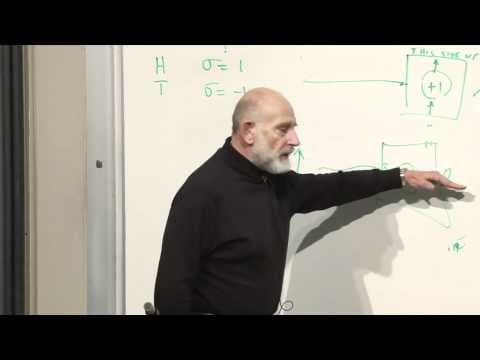
- A free-floating string end satisfies Neumann conditions, illustrated by a light almost massless ring sliding around poles so the string end is not held down, whereas a closed organ pipe forces zero displacement (Dirichlet) at its ends.
Install to Summarize YouTube Videos and Get Transcripts
Explore YouTube Video Summarizer or Get YouTube Transcript Extractor
Questions & Answers
Q: What are Dirichlet boundary conditions in string theory?
Dirichlet boundary conditions, named after the French mathematician Dirichlet who studied waves on strings, require the function to equal zero at the end points of the interval. For a function X of Sigma on 0 to Pi, this means X(0) equals 0 and X(pi) equals 0. Physically this describes a violin string whose ends are firmly held in place, so the displacement at the ends is pinned to zero. Functions satisfying these conditions are decomposed into sines.
Q: What are Neumann boundary conditions and when are they used?
Neumann boundary conditions, named after the German mathematician Neumann, state that the derivative of the function with respect to Sigma is zero at the end points, so the function is flat at the ends rather than pinned to zero. Susskind notes these are the appropriate conditions for discussing the motion of a string, specifically when a string's ends are not held down but are free-floating. Such functions are decomposed into cosines.
Q: How is a derivative approximated using discrete points?
Starting from a continuous function X of Sigma, you replace it by discrete values X_i where i runs from 1 to n. The difference Delta X between neighboring points equals X(i) minus X(i-1). Assuming the limiting function is smooth and differentiable, this difference is well approximated by the derivative dx/dSigma multiplied by Delta Sigma, where Delta Sigma is the interval between neighboring sigma values, equal to the whole interval pi divided by n.
Q: How does the integral emerge from a discrete sum?
To approximate an integral, you take the sum of all the discrete values X_i and multiply it by Delta Sigma, which equals pi divided by n. As n gets very large and more points fill in the axis, this expression becomes the integral from 0 to Pi of X of Sigma dSigma. In the limit you simply replace each X_i by X(Sigma) and replace Delta Sigma by dSigma, which is essentially the definition of an integral.
Q: Why do Dirichlet functions use sines and Neumann functions use cosines?
Sines are chosen for Dirichlet conditions because sin(n Sigma) is zero at both Sigma equals 0 and Sigma equals Pi for any n, matching the requirement that the function vanish at the endpoints. Cosines are chosen for Neumann conditions because cos(n Sigma) is flat, meaning its derivative is zero, at both end points. The general Dirichlet function is a sum of sines from n equals 1, while the Neumann function is a sum of cosines from n equals 0.
Q: Why does the Neumann sum start at n equals 0 but the Dirichlet sum starts at n equals 1?
For the Dirichlet decomposition, the n equals 0 term would be sin(0 times Sigma), which equals sine of zero, which is zero, so including it is pointless and the sum starts at n equals 1. For the Neumann decomposition, cos(0 times Sigma) equals one, a flat constant function that is a good Neumann function. If the function has a nonzero average over the interval, it begins with this constant term, so the cosine sum starts at n equals 0.
Q: What does a free-floating string end look like physically?
Susskind describes an idealized system with two poles put into the ground and a light, almost massless ring that slides around each pole, connected by a string whose height above the Earth is the value X. If the rings are very light, the ends of the string are free-floating rather than held down. This configuration satisfies Neumann boundary conditions, where the string's slope goes to zero at the free ends rather than the displacement being pinned to zero.
Q: What continuity requirements must these string functions satisfy?
The functions are taken to be continuous, and for the purposes of the discussion continuous and differentiable, so they have all the good smoothness properties. Functions are allowed to have sharp jumps as long as they are piecewise continuous, meaning discontinuities at isolated points are permitted mathematically. However, physicists dislike vertical jumps because discontinuities usually mean infinite energy, and for a physical string a jump would mean the string was broken, which is not allowed.
Summary
This video discusses some mathematical preliminaries and introduces the concept of string theory. It explains the use of calculus formulas to approximate functions, the representation of continuous functions as sums of sines and cosines, and the different boundary conditions for strings. The video also explores the concept of particles and their energy spectrum, as well as the light-cone frame and the precise conditions under which nonrelativistic physics can be used to describe a system.
Questions & Answers
Q: What are the mathematical preliminaries discussed in the video?
The video introduces calculus formulas to approximate functions and derivates, as well as the representation of continuous functions as sums of sines and cosines. It also covers the different boundary conditions for functions and strings, such as Dirichlet and Neumann boundary conditions.
Q: How are functions approximated using calculus formulas?
A function is approximated by replacing it with discrete points, where the difference between two neighboring points is called Delta X. This difference is well approximated by the derivative of the function with respect to a variable times Delta Sigma, where Delta Sigma is the interval between neighboring values of Sigma. As more points are added, the approximation gets better.
Q: How are continuous functions represented as sums of sines and cosines?
Any continuous function on the interval 0 to PI can be written as a sum of sines and cosines. For functions that satisfy Dirichlet boundary conditions, the function can be written as a sum of sines. For functions that satisfy Neumann boundary conditions, the function can be written as a sum of cosines. These representations provide a way to decompose complex functions into simpler harmonic components.
Q: What are Dirichlet and Neumann boundary conditions for strings?
Dirichlet boundary conditions refer to the case where a string is firmly held at the endpoints, resulting in zero displacement at the ends. Neumann boundary conditions refer to the case where the derivative of the function is zero at the endpoints, resulting in flat ends. These conditions depend on the nature of the string and its physical constraints, such as whether it is held down or open-ended.
Q: What are the differences between particles and strings?
Particles and strings differ in terms of their energy spectrum. Particles have discrete energy levels, while strings have a spectrum of energy levels that can be closely spaced and continuous. The excitations of particles require significant amounts of energy, while the excitations of strings require much larger energy levels due to the extremely small mass differences. String theory considers strings as particles due to their discrete energy spectrum and unique properties.
Q: What is the light-cone frame or infinite momentum frame?
The light-cone frame is a frame of reference in which the momentum along a specific axis, usually the z-axis, is much larger than the momentum in the other directions. In this frame, the motion in the perpendicular plane can be described using nonrelativistic physics. The internal motions of the system appear to be slowed down due to time dilation, allowing for a simpler nonrelativistic description.
Q: How can nonrelativistic physics be used to describe a fast-moving system?
By choosing the light-cone frame or infinite momentum frame, the system can be boosted along an axis to make the perpendicular plane appear nonrelativistic. The kinetic energy and motion in the plane are described using nonrelativistic formulas, while the energy and motion along the boosted axis are adjusted or removed in calculations. This simplifies the description of the system while capturing its essential properties.
Q: How is the motion along the z-axis treated in string theory?
In string theory, the relative motion along the z-axis is completely constrained and determined by the motion in the perpendicular plane. The specific details of how this works are not fully understood, but it is a remarkable property of strings that the relative motion along the z-axis does not need to be explicitly considered. This simplifies the calculations and allows for a focus on the essential properties of strings.
Q: What is the significance of the energy spectrum in distinguishing particles and strings?
The energy spectrum is a key factor in distinguishing particles from strings. Particles have discrete energy levels and require large amounts of energy to excite to higher levels. Strings, on the other hand, have energy levels that are closely spaced and continuous, making it extremely difficult to excite them due to the large energy required. This discrete nature of energy levels of strings is one of the properties that makes them different from particles.
Q: How is time dilation relevant to the light-cone frame?
Time dilation is relevant in the light-cone frame because it causes the internal motions of a fast-moving system to slow down when viewed from this frame. By rescaling the time variable, these internal motions can be described using nonrelativistic physics. Time dilation is a consequence of relativistic effects and the need to adjust the energy-momentum relation in the boosted frame.
Summary & Key Takeaways
-
Leonard Susskind opens Lecture 2 with mathematical preliminaries, writing a function X of Sigma where Sigma runs from 0 to Pi, half a cycle around a circle. He approximates the continuous function with discrete points X_i, letting n grow large to recover calculus.
-
The difference Delta X between neighboring points approximates the derivative dx/dSigma times Delta Sigma, where Delta Sigma equals pi divided by n. Summing all X_i and multiplying by Delta Sigma becomes, in the limit, the integral from 0 to Pi of X of Sigma dSigma.
-
He introduces Fourier decomposition, explaining functions on the interval split into two classes by their boundary behavior: Dirichlet conditions fix X to zero at the ends like a held violin string, while Neumann conditions set the derivative to zero at the ends like a free string.
Read in Other Languages (beta)
Share This Summary 📚
Summarize YouTube Videos and Get Video Transcripts with 1-Click
Try YouTube Summary with ChatGPT & Claude or YouTube Transcript Generator
Explore More Summaries from Stanford 📚


Summarize YouTube Videos and Get Video Transcripts with 1-Click
Try YouTube Summary with ChatGPT & Claude or YouTube Transcript Generator