Cosmology Lecture 2
TL;DR
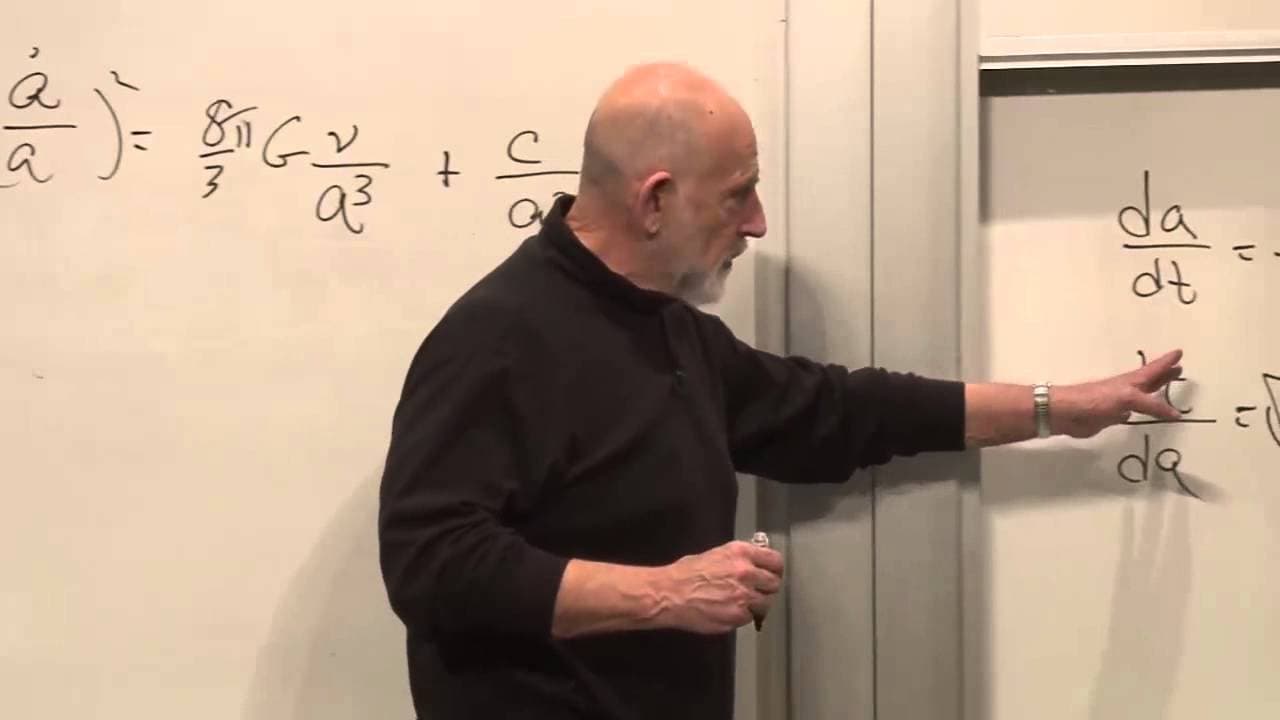
Newton's equations correctly describe an expanding universe locally, because a small patch of space looks flat even when the whole universe is curved. The derived equation is (a-dot/a) squared equals eight-pi-G times rho over three, where a-dot/a is the Hubble constant. Relativity is only needed when nearby matter, like radiation, moves near light speed.
Transcript
stanford university let's review a little bit and then i want to move on to um generalizations of what we've talked about so far i think we worked out we worked out the equations of an expanding universe they were newton's equations let's talk about something else first does newton's equations really get it right yeah newton's equations does get it... Read More
Key Insights
- Newton's equations describe cosmic expansion correctly for the most part because any small local patch of the universe looks flat, even if the universe as a whole turns out to be curved like a three-dimensional sphere. Curvature only matters over very large distances.
- Einstein's equations become necessary when space is curved, because they deal with curved space-time. If you measure triangles or do geometric exercises on curved space, the geometry departs from flat, though space currently looks essentially flat to observers.
- A small local patch can be studied without relativity as long as neighboring galaxies move at non-relativistic velocities relative to each other. A patch here can mean up to ten billion light years, since only relative nearby motion matters.
- Relativity must be reintroduced when nearby particles move at a significant fraction of the speed of light. Neutrinos qualify, and photons move at the speed of light, so the universe's homogeneous radiation forces a modification of the expansion equations.
- The scale factor a is only a bookkeeping device with no physical meaning by itself, because its value depends entirely on how coarse or fine the arbitrary coordinate grid laid on the universe is. A finer grid gives a smaller a.
- Ratios of the scale factor a are physically meaningful even though a itself is ambiguous. If a doubles over time, the distance between every pair of galaxies doubles, so ratios record the real history of expansion or contraction.
- The quantity a-dot divided by a is the Hubble constant at a given time. It is invariant under changes of grid scale because the arbitrary factors in the grid spacing cancel out, unlike a-dot alone which changes with the grid.
- The derived expansion equation is (a-dot/a) squared equals eight-pi-G-rho over three, where rho is density in kilograms per cubic meter. The three comes from the sphere volume four-thirds-pi-r-cubed, and this holds for the zero-total-energy escape-velocity case.
Install to Summarize YouTube Videos and Get Transcripts
Explore YouTube Video Summarizer or Get YouTube Transcript Extractor
Questions & Answers
Q: Why do Newton's equations work for describing an expanding universe?
Newton's equations get the expanding universe right for the most part because any small local region of space looks flat, even if the universe as a whole is curved. If you study only nearby galaxies, which can still mean up to ten billion light years, you are looking at a small patch where curvature does not matter. As long as the matter in that patch moves at non-relativistic velocities relative to you, Newtonian physics is legitimate and entirely consistent with relativity.
Q: When do you need Einstein's equations instead of Newton's?
You need Einstein's equations, which deal with curved space-time, when space itself is curved and that curvature becomes detectable over large distances. The universe may on average turn out to be curved, perhaps like a three-dimensional version of a sphere, though it currently looks flat. You also need relativity locally when neighboring particles move past each other at a significant fraction of the speed of light, which Newtonian assumptions cannot handle.
Q: What is the scale factor a in cosmology?
The scale factor a is the physical distance between neighboring points on a coordinate grid laid down over the universe, for example between x equals something and x equals something plus one. By itself a has no physical meaning, because its value depends entirely on how coarse or fine the arbitrary grid is. A finer grid, called a prime, gives half the value. So a is only a bookkeeping device, fixed once and then kept consistent.
Q: Why are ratios of a physically meaningful when a itself is not?
Ratios of a are meaningful because the arbitrary grid scale cancels out. If a doubles over a period of time, that means the distance between every pair of galaxies doubles, which is a real physical fact independent of the grid. Comparing a-dot over a with a-prime-dot over a-prime gives the same result, since the factor of two from a finer grid cancels. Ratios of a at different times record the actual history of the universe expanding or contracting.
Q: What is the Hubble constant in terms of the scale factor?
The Hubble constant at a given time is a-dot divided by a, the time derivative of the scale factor divided by the scale factor itself. This quantity is physically meaningful and invariant under changes of the grid, because the ambiguity in grid scale cancels between numerator and denominator. By contrast, a-dot alone depends on the grid, doubling if every a doubles, so only the ratio carries real physical content about the expansion rate.
Q: What is the expansion equation derived in the lecture?
The derived equation is a-dot over a squared equals eight-pi-G times rho over three, where rho is the density of matter measured in kilograms per cubic meter and G is Newton's gravitational constant. The left side came from kinetic energy and the right side from the mass density. The factor three ultimately comes from the volume of a sphere, four-thirds-pi-r-cubed, and the eight is two times four. This holds for the zero-total-energy case.
Q: How was the equation derived using Newton's theorem?
Placing yourself at the center of a uniform distribution of smoothed-out galaxies, you look at a galaxy at position x on the grid. Newton's theorem says the force on that galaxy depends only on the mass within the sphere centered on you, as if all that mass were concentrated at the center, and masses outside the sphere can be ignored. Treating the galaxy as moving under that central mass with conserved energy, combining kinetic and potential terms, yields the expansion equation.
Q: Why does radiation require modifying the expansion equations?
Radiation must be accounted for because photons move at the speed of light, violating the assumption that nearby matter moves non-relativistically. The universe is filled not only with galaxies but also with homogeneous radiation, and this radiation would be present even without stars like the sun. Neutrinos also move fast compared to light. Because these fast-moving components are present everywhere, the equations derived for slow matter must be modified to describe a radiation-filled universe correctly.
Summary
In this video, the speaker discusses the expansion of the universe and the equations that describe it. The speaker explains the difference between Newton's equations and Einstein's equations, and introduces the concept of curved space-time. They also discuss the role of photons in the universe and how they affect the equations. Finally, the speaker introduces the Friedman equation and explores its implications for the expansion of the universe.
Questions & Answers
Q: Does Newton's equations accurately describe the expanding universe?
Newton's equations accurately describe the expanding universe for the most part. However, Einstein's equations, which take into account curved space-time, are more suitable for studying the universe as a whole.
Q: What is curved space-time and how does it affect the universe?
Curved space-time refers to the idea that space itself can be curved. This means that if you were to measure triangles or perform geometric exercises in space, you might find that it is not flat but curved. In the case of the universe, this curvature can be visualized as a three-dimensional version of a sphere. The curvature of space-time has implications for how galaxies move relative to each other and how they move apart from each other.
Q: Can Newton's equations still be used to study the local behavior of galaxies?
Yes, if the galaxies are relatively close to each other and moving slowly with respect to each other, then Newton's equations can be used to study their behavior locally. However, if the galaxies are moving with a significant fraction of the speed of light relative to each other, then Einstein's equations need to be considered.
Q: What are some of the particles in the universe that move close to the speed of light?
Neutrinos and photons are examples of particles in the universe that can move close to the speed of light. Photons, in particular, are present in the universe as radiation and can affect the equations used to study the expanding universe.
Q: How is the density of matter in the universe related to the mass contained within a given volume?
The density of matter in the universe, denoted as rho, is related to the mass contained within a given volume by dividing the mass by that volume. This relationship allows us to measure the density of matter in units such as kilograms per cubic meter.
Q: How does the scale factor of the universe, denoted as "a", affect the equations?
The scale factor, "a", is a bookkeeping device in the equations and does not have a physical meaning by itself. However, ratios of scale factors at different times are physically meaningful and can indicate the expansion or contraction of the universe.
Q: What is the Friedman equation and how does it relate to the expansion of the universe?
The Friedman equation is a key equation in cosmology that relates the expansion rate of the universe, denoted as a dot over a squared, to the density of matter, denoted as rho. It also includes a term known as c, which represents the total energy of the universe. The equation can be solved to understand how the universe expands or contracts based on different values of c and rho.
Q: How does the total energy of the universe affect the expansion?
The total energy of the universe can be positive, negative, or zero. If the energy is positive, the universe will continue to expand. If the energy is zero, the expansion will depend on the density of matter. If the energy is negative, the universe will eventually contract.
Q: How does the expansion of the universe change as a becomes very large?
When the scale factor, a, becomes very large, the expansion of the universe behaves as a straight line with constant velocity. This is a non-accelerated motion that continues indefinitely as long as the energy is positive.
Q: What happens if the energy of the universe is negative?
If the energy of the universe is negative, there is a crossover point where the expansion of the universe transitions to contraction. This occurs when the term 8πGρa³ becomes zero, indicating that the universe momentarily comes to rest before collapsing.
Takeaways
The expansion of the universe can be described by the Friedman equation, which relates the expansion rate to the density of matter and the total energy of the universe. If the energy is positive, the universe will continue to expand indefinitely. If the energy is negative, the universe will eventually contract. The behavior of the expansion depends on the values of these parameters and can be understood by studying the equations and their implications in different scenarios.
Summary & Key Takeaways
-
Newton's equations get the expanding universe right for the most part because a local patch of space looks flat, even if the full universe is curved like a three-dimensional sphere. Einstein's equations, which handle curved space-time, only become necessary at large enough distances where curvature is detectable.
-
Studying nearby galaxies with Newton's equations is legitimate and consistent with relativity, provided neighboring objects move at non-relativistic velocities. Trouble arises with fast-moving material like neutrinos and photons, since the universe is filled with homogeneous radiation moving at the speed of light, requiring modified equations.
-
The scale factor a is ambiguous bookkeeping tied to an arbitrary grid, but ratios of a carry physical meaning, with a-dot over a equal to the Hubble constant. Using Newton's shell theorem on a sphere of matter, the derived zero-energy equation is (a-dot/a) squared equals eight-pi-G-rho over three.
Read in Other Languages (beta)
Share This Summary 📚
Summarize YouTube Videos and Get Video Transcripts with 1-Click
Try YouTube Summary with ChatGPT & Claude or YouTube Transcript Generator
Explore More Summaries from Stanford 📚

Summarize YouTube Videos and Get Video Transcripts with 1-Click
Try YouTube Summary with ChatGPT & Claude or YouTube Transcript Generator