What Is the Maximum Power Transfer Theorem?
TL;DR
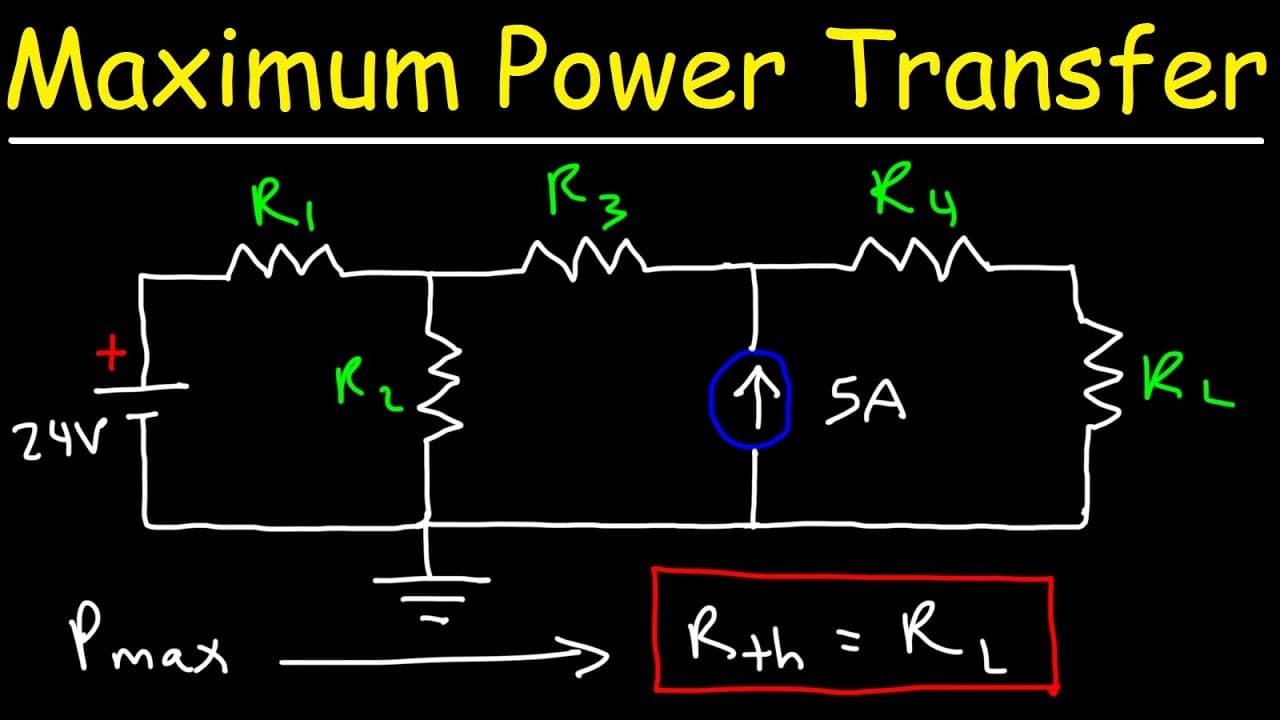
The maximum power transfer theorem states that maximum power is delivered to the load when the load resistance equals the Thevenin resistance. To find this, calculate the Thevenin voltage and resistance using circuit analysis. The maximum power can be determined using the formula: 1/4 times the Thevenin voltage squared divided by the Thevenin resistance.
Transcript
in this video we're going to talk about the maximum power transfer theorem this theorem states that the maximum power delivered from the source to the load resistance occurs when rl the load resistance is equal to r sub th the thevenin resistance and to calculate the maximum power delivered you could use this formula it's one over four times the sq... Read More
Key Insights
- ✊ The maximum power transfer theorem is based on matching the load resistance and Thevenin resistance.
- ❓ Calculating the Thevenin resistance requires finding the equivalent resistance of the circuit.
- 😥 Thevenin voltage is determined by finding the potential difference between two points in the circuit.
Install to Summarize YouTube Videos and Get Transcripts
Explore YouTube Video Summarizer or Get YouTube Transcript Extractor
Questions & Answers
Q: What is the maximum power transfer theorem?
The maximum power transfer theorem states that the maximum power is transferred from the source to the load resistance when the load resistance is equal to the Thevenin resistance. This ensures optimum power efficiency in a circuit.
Q: How do you calculate the Thevenin resistance?
To calculate the Thevenin resistance, replace the load resistor with an open circuit and determine the equivalent resistance of the circuit. This can be done by combining resistors in series and parallel using equivalent resistance formulas.
Q: How do you calculate the Thevenin voltage?
To calculate the Thevenin voltage, remove the load resistor and find the potential difference between point A and point B in the circuit. This can be done by analyzing voltage divider circuits and using Ohm's law.
Q: How do you calculate the maximum power delivered?
The maximum power delivered can be calculated using the formula: 1/4 times the Thevenin voltage squared divided by the Thevenin resistance. This formula allows for determining the maximum power that can be transferred from the source to the load resistance.
Summary & Key Takeaways
-
The maximum power transfer theorem states that maximum power is transferred when the load resistance equals the Thevenin resistance.
-
To calculate the Thevenin resistance, replace the load resistor with an open circuit and determine the equivalent resistance of the circuit.
-
To calculate the Thevenin voltage, remove the load resistor and find the potential difference between point A and point B.
-
The maximum power delivered can be calculated using the formula: 1/4 * Thevenin voltage squared divided by Thevenin resistance.
Read in Other Languages (beta)
Share This Summary 📚
Summarize YouTube Videos and Get Video Transcripts with 1-Click
Try YouTube Summary with ChatGPT & Claude or YouTube Transcript Generator
Explore More Summaries from The Organic Chemistry Tutor 📚


Summarize YouTube Videos and Get Video Transcripts with 1-Click
Try YouTube Summary with ChatGPT & Claude or YouTube Transcript Generator