How to Assess IoT Radio Security Using SDR Tools
TL;DR
IoT and operational technology devices can be assessed by capturing, analyzing, and replaying radio signals with software-defined radio tools. Effective testing begins by profiling the target frequency, modulation, protocol, and communication flow, while treating wireless links, controlling devices, cloud services, local networks, firmware updates, and embedded components as one connected security ecosystem.
Transcript
Hello, RSA. Are you all excited about RF exploitation? Yes. How many of you know about IoT and OT hacking with HDR? Like how many of you are familiar? One, two. Okay. Many, many hands. Yeah. So we are gonna really start with RF exploitation, the IoT and OT hacking with HDR. How we actually hack IoT devices through radio frequencies, because there a... Read More
Key Insights
- RF exploitation is a physical-layer security problem involving patterns of energy transmitted through a wireless medium. Assessors must examine how data is encoded, carried at a selected frequency, received, and decoded rather than limiting analysis to higher network layers.
- Software-defined radio is a radio communication approach that implements functions traditionally handled by hardware through more flexible software-based processing. The talk presents tools such as RTL-SDR, GNU Radio, HackRF, and GQRX as accessible options for capturing or examining wireless signals.
- IoT security is an ecosystem problem because devices interact with controllers, cloud services, internet connections, local networks, and telemetry systems. A weakness in any connected component or interface can provide a route to compromise the device or affect related services.
- Weak or hard-coded credentials are a common IoT vulnerability because manufacturers may ship devices with predictable usernames and passwords. Secure deployments require credentials that are not easily guessed and should avoid fixed secrets embedded permanently within products.
- Secure update mechanisms require firmware validation, protected delivery, and safeguards against rollback. Devices that accept unverified, insecurely delivered, or older firmware may expose a path for attackers to introduce vulnerable or unauthorized software into the operating environment.
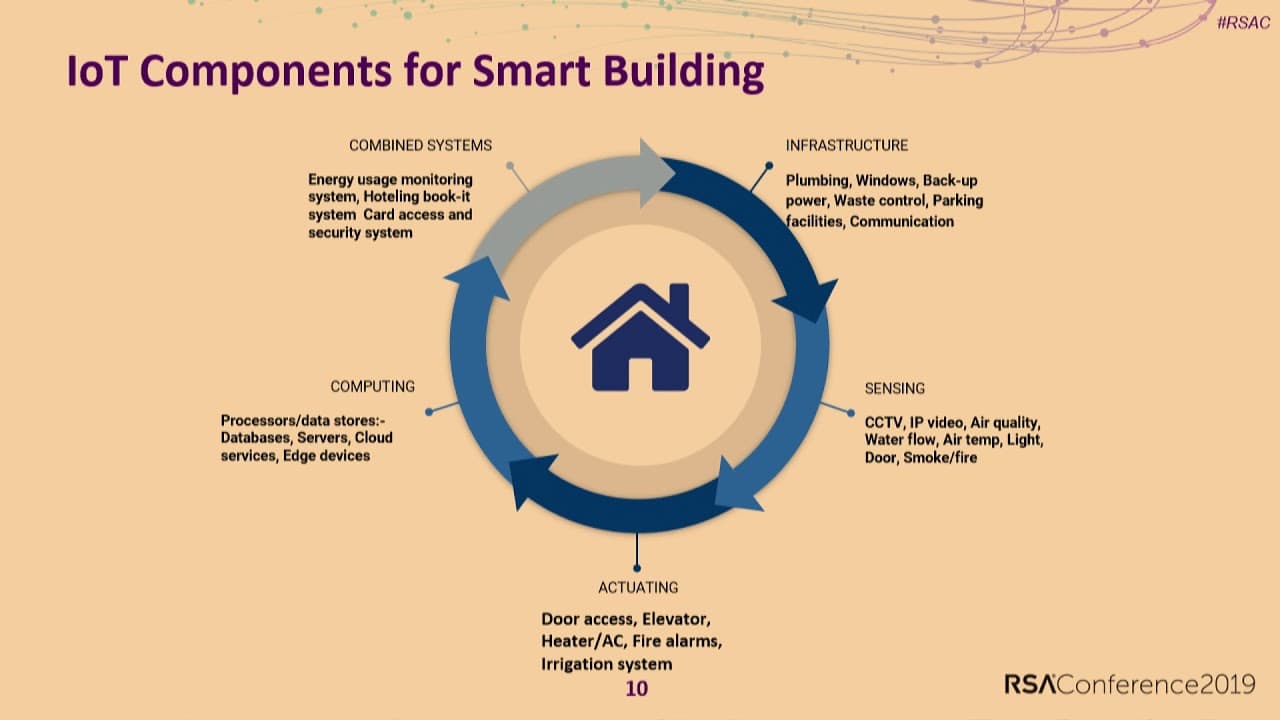
- Smart-building radio risks can produce physical consequences because wireless systems may control doors, elevators, heaters, air conditioning, lighting, sensors, and energy functions. Disrupting these components can affect safety, equipment reliability, environmental conditions, and operational continuity.
- Target profiling is the foundation of wireless exploitation because an assessor must identify the relevant frequency, modulation, protocol, signal behavior, and communication participants. This preliminary understanding determines how signals should be captured, interpreted, and tested during later attack phases.
- Wireless attack surfaces extend beyond Wi-Fi into Bluetooth, Zigbee, cellular links, key fobs, aviation broadcasts, and proprietary protocols. The talk argues that unfamiliar non-Wi-Fi technologies should receive security scrutiny because many connected products rely on radio communication outside conventional enterprise networks.
Install to Summarize YouTube Videos and Get Transcripts
Explore YouTube Video Summarizer or Get YouTube Transcript Extractor
Questions & Answers
Q: What is RF exploitation in IoT and OT security?
RF exploitation is the assessment or manipulation of communications sent through radio frequencies by connected and operational devices. It focuses on the physical layer, where information appears as energy patterns transmitted through the air. Testing examines how messages are encoded, broadcast, captured, decoded, and potentially replayed to determine whether the wireless communication protects the device and its surrounding ecosystem.
Q: How does software-defined radio support wireless security testing?
Software-defined radio supports testing by replacing radio functions traditionally implemented in dedicated hardware with flexible software-based processing. Security researchers can use tools named in the talk, including RTL-SDR, GNU Radio, HackRF, and GQRX, to receive, inspect, and work with wireless signals. This makes it practical to study protocols beyond common Wi-Fi testing and understand what devices transmit over the air.
Q: How should an RF security assessment begin?
An RF security assessment should begin with target profiling and a basic understanding of wireless communication. The assessor identifies the device, its communication participants, the frequency it uses, its modulation, its protocol, and the observable signal pattern. That foundation helps determine how to capture and decode traffic, distinguish meaningful transmissions, and select an appropriate strategy for evaluating or reproducing device behavior.
Q: What are the main IoT security weaknesses discussed?
The main weaknesses include guessable or hard-coded passwords, insecure network services, insecure web, cloud, mobile, and back-end interfaces, weak update mechanisms, and outdated software components or libraries. The update problem also includes missing firmware validation, insecure delivery, and inadequate rollback protection. Each weakness can compromise confidentiality, integrity, availability, the device itself, or connected components within the broader ecosystem.
Q: Why must IoT devices and their ecosystems be assessed together?
IoT devices depend on more than their embedded hardware. Their attack surface can include controlling phones or tablets, cloud repositories, access-control services, internet connections, home or industrial local networks, remote-control functions, and telemetry channels. Assessing only the device can miss weaknesses in interfaces and supporting services that allow an attacker to influence the product, obtain data, or compromise related components.
Q: Why is RF security important for smart buildings?
RF security matters in smart buildings because wireless communication may connect physical infrastructure, sensors, actuators, computing resources, and combined control systems. Examples in the talk include door access, elevators, heaters, air conditioning, lighting, cameras, environmental sensing, servers, backup power, and energy controls. Manipulating these systems can disrupt operations and create physical effects rather than causing only a conventional data-security incident.
Q: What physical consequences can wireless IoT attacks cause?
Wireless IoT attacks can affect environmental controls and electrically operated equipment. The talk describes air-conditioning disruption that could overheat computers, repeated switching that could place thermal stress on smart bulbs, and thermostat interference in a cold climate that could contribute to frozen and burst water pipes. These examples show why availability and integrity are essential protections for devices controlling real-world conditions.
Q: Which wireless technologies and signals can be examined for security weaknesses?
The talk identifies Wi-Fi, Bluetooth, Zigbee, cellular communications, wireless vehicle key fobs, FM radio, GPS-related services, aviation broadcasts, and proprietary protocols as parts of the wider radio environment. The central lesson is that assessments should not stop at familiar network technologies. Any connected device transmitting control data, telemetry, or identifiers through radio may warrant physical-layer inspection and ecosystem-level threat modeling.
Summary & Key Takeaways
-
Wireless IoT security extends beyond familiar Wi-Fi and Bluetooth testing into Zigbee, standard radio services, and proprietary protocols. The talk frames software-defined radio as a practical way to inspect physical-layer communication, understand how devices exchange encoded messages, and expose weaknesses that conventional network-focused assessments may overlook.
-
The attack surface includes controlling smartphones and tablets, cloud services, internet connections, local networks, remotely controlled devices, and telemetry channels. Common weaknesses include guessable or hard-coded passwords, insecure services and interfaces, unsafe update mechanisms, missing firmware validation, inadequate delivery protections, absent rollback prevention, and outdated software components.
-
A structured assessment begins with basic radio concepts and target profiling before advancing to capture, analysis, and exploitation strategies. Smart buildings illustrate the consequences because wireless systems may control access, elevators, heating, lighting, sensing, backup power, servers, and energy management, allowing a radio weakness to affect physical operations.
Read in Other Languages (beta)
Share This Summary 📚
Summarize YouTube Videos and Get Video Transcripts with 1-Click
Try YouTube Summary with ChatGPT & Claude or YouTube Transcript Generator
Explore More Summaries from RSAC Cybersecurity 📚

Summarize YouTube Videos and Get Video Transcripts with 1-Click
Try YouTube Summary with ChatGPT & Claude or YouTube Transcript Generator