How to Build and Sell AI Agent SaaS Products
TL;DR
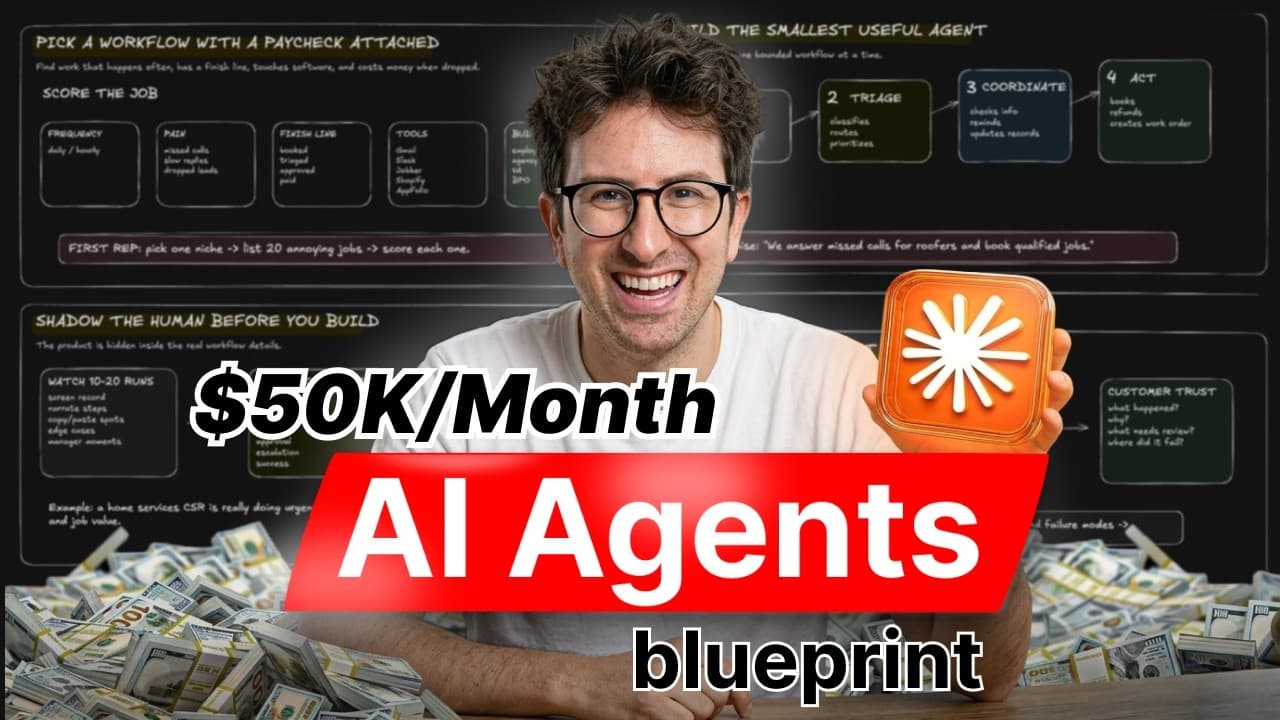
Start by identifying a frequent, costly job that businesses already pay someone to perform, then shadow the human responsible for 10–20 real cases before building anything. Launch a narrowly scoped agent with clear tools, permissions, success criteria, and escalation rules, sell an initial pilot like labor, and productize the repeatable parts after proving the workflow works.
Transcript
Okay, I'll say it. Building agents is the new SAS. I mean, we saw billions of dollars of value creation during the SAS era. People, founders, 21 years old, 24 years old, you name it, come up with SAS ideas that changed their lives. Of course, not everyone was successful, but this is a new wave that's happening. And I want you to understand what thi... Read More
Key Insights
- Agent SaaS sells completed work rather than merely providing software tools. Its core promise is that a team no longer needs to perform a specific job manually, which changes how founders define the product and how customers evaluate its value.
- A valuable agent workflow has an existing paycheck attached to it. Businesses already spend money on employees, agencies, receptionists, coordinators, or dispatchers, creating an opportunity to automate part of that paid work while allowing people to concentrate on more creative responsibilities.
- A promising workflow is frequent, measurable, software-connected, and financially painful when neglected. It should have a clear completion state, touch tools such as Gmail, Slack, Shopify, HubSpot, Zendesk, or Stripe, and involve edge cases that are difficult but still learnable.
- Human observation is essential before agent development begins. Shadowing someone through 10–20 real jobs reveals hidden context, unusual cases, decision checks, and common mistakes that a founder is unlikely to capture by immediately writing prompts or code.
- A complete agent specification defines seven elements: its trigger, required context, available tools, independent authority, approval requirements, escalation conditions, and success criteria. These boundaries help the agent perform consistently while preserving human involvement when a case exceeds its permitted scope.
- The minimum useful agent should solve one workflow before attempting broad autonomy. Practical first versions draft outputs for approval, triage incoming work, coordinate between systems and people, or take bounded actions such as booking appointments and processing refunds under a defined limit.
- Agent autonomy should be earned by beginning with predictable workflows. A fixed workflow is appropriate when the path is known, while dynamic judgment should be added only where it creates value, reduces friction, or handles meaningful variation in the work.
- A focused promise is sufficient for an initial product. Examples include answering missed calls and booking qualified roofing jobs, triaging property-maintenance requests and scheduling vendors, or handling restaurant reservation calls while alerting staff when human intervention is necessary.
Install to Summarize YouTube Videos and Get Transcripts
Explore YouTube Video Summarizer or Get YouTube Transcript Extractor
Questions & Answers
Q: How do you find a valuable AI agent business idea?
Choose one niche and identify 20 jobs that people regularly complain about. Score each job by how often it occurs, how expensive the underlying pain is, how clearly completion can be measured, which software tools it requires, and who controls the existing budget. Prioritize a workflow that businesses already pay an employee, agency, receptionist, coordinator, or dispatcher to perform.
Q: What does it mean that the product is the job?
The phrase means an agent product sells the performance of work, not merely access to a tool. Traditional SaaS gives a team software it can use, while agent SaaS promises to remove a defined manual responsibility. A compelling offer therefore states which annoying job the agent handles, how it compares with junior employees or agencies, and why it costs less than adding headcount.
Q: What characteristics make a workflow suitable for an AI agent?
A suitable workflow happens frequently, has a clear finish line, interacts with existing software, includes edge cases that are difficult but learnable, and creates a loss the buyer can feel. Examples of measurable outcomes include booking a job, categorizing a ticket, approving a refund, scheduling a vendor, or giving a customer a useful answer. Missed calls and slow replies make the economic pain visible.
Q: Why should founders shadow a human before building an agent?
Shadowing exposes the real workflow that formal descriptions often omit. A founder should observe 10–20 jobs, request screen recordings and narration, and ask what makes cases easy, unusual, or error-prone. The worker can reveal the context checked before decisions and the points where mistakes occur. Those operational details become part of the product and help produce a higher-quality agent.
Q: How should an AI agent workflow be specified?
An agent specification should answer seven questions: what triggers the agent, what context it needs, which tools it can use, what it may do independently, where approval is required, when it must escalate to a human, and what successful completion looks like. Defining these elements creates operational boundaries and makes it possible to evaluate whether the agent performs the intended job consistently.
Q: What is a minimum useful agent?
A minimum useful agent is the smallest version that completes a meaningful part of one workflow. It does not attempt to behave like a fully autonomous employee. It can draft work for human approval, triage and route incoming requests, coordinate information across systems and people, or execute one bounded action under explicit rules. One reliable workflow and one clear promise are enough initially.
Q: When should an AI agent require human approval or escalation?
Human approval is appropriate when a workflow carries risk, requires creativity, or includes decisions outside the agent's defined authority. A draft-and-approve design lets the agent read context and prepare a reply, quote, summary, or next step while a person makes the final decision. The specification should also define which unusual or high-priority cases must be escalated rather than handled automatically.
Q: How can an AI agent startup launch and become SaaS?
The proposed path is to select a niche, find a workflow with an existing paycheck, shadow the person doing it, define the agent's boundaries, and build the minimum useful version. The founder then sells a pilot like labor and proves that the workflow works. After identifying what is repeatable, the business can package those common elements as SaaS and build distribution through workflow teardowns.
Summary & Key Takeaways
-
Agent SaaS changes the product from software that helps a team perform work into a system that performs a defined job. The opportunity extends beyond traditional software budgets because agents can address paid human work, including answering calls, coordinating appointments, routing requests, processing bounded refunds, and following up with customers.
-
A strong agent opportunity begins with a frequent workflow that has a clear finish line, uses existing software, contains learnable edge cases, and creates losses buyers can recognize. Founders should list 20 complained-about jobs in one niche, score them for value and feasibility, and prioritize work with an existing budget.
-
The recommended launch process is to shadow a worker, document the real workflow, define permissions and escalation points, and build one minimum useful agent. Early versions can draft, triage, coordinate, or take bounded actions. After selling a labor-like pilot and proving results, founders can package repeatable elements as SaaS.
Read in Other Languages (beta)
Share This Summary 📚
Summarize YouTube Videos and Get Video Transcripts with 1-Click
Try YouTube Summary with ChatGPT & Claude or YouTube Transcript Generator
Explore More Summaries from Greg Isenberg 📚


Summarize YouTube Videos and Get Video Transcripts with 1-Click
Try YouTube Summary with ChatGPT & Claude or YouTube Transcript Generator