What Is the Decarboxylation Reaction Mechanism?
TL;DR
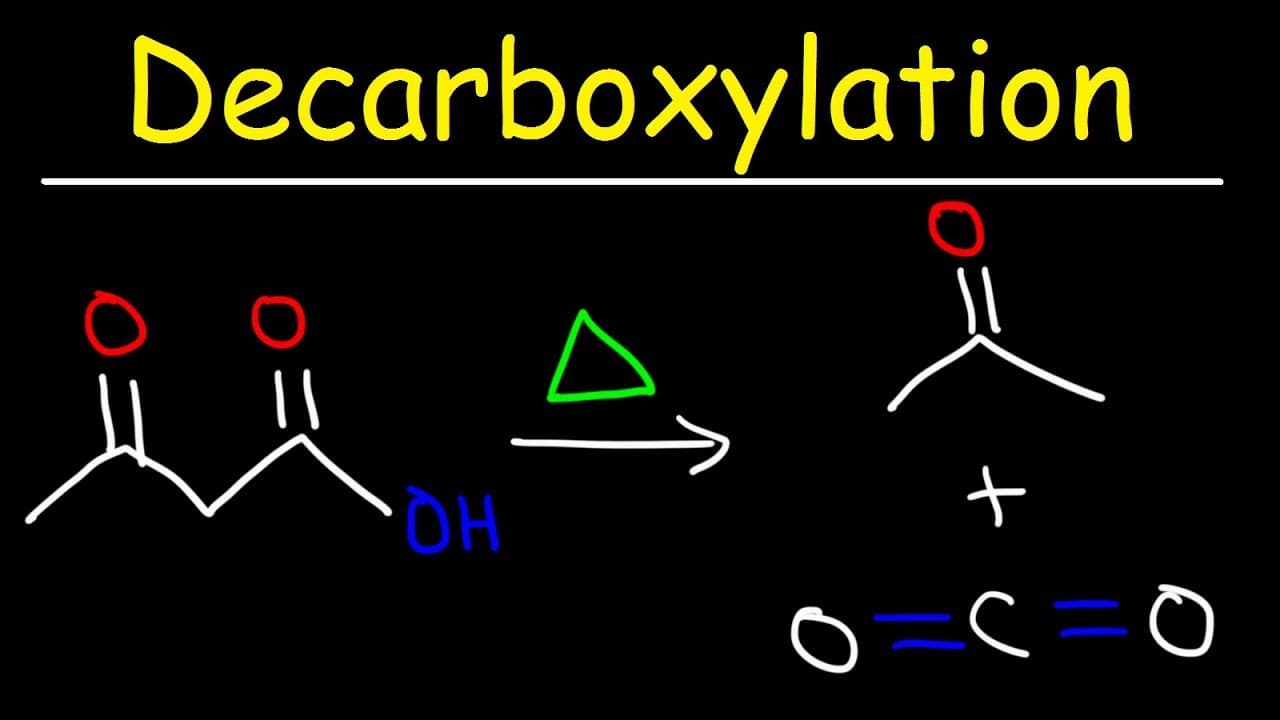
The decarboxylation reaction mechanism involves heating a beta keto carboxylic acid, which leads to the removal of a carboxylic acid group and its replacement with a hydrogen atom. This process produces an enol and carbon dioxide, with the enol subsequently converting into a ketone under acidic conditions, ultimately forming the ketone product.
Transcript
in this video we're going to go over the decarboxylation reaction mechanism so let's say if we have a beta keto carboxylic acid so here on the beta carbon this is the alpha carbon we have a carbonyl group on a beta carbon now this doesn't have to be ketone it could be an ester it could be another carboxylic acid but if there's a carbonyl group on a... Read More
Key Insights
- 🥵 Decarboxylation reaction occurs when a beta keto carboxylic acid is heated, resulting in the replacement of a carboxylic acid group with a hydrogen atom.
- 💁 The decarboxylation mechanism involves breaking bonds, rearranging electrons, and the formation of an enol and carbon dioxide.
- 🫀 Conversion of the enol into a ketone is achieved by adding a hydrogen atom under acidic conditions.
- ❓ The final step in the mechanism is deprotonating the ketone to produce the final ketone product.
- ❓ Decarboxylation is a significant reaction in organic chemistry, commonly used in the synthesis of various compounds.
- 👥 The presence of a carbonyl group on the beta carbon is essential for decarboxylation to occur.
- 🧑🏭 The decarboxylation reaction is influenced by factors such as temperature, acidity, and the nature of the carboxylic acid group.
Install to Summarize YouTube Videos and Get Transcripts
Explore YouTube Video Summarizer or Get YouTube Transcript Extractor
Questions & Answers
Q: What is the basic concept behind decarboxylation in organic chemistry?
Decarboxylation involves the removal of a carboxylic acid group and its replacement with a hydrogen atom on a beta carbon when a compound is heated.
Q: How is the decarboxylation reaction mechanism initiated?
The decarboxylation reaction mechanism begins by breaking the O-H bond, with the electrons rearranging to form an enol and a molecule of carbon dioxide.
Q: How is the enol converted into a ketone?
The enol is converted into a ketone by adding a hydrogen atom under acidic conditions, resulting in the formation of a protonated ketone.
Q: What is the final step in the decarboxylation mechanism?
The final step involves deprotonating the ketone by using a base, such as water, to remove the extra hydrogen atom and stabilize the ketone product.
Summary & Key Takeaways
-
Decarboxylation occurs when a beta keto carboxylic acid with a carbonyl group on the beta carbon is heated, resulting in the removal of the carboxylic acid group and its replacement with a hydrogen atom.
-
The mechanism involves breaking the O-H bond and rearranging the electrons to form an enol (product 1) and a molecule of carbon dioxide.
-
The enol is then further converted into a ketone by adding a hydrogen atom under acidic conditions, and finally deprotonated to form the ketone product.
Read in Other Languages (beta)
Share This Summary 📚
Summarize YouTube Videos and Get Video Transcripts with 1-Click
Try YouTube Summary with ChatGPT & Claude or YouTube Transcript Generator
Explore More Summaries from The Organic Chemistry Tutor 📚




Summarize YouTube Videos and Get Video Transcripts with 1-Click
Try YouTube Summary with ChatGPT & Claude or YouTube Transcript Generator