How to Delegate Complex Work to ChatGPT 5.2: Excel, PowerPoint, and 10,000-Row Data Tests
TL;DR
To delegate complex work to ChatGPT 5.2, define a scoped deliverable, explain every input, and state exactly how the material should be used. In testing, the model analyzed 10,000 rows and produced PowerPoint, document, and Excel artifacts during tasks lasting 20 to 40 minutes. Because vague framing can lead to unwanted assumptions after a long wait, read on for practical delegation steps and comparisons with Gemini 3 and Claude Opus 4.5.
Transcript
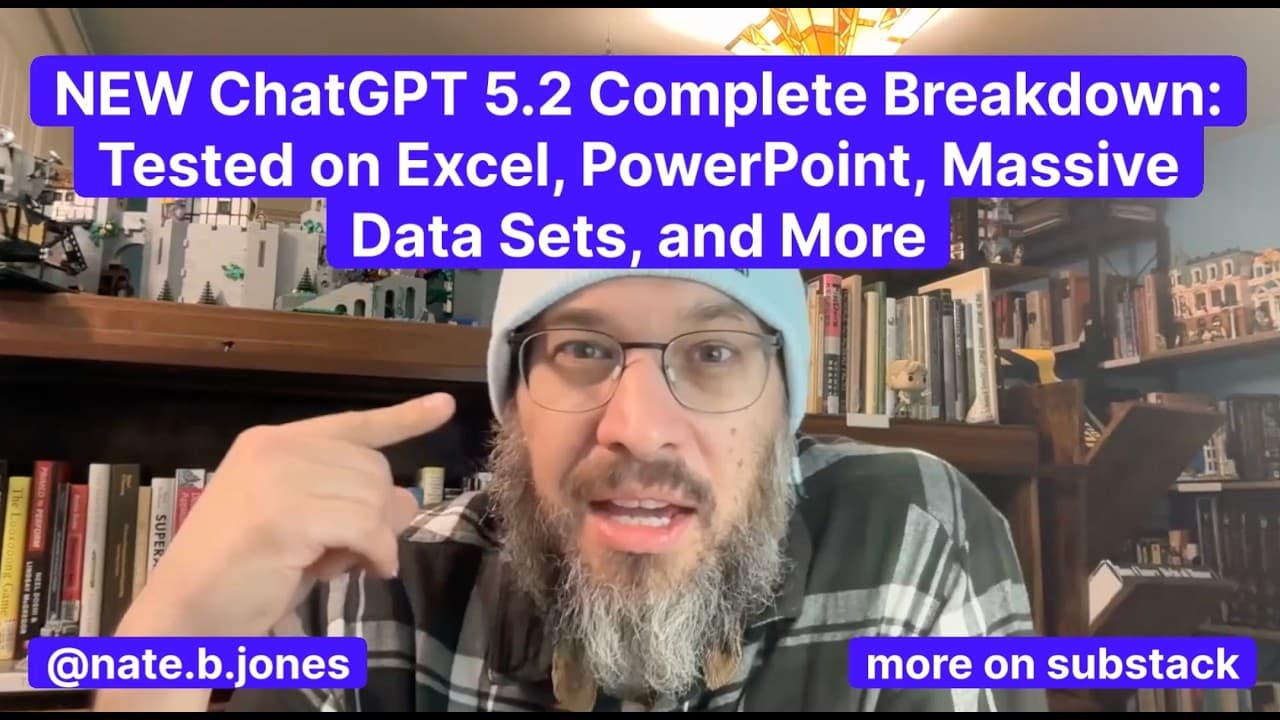
Chad GPT 5.2 time traveled back to see us here. I am convinced that this is a model that shows us what the future is like for 2026. It's not an incremental upgrade, guys. I know it's positioned that way, but it's actually got some capabilities that I haven't seen in other models that I want to lay out here so that you understand what they are and y... Read More
Key Insights
- ChatGPT 5.2 is agentic by default, meaning it can continue working on substantial assignments instead of merely returning an instant response. The testing described tasks lasting 20 to 40 minutes and producing results judged better than work that could have taken four to eight hours manually.
- Large-scale data processing is a central strength of ChatGPT 5.2. In one test, the model worked through a data set containing 10,000 rows, performed computations, developed insights, and returned multiple finished artifacts, including a PowerPoint presentation, a document, and an Excel spreadsheet.
- Clear output definition is the foundation of successful AI delegation. A user should explicitly identify the desired deliverable, such as a PowerPoint deck, Word document, or Excel spreadsheet, and describe what that artifact must contain rather than asking the model to interpret an open-ended assignment.
- Input explanation is necessary when using a large context window. Users should tell the model what each uploaded file or data source contains and how it should be used, because missing context forces the model to make its best guess about the intended meaning and analysis.
- Long-running tasks make problem framing more consequential. When a model spends significant time completing an assignment, an unclear scope can delay feedback and produce an unsuitable deliverable, so users need to divide problems into well-defined blocks of work before delegating them.
- ChatGPT 5.2 handles mixed input formats within one assignment. The speaker reports combining materials such as screenshots, CSV files, documents, presentations, transcripts, recordings, tickets, responses, transaction records, and spreadsheets so the model can synthesize varied evidence into a useful output.
- Model ergonomics affect practical value as much as reasoning capability. The comparison found Gemini 3 difficult to use for large, artifact-heavy assignments because the tested interfaces did not conveniently accept files such as PowerPoint, Excel, and CSV inputs for producing a finished output.
- Narrative construction emerges from coherent analysis, reduced hallucination, and effective artifact creation. ChatGPT 5.2 was able to identify an overall story in data that lacked an obvious narrative, explain the supporting evidence, and express the result in a presentation, although the user still needed to verify it.
Install to Summarize YouTube Videos and Get Transcripts
Explore YouTube Video Summarizer or Get YouTube Transcript Extractor
Questions & Answers
Q: How should you delegate a complex task to ChatGPT 5.2?
Define a bounded piece of work and specify the exact output you want, such as a PowerPoint deck, Word document, Excel spreadsheet, or complete analysis. Explain what each input contains and what the model should do with it. Clear framing reduces the chance that the model will fill gaps with its own best guess.
Q: What work did ChatGPT 5.2 perform on a 10,000-row data set?
It computed against the 10,000-row data set, developed insights, and crafted an executive narrative. It also returned a PowerPoint presentation, a document, and an Excel spreadsheet. The speaker described the results as accurate, coherent, cogent, and thoughtful.
Q: Why is clear problem framing important for long-running ChatGPT 5.2 tasks?
ChatGPT 5.2 tasks can run for 20, 30, or 40 minutes, so unclear instructions can produce an unsuitable result after a substantial wait. The speaker recommends framing and chunking problems into well-defined scopes of work. This becomes more important when delegating work that might otherwise take four to eight hours.
Q: What output details should you specify before assigning work to ChatGPT 5.2?
Name the required artifact and define what it must contain. The transcript specifically mentions PowerPoint decks, Word documents, and Excel spreadsheets. You should also describe the supplied inputs and explain how the model should use them.
Q: How does ChatGPT 5.2 compare with Gemini 3 for artifact-heavy analysis?
The speaker found Gemini 3 difficult to use for assignments involving many documents and a fully finished output. In the tested interfaces, uploading materials such as PowerPoint files was not easy, even if the model had the reasoning ability to analyze them. ChatGPT 5.2 was presented as more practical for substantial work involving a large bucket of inputs.
Q: How does ChatGPT 5.2 compare with Claude Opus 4.5 for presentations?
The existing comparison describes their functional narrative quality as roughly comparable. Claude Opus 4.5 produced slightly better presentation aesthetics, while ChatGPT 5.2 benefited from handling extensive, mixed data and turning it into a coherent story. The resulting analysis still needed human verification.
Q: What makes ChatGPT 5.2 agentic by default?
The model can continue executing substantial assignments instead of only returning an instant response. The speaker tested tasks that ran for 20 to 40 minutes and involved thousands of data rows, computations, insights, and finished artifacts. This capability shifts the user’s job toward defining delegable blocks of work.
Q: What skill does the speaker say users need for ChatGPT 5.2?
Users need to learn how to define work correctly for a long-running agent. That includes choosing a valuable scoped output, explaining the inputs, setting boundaries, and dividing larger problems into suitable blocks. The speaker presents this as a skill needed by both technical and non-technical users.
Summary & Key Takeaways
-
ChatGPT 5.2 is presented as an agentic model capable of working for 20 to 40 minutes on substantial assignments. In the described tests, it analyzed a data set containing 10,000 rows and returned coherent insights alongside usable PowerPoint, document, and Excel artifacts that would otherwise have required several hours of manual work.
-
Effective delegation begins by defining a scoped, valuable output and explaining the supplied inputs. Users should specify whether they need a presentation, document, spreadsheet, or another artifact, then describe what each uploaded item contains. Ambiguous instructions encourage the model to make assumptions, which becomes more costly when a task takes longer to complete.
-
The comparison found that ChatGPT 5.2 handled varied, high-volume inputs more conveniently than Gemini 3 and produced PowerPoint narratives functionally comparable to Claude Opus 4.5. Opus created slightly better presentation aesthetics, while ChatGPT 5.2 gained an advantage from its capacity to process extensive, mixed data and build a coherent, verifiable story from it.
Read in Other Languages (beta)
Share This Summary 📚
Summarize YouTube Videos and Get Video Transcripts with 1-Click
Try YouTube Summary with ChatGPT & Claude or YouTube Transcript Generator
Explore More Summaries from AI News & Strategy Daily | Nate B Jones 📚






Summarize YouTube Videos and Get Video Transcripts with 1-Click
Try YouTube Summary with ChatGPT & Claude or YouTube Transcript Generator