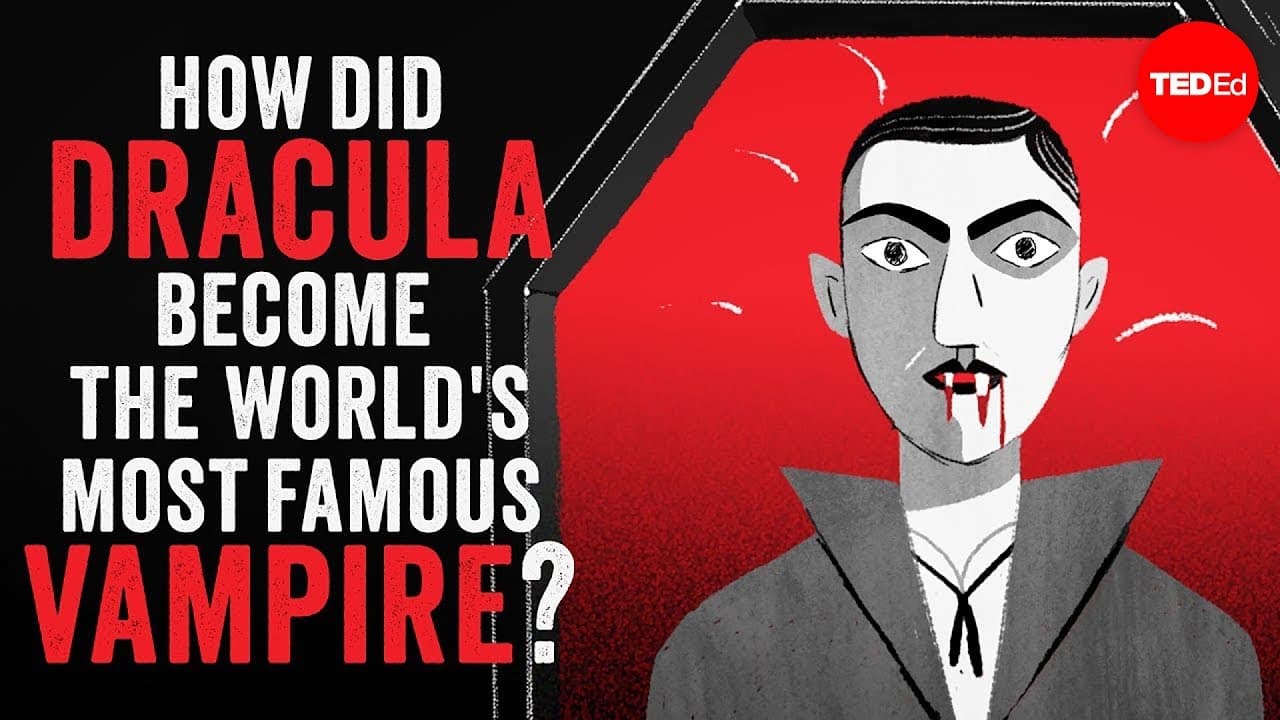
How did Dracula become the world's most famous vampire? - Stanley Stepanic
TL;DR
Dracula became the world’s most famous vampire through a chain of adaptations sparked by Bram Stoker’s 1897 novel, especially Hamilton Deane’s successful stage production, Bela Lugosi’s Broadway performance, and Universal’s 1931 film. The novel itself was only moderately successful at first, but a copyright battle over the 1922 silent film “Nosferatu” changed its fate. Read on to trace how folklore, publishing, theater, and film created an enduring icon.
Transcript
How did Dracula become the world's most famous vampire? More than 100 years after his creator was laid to rest, Dracula lives on as the most famous vampire in history. But this Transylvanian noble, neither the first fictional vampire nor the most popular of his time, may have remained buried in obscurity if not for a twist of fate. Dracula's first ... Read More
Key Insights
- 🧛 Dracula's fame is attributed to Bram Stoker's 1897 novel, but vampire myths had a long history before that.
- 🧛 Vampire folklore originated in Slavic regions and persisted despite efforts by the church to eliminate pagan beliefs.
- 🧛 Vampire hysteria spread in the 18th century due to Austrian soldiers' documentation of local burial rituals in Serbia.
- 💢 Bram Stoker drew inspiration from various works in the Victorian Era, not just the historical figure Vlad the Impaler, in creating Dracula.
- 🎥 The success of the stage adaptation of "Dracula" and Bela Lugosi's portrayal in the 1931 film solidified the character's popularity.
Install to Summarize YouTube Videos and Get Transcripts
Explore YouTube Video Summarizer or Get YouTube Transcript Extractor
Questions & Answers
Q: How did Dracula become the world’s most famous vampire?
Dracula began in Bram Stoker’s moderately successful 1897 novel, but a copyright battle over the 1922 film “Nosferatu” helped propel the character into literary renown. Hamilton Deane’s stage adaptation, Bela Lugosi’s Broadway performance, and Universal’s 1931 film then established many of Dracula’s signature characteristics and led to countless adaptations.
Q: Where did vampire myths originate?
The vampire myths described here came from Slavic folklore, which supplied the word “vampire,” or “upir” in Old Russian. The term’s first known written mention dates to the 11th century, while blood-sucking monsters had already appeared in folklore for at least 800 years.
Q: How did disease and decomposition contribute to vampire folklore?
Vampire stories arose partly from misunderstandings of diseases such as rabies and pellagra, as well as decomposition. Gases could swell a corpse and blood could ooze from its mouth, making the body appear recently alive and fed.
Q: What rituals were used to prevent the dead from becoming vampires?
People buried bodies with garlic or poppyseeds to prevent the dead from rising. Corpses could also be staked, burned, or mutilated.
Q: How did vampire hysteria spread across Western Europe?
Vampire lore remained local until the 18th century, when Austrian soldiers and officials documented Serbian burial rituals during a struggle involving the Habsburg Monarchy and Ottoman Empire. Their widely publicized reports caused hysteria and planted the vampire in Western Europe’s imagination.
Q: How was the 1755 vampire panic brought to an end?
The hysteria became so severe that the Austrian Empress dispatched her personal physician in 1755. He investigated the reports and ended the rumors by publishing a thorough scientific refutation, although vampire stories had already captured Western Europe’s imagination.
Q: What inspired Bram Stoker to create Dracula?
Stoker was influenced by earlier works including Joseph Sheridan Le Fanu’s 1872 “Carmilla” and “The Mysterious Stranger.” His mother also told him folktales and accounts of the 1832 cholera outbreak, including stories of victims buried alive in mass graves.
Q: Was Dracula based on Vlad the Impaler?
The novel’s villain is thought to be based on Vlad III Dracula, also called Vlad the Impaler, but the transcript says their association is mostly limited to a shared name. Other elements and characters drew directly or indirectly from works of the Victorian Era.
Summary & Key Takeaways
-
Dracula's first appearance was in Bram Stoker's 1897 novel, but vampire myths had already been part of folklore for at least 800 years.
-
Vampire lore originated from misinterpretations of diseases and decomposition, leading to rituals to prevent the dead from rising.
-
Vampire hysteria spread in the 18th century when Austrian soldiers documented unusual burial rituals in Serbia, and the vampire myth took root in Western Europe's imagination.
Read in Other Languages (beta)
Share This Summary 📚
Summarize YouTube Videos and Get Video Transcripts with 1-Click
Try YouTube Summary with ChatGPT & Claude or YouTube Transcript Generator
Explore More Summaries from TED-Ed 📚
Summarize YouTube Videos and Get Video Transcripts with 1-Click
Try YouTube Summary with ChatGPT & Claude or YouTube Transcript Generator