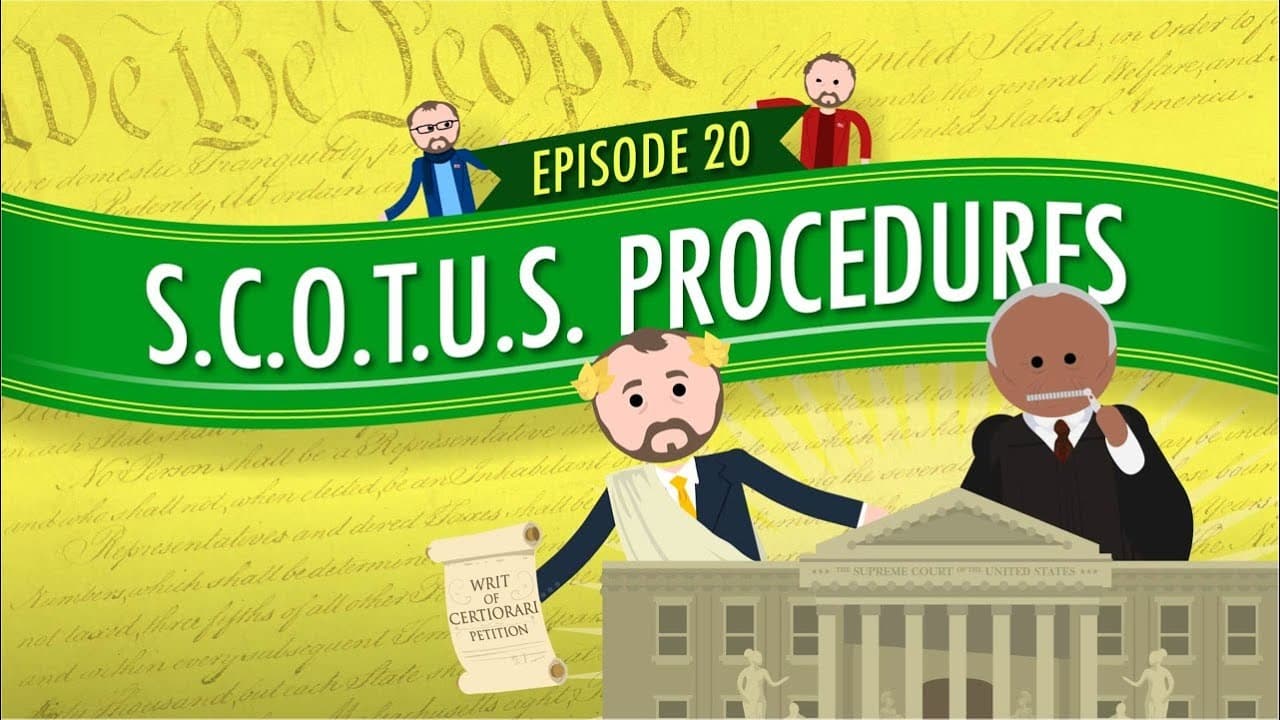
Supreme Court of the United States Procedures: Crash Course Government and Politics #20
TL;DR
The video explains the procedures of the U.S. Supreme Court.
Transcript
Hi, I'm Craig, and this is Crash Course Government and Politics and today, finally, we are stepping into the big leagues. That's right, I'm trying out for the Cubs. No, we're gonna talk about how the Supreme Court of the United States actually works! I could try out for the Cubs right, Stan? Sometimes people refer to it by the unfortunate nickname ... Read More
Key Insights
- To bring a case to the Supreme Court, it must be a case or controversy and have been decided by a lower court before appealing.
- A writ of certiorari is a formal request for the Supreme Court to hear a case, but it's not guaranteed.
- The solicitor general acts as a gatekeeper, screening petitions that lack significant federal law questions.
- The rule of four requires four justices to agree to hear a case for it to be granted certiorari.
- Briefs are written legal arguments submitted by both sides, and amicus curiae briefs can be filed by interested parties.
- Oral arguments are scheduled after briefs are filed, with each side having 30 minutes to present their case.
- A majority of five justices is needed for the court to render an official decision, which becomes binding precedent.
- Dissenting opinions, while not legally binding, can influence future cases and sometimes form the basis for later majority opinions.
Install to Summarize YouTube Videos and Get Transcripts
Explore YouTube Video Summarizer or Get YouTube Transcript Extractor
Questions & Answers
Q: What is required to bring a case to the Supreme Court?
To bring a case to the Supreme Court, it must be a case or controversy that has already been decided by a lower court and gone through the appeals process. Only after these steps can a petition for a writ of certiorari be filed, requesting the Supreme Court to hear the case.
Q: What role does the solicitor general play in Supreme Court procedures?
The solicitor general acts as a gatekeeper for the Supreme Court by screening petitions for writs of certiorari. The solicitor general evaluates whether cases raise significant federal law questions or have been adequately addressed in other cases. This screening helps manage the court's docket by filtering out cases that may not warrant the court's attention.
Q: What is the rule of four in the context of the Supreme Court?
The rule of four is a procedural rule used by the U.S. Supreme Court, requiring at least four of the nine justices to agree to grant certiorari for a case to be heard. This rule ensures that a minority of justices can bring a case before the full court, even if a majority is not initially in favor.
Q: How do amicus curiae briefs influence Supreme Court decisions?
Amicus curiae briefs, or 'friend of the court' briefs, are submitted by individuals or groups not directly involved in a case but who have a vested interest in the outcome. These briefs can provide additional legal, economic, or historical perspectives that may persuade justices and influence their opinions, thereby impacting the court's decision-making process.
Q: What happens during oral arguments at the Supreme Court?
During oral arguments at the Supreme Court, each side is allocated 30 minutes to present their case. This time is primarily spent answering questions posed by the justices, who use this opportunity to probe the arguments presented in the written briefs. The justices' questioning can be intense, as they seek to clarify points and challenge the arguments made by both parties.
Q: What constitutes a majority opinion in the Supreme Court?
A majority opinion in the Supreme Court is an official decision agreed upon by at least five of the nine justices. This opinion includes the court's holding, which either affirms or overturns the lower court's decision, and the rationale behind the decision. The majority opinion becomes binding precedent for lower courts to follow in future cases.
Q: How do dissenting opinions affect future Supreme Court decisions?
Dissenting opinions, while not legally binding, can influence future Supreme Court decisions by providing alternative legal reasoning and perspectives. These opinions can be eloquent and persuasive, potentially shaping the arguments in later cases. In some instances, dissents have laid the groundwork for majority opinions in subsequent cases, as seen with the transition from Plessy v. Ferguson to Brown v. Board of Education.
Q: What is the significance of a concurring opinion in the Supreme Court?
A concurring opinion is written by a justice who agrees with the majority's holding but for different legal reasons. While the rationale in a concurrence is not binding on lower courts, it can offer valuable insights and alternative interpretations of the law. Other justices may sign onto a concurrence if they agree with its logic, adding weight to the opinion.
Summary & Key Takeaways
-
The video discusses the procedural steps necessary for a case to be heard by the U.S. Supreme Court, including the requirement for a case or controversy and the exhaustion of lower court appeals. It explains the importance of a writ of certiorari and the role of the solicitor general in screening cases.
-
It describes the process of granting certiorari, requiring agreement from four justices, and the submission of written briefs by both parties. Amicus curiae briefs from non-parties with an interest in the case are also discussed as a means to influence the court.
-
The video outlines the oral argument process, where each side has 30 minutes to present their case, and the subsequent conference where justices deliberate and decide the case. The importance of majority opinions, concurrences, and dissents in shaping legal precedent is highlighted.
Read in Other Languages (beta)
Share This Summary 📚
Summarize YouTube Videos and Get Video Transcripts with 1-Click
Try YouTube Summary with ChatGPT & Claude or YouTube Transcript Generator
Explore More Summaries from CrashCourse 📚



Summarize YouTube Videos and Get Video Transcripts with 1-Click
Try YouTube Summary with ChatGPT & Claude or YouTube Transcript Generator