How to Name Organic Compounds in Organic Chemistry
TL;DR
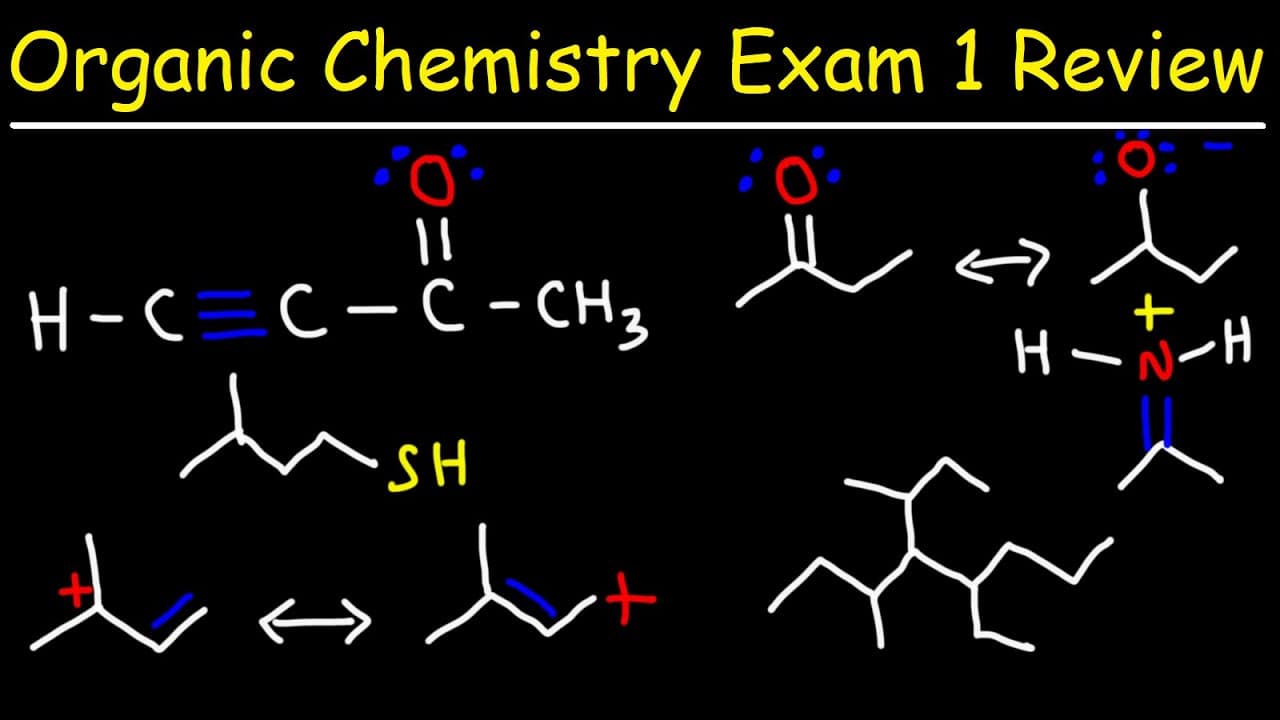
To name organic compounds, identify the longest carbon chain, apply IUPAC nomenclature rules, and consider functional groups like alcohols, aldehydes, and amines. Understanding hybridization helps predict bond angles and molecular geometry, while resonance structures illustrate how electron delocalization stabilizes molecules. Calculating formal charges aids in assessing molecular stability.
Transcript
in this video we're going to review some of the topics that are typically covered in the first exam of organic chemistry so let's go ahead and begin this is methane c2h6 if you see that that's ething sometimes it'll be written this way you can also show with a line structure c3h8 this is propane which you can write the condensed structure like this... Read More
Key Insights
- 🎮 The video covers the nomenclature of alkanes and naming conventions for various organic compounds.
- 👥 Different functional groups in organic chemistry, such as alcohols, aldehydes, ketones, carboxylic acids, and amines, are explained.
- 🖐️ Hybridization plays a crucial role in determining bond angles and molecular geometry in organic molecules.
- 👔 Calculating and interpreting formal charges helps determine the stability and reactivity of molecules.
- ❓ Resonance structures contribute to the overall stability and reactivity of compounds, with the major resonance contributor being the most stable structure.
- ❓ Resonance hybrids accurately represent the true structure of a molecule, considering all possible resonance structures.
Install to Summarize YouTube Videos and Get Transcripts
Explore YouTube Video Summarizer or Get YouTube Transcript Extractor
Questions & Answers
Q: How do you name alkanes?
To name alkanes, you count the number of carbon atoms in the longest chain and use the appropriate prefix (e.g. meth-, eth-, prop-, but-, pent-, etc.) followed by the -ane suffix. Then, you indicate any substituent groups and their position using numbers.
Q: What is the difference between an alcohol and an aldehyde?
An alcohol has an -OH group attached to a carbon atom, while an aldehyde has a double-bonded oxygen (carbonyl group) attached to a carbon atom and a hydrogen atom.
Q: How do you determine the hybridization and bond angles in organic molecules?
The hybridization of an atom is determined by counting the number of groups attached to it. The bond angles in organic molecules depend on the hybridization of the atoms involved. For example, SP hybridized carbons have a linear geometry with a bond angle of 180 degrees, while SP3 hybridized carbons have a tetrahedral geometry with a bond angle of around 109.5 degrees.
Q: How do you calculate formal charges?
The formal charge of an atom is calculated using the formula: (Valence electrons) - (Bonds) - (Lone pairs). Valence electrons are determined by the atom's position on the periodic table. Bonds are the number of bonding electrons, and lone pairs are the non-bonding electrons.
Q: What is the significance of resonance structures?
Resonance structures represent different ways to arrange electrons in a molecule, resulting in multiple contributing forms. They help explain the stability and reactivity of molecules and contribute to the overall structure, stability, and properties of the compound.
Q: How do you determine the major resonance contributor?
The major resonance contributor is the resonance structure that is more stable than others. Factors such as formal charges, electronegativity, and delocalization of charges are considered when determining the major resonance contributor.
Q: How do you draw resonance hybrids?
Resonance hybrids are drawn by combining the atoms and bonds that remain the same in all resonance structures. The electrons that move between different resonance structures are represented by dashed lines, indicating their partial presence in different locations.
Summary & Key Takeaways
-
The video covers the nomenclature of alkanes and examples of how to name different organic compounds based on their structure.
-
It explains the different functional groups in organic chemistry, such as alcohols, aldehydes, ketones, carboxylic acids, and amines.
-
The concept of hybridization and its relationship to bond angles and molecular geometry is discussed.
-
The video provides examples and explanations of how to calculate and interpret formal charges in different molecules.
-
Resonance structures and their role in stabilizing molecules are introduced, along with determining the major resonance contributor.
-
The video concludes with drawing resonance hybrids and discussing their significance in representing the true structure of a molecule.
Read in Other Languages (beta)
Share This Summary 📚
Summarize YouTube Videos and Get Video Transcripts with 1-Click
Try YouTube Summary with ChatGPT & Claude or YouTube Transcript Generator
Explore More Summaries from The Organic Chemistry Tutor 📚




Summarize YouTube Videos and Get Video Transcripts with 1-Click
Try YouTube Summary with ChatGPT & Claude or YouTube Transcript Generator