How RNN Classifiers Enhance Sentiment Analysis
TL;DR
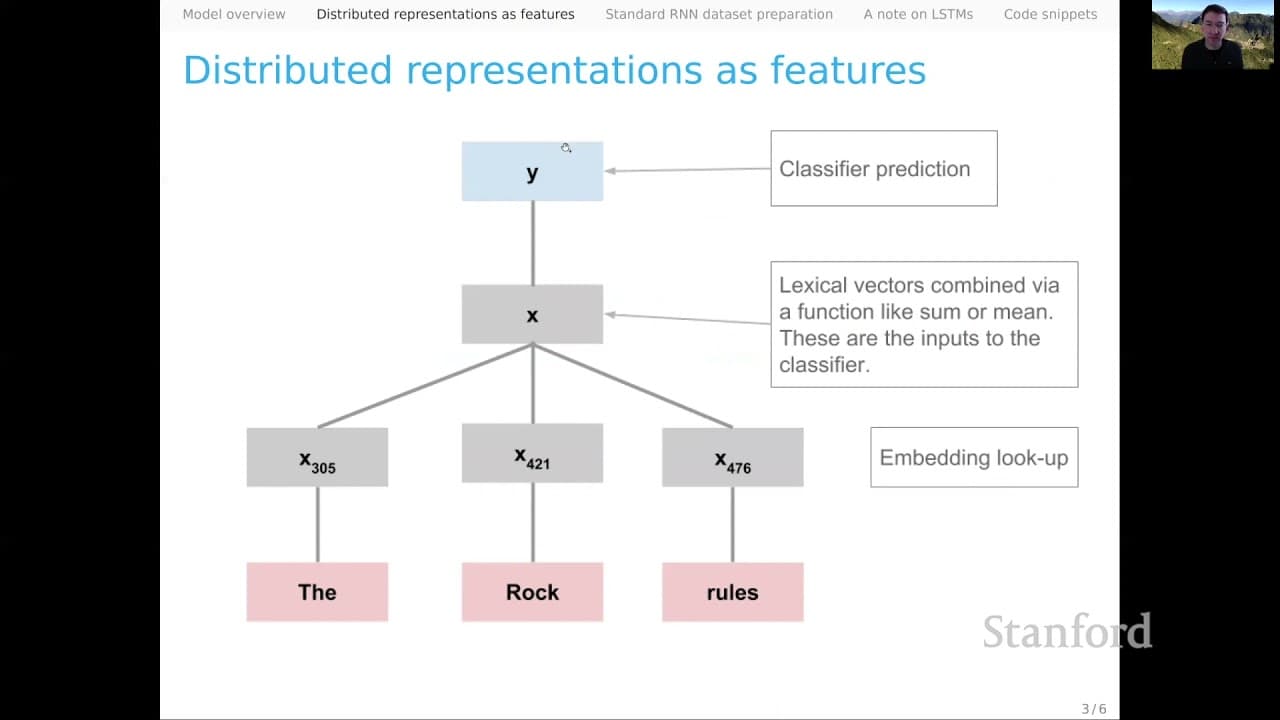
RNN classifiers significantly improve sentiment analysis by processing variable-length token sequences through a fixed embedding space that generates vector representations. These representations evolve through learned weight matrices, creating hidden states that feed into a softmax classifier, enabling deeper insights into text data.
Transcript
welcome back everyone this is part eight in our series on supervised sentiment analysis the final screencast in the series we're going to be talking about recurrent neural network or rnn classifiers i suppose this is officially our first step into the world of deep learning for sentiment analysis this slide gives an overview of the model and let's ... Read More
Key Insights
- 😒 RNN classifiers use vector representations of tokens in a fixed embedding space to analyze sentiment in variable length sequences.
- 😒 The use of hidden states allows RNN classifiers to capture and retain information from previous tokens in the sequence.
- 🍹 RNN classifiers can be considered an elaboration of simpler models that rely on sum or average combinations of token representations.
- 🪘 Long Short-Term Memory (LSTM) networks are a more powerful variation of RNN classifiers, addressing the issue of poor performance with long sequences.
- 💁 LSTM cells introduce mechanisms that control information flow and optimize the learning process.
- ❓ Fine-tuning strategies, such as using contextual models like BERT, can be explored to improve RNN classifiers.
- 📚 RNN classifiers can be easily implemented using code repositories and libraries, such as the sst library, for sentiment analysis.
Install to Summarize YouTube Videos and Get Transcripts
Explore YouTube Video Summarizer or Get YouTube Transcript Extractor
Questions & Answers
Q: What is the main purpose of recurrent neural network (RNN) classifiers in sentiment analysis?
RNN classifiers are used to analyze sentiment by processing variable length sequences of tokens and creating hidden representations that capture the contextual meaning of each token.
Q: How do RNN classifiers handle sequences with different lengths?
RNN classifiers are designed to handle variable length sequences by using learned weight matrices that transform the token representations and create hidden states at each time step.
Q: What is the advantage of using RNN classifiers over simpler models for sentiment analysis?
RNN classifiers have the capacity to learn more complex combinations of token representations, making them better suited for capturing nuanced sentiment patterns and improving accuracy in sentiment analysis tasks.
Q: Can RNN classifiers be modified or expanded upon for more advanced sentiment analysis tasks?
Yes, RNN classifiers can be further elaborated by incorporating bidirectional processing or fully utilizing the different hidden representations. These modifications can enhance the model's ability to capture and analyze sentiment in more sophisticated ways.
Summary & Key Takeaways
-
RNN classifiers are a type of deep learning model used in sentiment analysis.
-
The model starts by assigning vector representations to tokens using a fixed embedding space.
-
The RNN uses learned weight matrices to transform these representations and create hidden states, which can then be used as input for a softmax classifier.
Read in Other Languages (beta)
Share This Summary 📚
Summarize YouTube Videos and Get Video Transcripts with 1-Click
Try YouTube Summary with ChatGPT & Claude or YouTube Transcript Generator
Explore More Summaries from Stanford Online 📚

Summarize YouTube Videos and Get Video Transcripts with 1-Click
Try YouTube Summary with ChatGPT & Claude or YouTube Transcript Generator