How Does 3D Vision Enhance Deep Learning?
TL;DR
3D vision transforms how we perceive and interact with digital models by utilizing advanced deep learning techniques. It enables more accurate representations and reconstructions of 3D objects through explicit and implicit methods. This approach is crucial for applications in AI, robotics, and computer graphics, where understanding and manipulating 3D shapes are essential.
Transcript
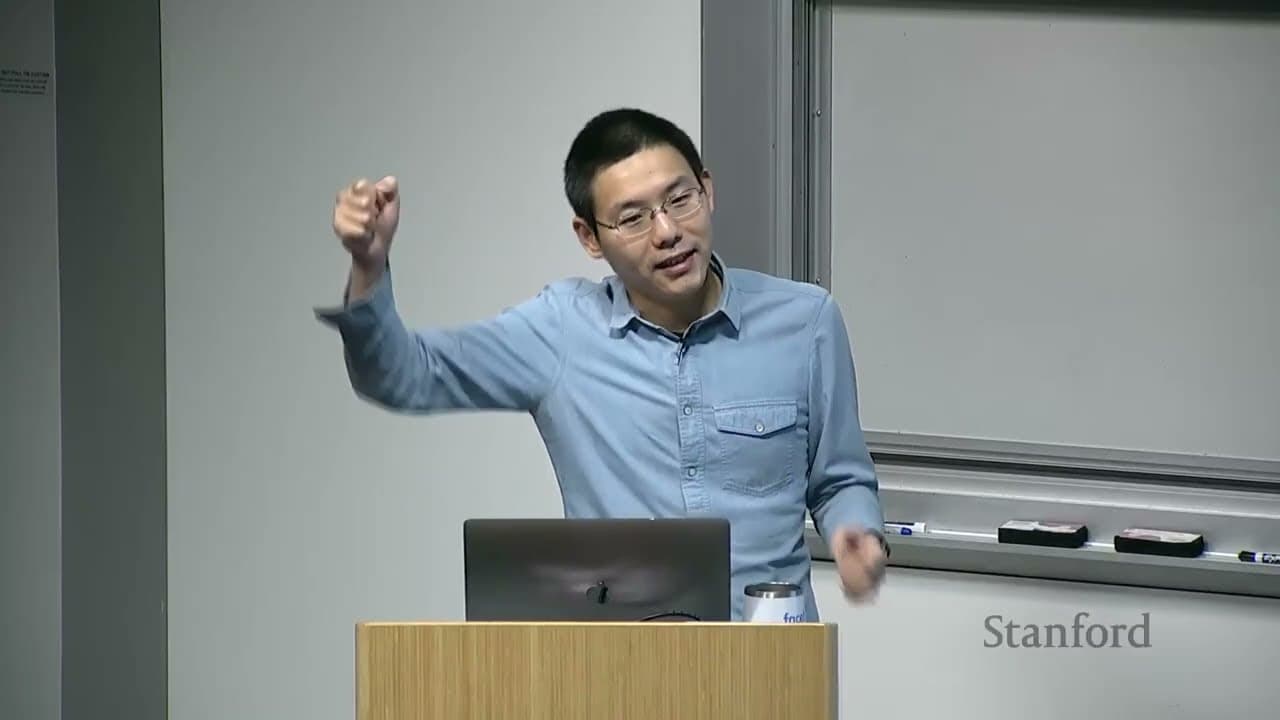
I'm really happy to announce our next guest speaker for the course, Professor Jiajun Wu. So Jiajun is an assistant professor here at Stanford in the Department of Computer Science, and he's a faculty member of the Stanford Vision and Learning Lab. His research focuses on scene understanding with an emphasis on multimodal perception, robotics and em... Read More
Key Insights
- 3D representations can be explicit, like point clouds and meshes, or implicit, like level sets and algebraic surfaces.
- Point clouds are simple 3D representations but lack connectivity information, making complex operations challenging.
- Polygonal meshes are widely used in graphics engines due to their ability to represent surfaces and support operations like simplification.
- Parametric representations use functions to describe shapes, allowing for efficient design and manipulation of objects.
- Implicit representations classify points based on functions, useful for determining if points are inside or outside objects.
- Deep learning has evolved to handle 3D data, starting with voxel-based methods before advancing to point clouds and implicit functions.
- NeRF (Neural Radiance Fields) leverages implicit functions to model both geometry and appearance, enabling realistic rendering from 2D images.
- Integrating neural networks with 3D data allows for tasks like shape generation, classification, and multimodal modeling.
Install to Summarize YouTube Videos and Get Transcripts
Explore YouTube Video Summarizer or Get YouTube Transcript Extractor
Questions & Answers
Q: How do explicit and implicit 3D representations differ?
Explicit 3D representations, such as point clouds and meshes, directly describe the geometry of objects by defining points or surfaces. These methods are intuitive and straightforward but may lack flexibility in complex operations. Implicit representations, on the other hand, use mathematical functions to define object boundaries, allowing for more complex queries like determining if a point is inside or outside an object. Implicit methods offer advantages in flexibility and composability, especially when integrated with deep learning techniques.
Q: What are the advantages of using point clouds in 3D vision?
Point clouds offer a simple and flexible way to represent 3D objects by using a collection of unconnected points in space. They are particularly useful for capturing raw data from 3D sensors, such as depth sensors and scanners, and can represent diverse object geometries. However, point clouds lack connectivity information, making it challenging to perform operations like rendering or editing. Despite these limitations, they are widely used due to their simplicity and ability to represent complex shapes without predefined topology.
Q: Why are polygonal meshes popular in graphics engines?
Polygonal meshes are popular in graphics engines because they provide a detailed and structured way to represent 3D surfaces. They consist of vertices, edges, and faces, allowing for the accurate depiction of complex geometries. Meshes support various operations, such as simplification and subdivision, making them versatile for rendering and animation. Their structured nature facilitates efficient processing and manipulation, which is essential in applications like computer games and simulations where realism and performance are critical.
Q: How do parametric representations benefit 3D modeling?
Parametric representations benefit 3D modeling by using mathematical functions to define curves and surfaces, allowing for precise control over shapes. This approach enables the creation of smooth and continuous geometries, which are essential in design and manufacturing. Parametric models are highly flexible, allowing designers to easily modify and manipulate shapes by adjusting parameters. This capability is particularly useful in applications like CAD (Computer-Aided Design), where accuracy and customization are crucial for producing complex designs.
Q: What role do implicit representations play in deep learning?
Implicit representations play a crucial role in deep learning by providing a flexible way to model 3D geometries and their properties using functions. These representations allow for complex queries, such as determining if a point is inside or outside an object, and can be easily integrated with neural networks. Implicit methods are particularly useful in tasks like neural rendering, where they enable the modeling of both geometry and appearance. By leveraging implicit functions, deep learning can achieve more accurate and realistic representations of 3D objects.
Q: How has deep learning evolved to handle 3D data?
Deep learning has evolved to handle 3D data by initially adapting 2D convolutional techniques to 3D voxel grids, allowing for volumetric analysis. As research progressed, methods shifted towards more efficient representations, such as point clouds and implicit functions, which offer greater flexibility and accuracy. Recent advancements, like Neural Radiance Fields (NeRF), leverage implicit functions to model both geometry and appearance from 2D images, enabling realistic rendering. These developments have expanded the capabilities of deep learning in 3D vision applications.
Q: What is NeRF, and how does it impact 3D vision?
NeRF (Neural Radiance Fields) is a technique that uses deep learning to model 3D scenes by representing both geometry and appearance through implicit functions. It allows for the realistic rendering of 3D objects from 2D images by querying properties like color and density for points in space. NeRF impacts 3D vision by enabling high-quality reconstructions and rendering without the need for extensive 3D data, bridging the gap between 2D and 3D domains. This approach has revolutionized applications in graphics, virtual reality, and augmented reality.
Q: How do Gaussian splats improve the efficiency of 3D rendering?
Gaussian splats improve the efficiency of 3D rendering by representing scenes with sparse, point-based Gaussian blobs instead of densely sampled grids. This approach reduces computational overhead by focusing on areas with relevant data, minimizing the sampling of empty spaces. By integrating implicit functions with point-based representations, Gaussian splats achieve comparable rendering quality to traditional methods like NeRF while significantly increasing rendering speed. This efficiency makes them ideal for real-time applications in graphics and virtual environments.
Summary & Key Takeaways
-
3D vision in deep learning involves representing and reconstructing 3D objects using explicit and implicit methods. Explicit methods include point clouds and meshes, while implicit methods use functions to define object boundaries. These representations are crucial for applications in AI, robotics, and graphics.
-
Deep learning techniques have evolved to handle 3D data, initially using voxel-based methods similar to 2D pixel processing. Advances led to the use of point clouds and implicit functions, enabling more efficient and accurate 3D modeling and rendering.
-
NeRF (Neural Radiance Fields) represents a significant advancement in 3D vision, allowing for the modeling of geometry and appearance from 2D images. This technique uses deep networks to query properties of 3D points, facilitating realistic rendering and bridging the gap between 2D and 3D data.
Read in Other Languages (beta)
Share This Summary 📚
Summarize YouTube Videos and Get Video Transcripts with 1-Click
Try YouTube Summary with ChatGPT & Claude or YouTube Transcript Generator
Explore More Summaries from Stanford Online 📚

Summarize YouTube Videos and Get Video Transcripts with 1-Click
Try YouTube Summary with ChatGPT & Claude or YouTube Transcript Generator