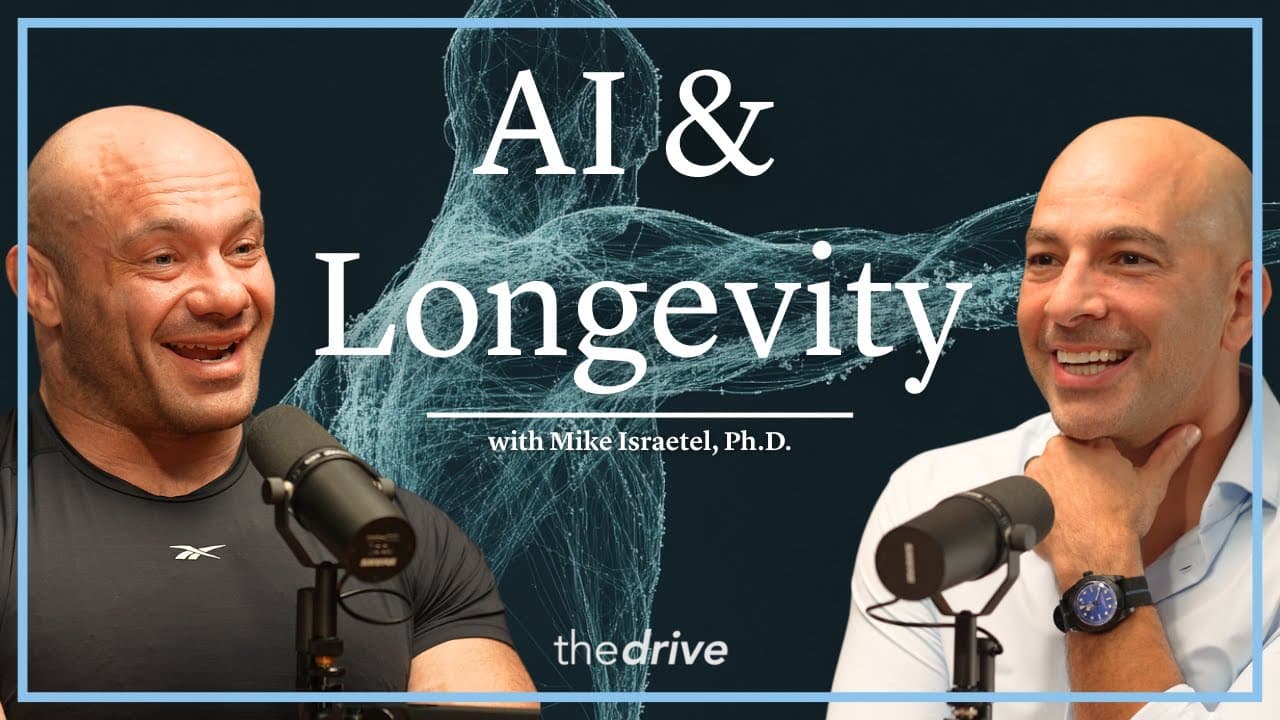
How will AI and aging research change longevity
TL;DR
AI, protein folding, and drug design could accelerate aging research and disease cures within the next decades. Progress is exponential, with AI helping reduce exploration time, speed up drug discovery, and streamline trials while regulatory hurdles still shape timelines. The discussion emphasizes long term healthspan benefits and the potential for radical improvements in medicine.
Transcript
Now, my hedge is, you know, how about I just stave off chronic disease as long as possible, stay as healthy as possible, stay in the game as long as possible, so that if it turns out that that was for nothing. We're sitting here, it's 10 years from now, I'm in my early 60s, and someone comes along and says, "Peter, all that stuff you did was totall... Read More
Key Insights
- AI accelerates aging research by compressing drug discovery timelines and enabling rapid exploration of molecular designs.
- Protein folding breakthroughs, driven by AI, enable better understanding of biological targets and faster development of therapies.
- Regulatory processes are a major hurdle that can delay bringing AI designed drugs to market, despite faster initial discovery.
- Exponential progress in technology often outpaces societal and regulatory readiness, creating a mismatch between potential and implementation.
- Historically, predictions have underestimated near term breakthroughs; current trends suggest significant changes by the 2030s.
- AGI and advanced AI are forecast to transform multiple stages of drug development from discovery to trials to approval.
- The discussion emphasizes that even with powerful tools, practical constraints and incentives will shape what gets pursued.
- The trajectory of technology suggests a future where chronic diseases could be addressed more effectively, altering healthspan and aging trajectories
Install to Summarize YouTube Videos and Get Transcripts
Explore YouTube Video Summarizer or Get YouTube Transcript Extractor
Questions & Answers
Q: What is the direct path to curing aging according to the discussion
The discussion frames curing aging as a result of accelerating understanding and manipulation of biology through AI, protein folding breakthroughs, and smarter drug design. The key idea is that as compute power and AI capabilities grow, the ability to identify, design, and test therapies will accelerate, potentially addressing major diseases and aging processes earlier than expected while regulatory factors may slow exact timelines.
Q: How does exponential progress in technology relate to aging research
Exponential progress is described as a consistent acceleration where each advance makes subsequent advances easier or faster. In aging research this means computing power, AI, and biological understanding grow together, enabling rapid improvements in drug discovery and therapy development. The phenomenon is used to support the claim that advances in longevity and disease treatment could happen much sooner than linear projections would suggest.
Q: What role does protein folding play in the longevity discussion
Protein folding is presented as a major breakthrough that enables better prediction of molecular structures, which in turn informs drug design and potential therapies. This capability is cited as a foundational tool that will accelerate identifying targets and optimizing compounds, contributing to faster development of treatments that could impact aging and chronic disease.
Q: Why are regulatory hurdles mentioned as important
Regulatory hurdles are described as the biggest obstacle to rapid medical advancement. Even when AI and biology enable rapid discovery, getting safe and effective therapies approved requires time and strict oversight. The discussion suggests AI may speed up early stages, but the journey through trials and regulatory review still governs final availability.
Q: What is the expected timeline for disease and aging breakthroughs
The speakers suggest that breakthroughs could become visible in the 2030s, with some predicting closer arrivals for certain capabilities, while debates exist about exact years for broad AGI or disease eradication. The core message is that progression could reach substantial milestones within the next decade or two, driven by AI and accelerated discovery.
Q: How might AI change the drug development pipeline
AI is described as transforming the initial steps of drug development by identifying molecules and predicting structures more efficiently, reducing trial and error. This could accelerate preclinical work, enable faster phase transitions, and shorten the overall development cycle, potentially allowing more therapies to reach patients sooner.
Q: What are the optimistic and cautious views presented
Optimists argue that AI and biology will unlock major healthspan extensions and disease cures by leveraging exponential progress and smarter design. Cautious perspectives emphasize regulatory delays, ethical considerations, and the possibility that some predicted timelines may not materialize as quickly due to practical constraints and complex biological systems.
Q: How do past predictions relate to current expectations
Past predictions often underestimated near term breakthroughs, with some experts dismissing possibilities of rapid AI-driven medicine. The conversation notes that previous skepticism, such as doubts about AGI, has been challenged by recent progress, and current expectations are that significant changes may occur sooner than older forecasts suggested.
Summary & Key Takeaways
-
A high level overview explains that exponential progress in computing and biology could dramatically impact aging research and disease treatment, though regulatory and practical barriers remain significant.
-
The clip highlights AI driven drug discovery, protein folding breakthroughs, and the potential for near term to mid term advances in disease treatment and longevity.
-
The conversation frames the pace of change as rapid and multi-faceted, with ongoing debate about optimism versus caution in biologically extending healthspan
Read in Other Languages (beta)
Share This Summary 📚
Summarize YouTube Videos and Get Video Transcripts with 1-Click
Try YouTube Summary with ChatGPT & Claude or YouTube Transcript Generator
Explore More Summaries from Peter Attia MD 📚

Summarize YouTube Videos and Get Video Transcripts with 1-Click
Try YouTube Summary with ChatGPT & Claude or YouTube Transcript Generator