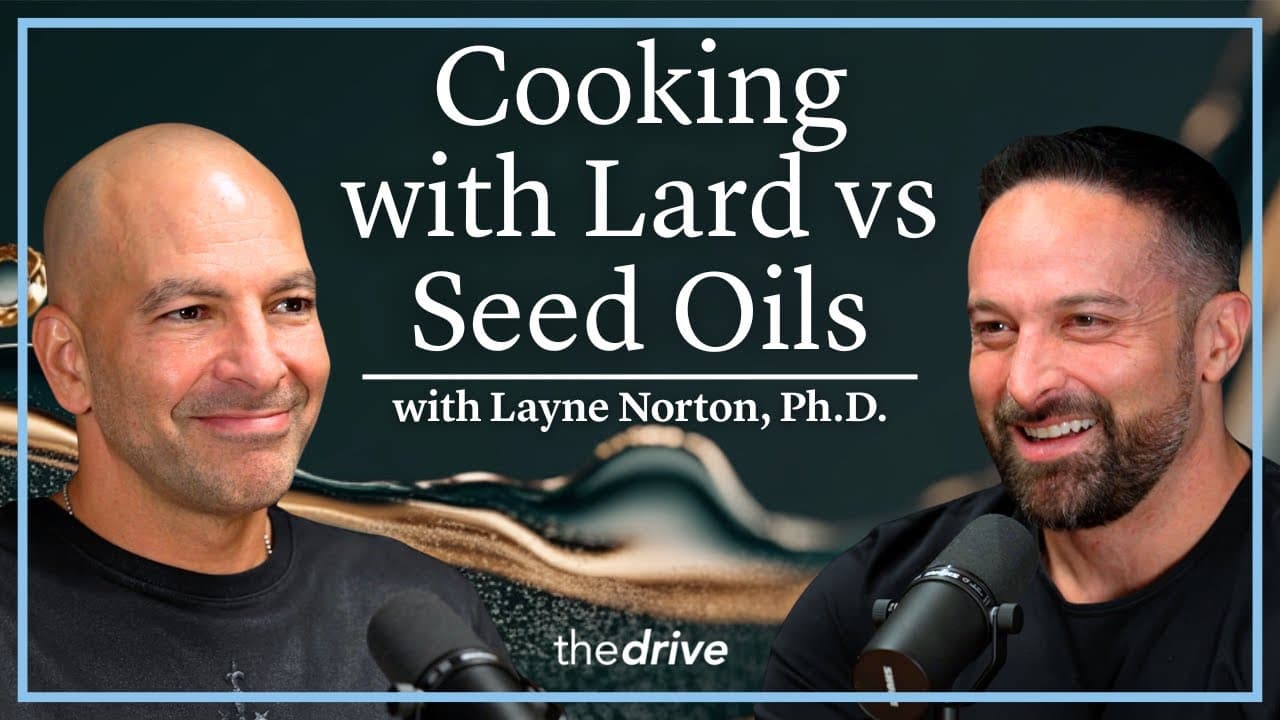
Should You Cook with Lard or Seed Oils?
TL;DR
If avoiding seed oils, it's crucial to replace them with healthier alternatives rather than increasing saturated fats. Lean protein and monounsaturated fats like olive oil can be beneficial. Frying in lard reduces oxidation but may increase LDL risk. Larger health issues include caloric excess and inactivity, overshadowing the choice of cooking oil.
Transcript
Is there a precautionary principle? Uh if someone says, "You know what, Lane, I've heard everything you've said. I can't poke holes in it, but it just why should I go out and eat seed oils?" You know, um what what would you say to that person? >> I would say, okay, if you don't want to consume seed oils, fine, but find something to displace the sat... Read More
Key Insights
- Replacing seed oils requires careful consideration to avoid increasing saturated fats.
- Leaner cuts of meat and lower-saturated-fat proteins are recommended substitutes.
- Monounsaturated fats like olive and avocado oil can lower LDL cholesterol.
- Frying in saturated fats like lard reduces oxidation compared to seed oils.
- There is no clear human trial data comparing frying in lard versus seed oils.
- Larger health issues include excessive calorie intake and low physical activity.
- Food companies may market changes like using lard as healthier without real benefits.
- Public perception of health studies can be skewed by social media hot takes.
Install to Summarize YouTube Videos and Get Transcripts
Explore YouTube Video Summarizer or Get YouTube Transcript Extractor
Questions & Answers
Q: Why should seed oils be replaced with healthier alternatives?
Replacing seed oils with healthier alternatives is important to avoid increasing saturated fats, which can negatively affect cardiovascular health. Lean protein sources and monounsaturated fats, such as olive oil, can lower LDL cholesterol and provide cardiovascular benefits, making them preferable substitutes.
Q: What are some recommended alternatives to seed oils?
Recommended alternatives to seed oils include leaner cuts of meat and lower-saturated-fat protein sources. Monounsaturated fats like olive oil and avocado oil are also beneficial, as they can help lower LDL cholesterol when used in place of saturated fats, though less effectively than polyunsaturated fats.
Q: Is frying in lard better than using seed oils?
Frying in lard reduces the risk of oxidation compared to seed oils, but it may increase LDL-related risks. There is no definitive human trial data to conclusively favor one over the other, and both options have potential downsides. The choice should consider overall dietary and health context.
Q: What are the larger health issues beyond cooking oil choices?
Larger health issues include excessive calorie consumption, low fiber intake, and low physical activity levels, which significantly contribute to disease risk. Focusing solely on the type of cooking oil used can distract from these more impactful factors that drive disease in developed countries.
Q: How do food companies market changes in cooking oils?
Food companies may market changes, such as using lard instead of seed oils, as healthier options. This can mislead consumers into believing these products are significantly better for health, potentially leading to increased consumption without addressing the actual nutritional quality of the food.
Q: How does public perception of health studies get influenced?
Public perception of health studies is often influenced by social media hot takes that oversimplify findings. These hot takes can omit important context, leading to misunderstandings and skepticism about scientific research. Detailed examination of studies typically reveals more nuanced insights.
Q: What role do social media platforms play in health information dissemination?
Social media platforms often prioritize catchy, simplified content that can spread widely, influencing public understanding of health information. This can lead to misinterpretations and oversimplifications, as nuanced scientific discussions rarely fit into brief social media formats, affecting public perception.
Q: Why is it important to consider the context of scientific studies?
Considering the context of scientific studies is crucial as limitations exist in all research. Studies must be interpreted carefully to avoid overgeneralizing results. High-quality studies with rigorous controls provide more reliable insights, but understanding their context helps in making informed health decisions.
Summary & Key Takeaways
-
Avoiding seed oils is beneficial only if they are replaced with healthier alternatives, not more saturated fats. Leaner meat cuts and monounsaturated fats like olive oil can help lower LDL cholesterol. Frying in lard reduces oxidation but may increase LDL-related risks.
-
The choice between lard and seed oils is complex, with no clear human trial data favoring one over the other. Larger health concerns, such as excessive calorie consumption and low physical activity, play a more significant role in disease risk than the type of cooking oil used.
-
Food companies often market changes like using lard instead of seed oils as healthier, but this can mislead consumers into thinking these options are significantly better. Public understanding of nutritional studies is often influenced by oversimplified social media content.
Read in Other Languages (beta)
Share This Summary 📚
Summarize YouTube Videos and Get Video Transcripts with 1-Click
Try YouTube Summary with ChatGPT & Claude or YouTube Transcript Generator
Explore More Summaries from Peter Attia MD 📚




Summarize YouTube Videos and Get Video Transcripts with 1-Click
Try YouTube Summary with ChatGPT & Claude or YouTube Transcript Generator