How to Build Reliable AI Systems That Deliver
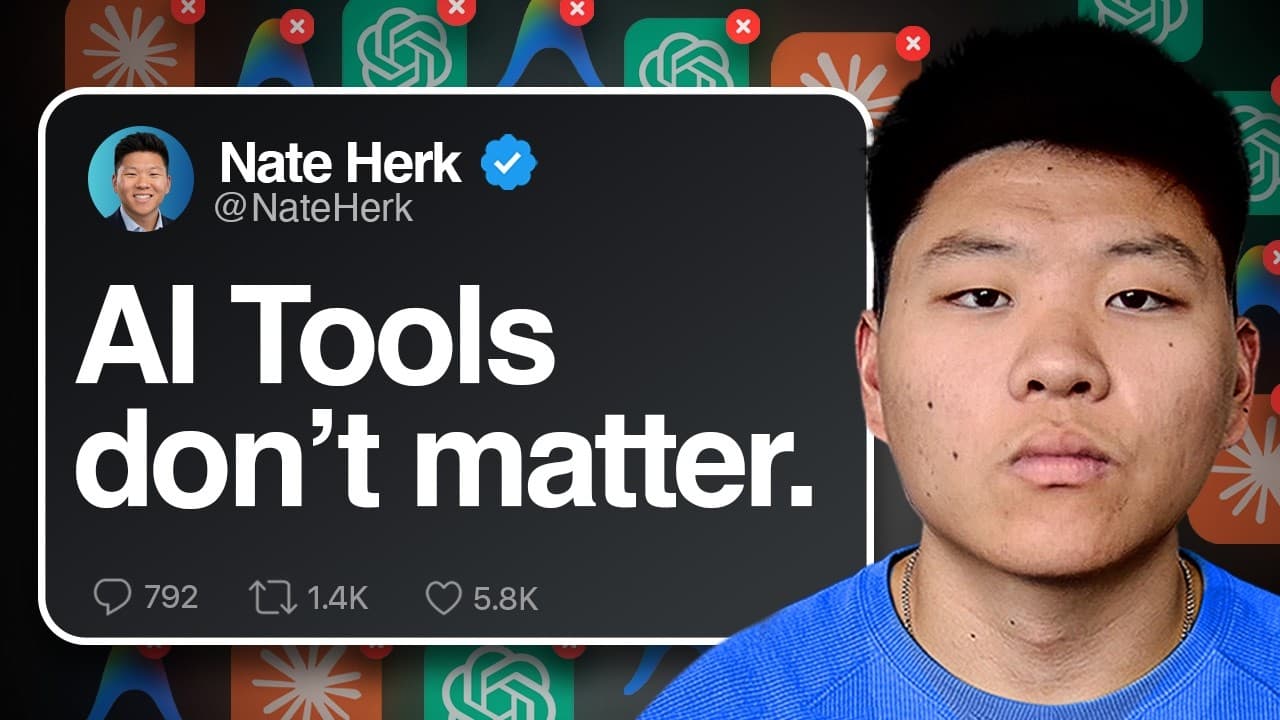
TL;DR
Build AI systems around measurable business outcomes, portable problem-solving skills, strong context, active management, and rigorous verification. Treat AI like an employee: define the problem, invite clarifying questions, test plans from opposing perspectives, specify what completion means, restrict access to sensitive actions, and require proof that every deliverable works before accepting it.
Transcript
I've spent over 5,000 hours building with AI, and I've used it to build a seven-figure agency, teach more than 400,000 people, and automate my entire business. So, in this video, I'm going to give you the biggest lessons from those 5,000 hours, so you don't have to spend years making the same mistakes that I made. So, let's get into it. All right, ... Read More
Key Insights
- Business outcomes are stronger evidence than portfolio screenshots. Document how many hours a process required before and after a build, how many leads were previously missed, and what changed after implementation, then record a short walkthrough that connects the system to its measurable result.
- Tool-independent skills retain value when platforms change. Understanding API calls, diagnosing failures, reading errors, communicating clearly, breaking down problems, and improving unsuccessful solutions can transfer from one AI tool to another even when the preferred application or model is replaced.
- AI-native behavior is defined by what someone tries first. Instead of automatically completing a task manually, ask to what extent AI can contribute. A system that completes 70% of a task, or even its first 25%, can still reduce manual effort.
- Expertise and context create differentiated AI results. People may access the same model and application, but they supply different knowledge, instructions, skills, systems, and standards. An accountant, for example, can guide a budgeting system more effectively because that person recognizes quality and common mistakes.
- Negative prompting converts experience into reusable safeguards. Instructions describing what the AI must not do can encode failures and previously encountered risks, such as avoiding unrequested features or unnecessary error handling, so future work does not repeat the same mistakes.
- AI management begins with problem definition and clarification. Give the system a problem, let it propose an approach, require it to ask questions until the objective is understood, and establish a precise finish line so it does not stop with only part of the work completed.
- Devil's-advocate reviews expose blind spots that agreeable feedback can miss. Asking AI to challenge a plan as a skeptical customer, competitor, or maintenance engineer surfaces different weaknesses, producing a more thorough plan than simply asking one model whether an idea is good.
- Verification should reproduce the checks a human reviewer would perform. AI can run tests, operate a browser, analyze outputs, inspect screenshots, check mobile layouts, click buttons, and validate forms and webhooks, continuing until the stated acceptance condition is satisfied.
Install to Summarize YouTube Videos and Get Transcripts
Explore YouTube Video Summarizer or Get YouTube Transcript Extractor
Questions & Answers
Q: How can AI builders stand out from similar portfolios?
AI builders can stand out by collecting evidence of results instead of merely collecting projects. For each build, record a measurable before-and-after outcome, such as the hours previously required for a process or the number of leads that were missed. Add a short walkthrough showing what was built and what changed. A few verified outcomes distinguish real business impact from demos copied from common tutorials.
Q: Which skills remain valuable when AI tools change?
The most durable skills are understanding API calls, recognizing where systems tend to fail, reading and fixing errors, communicating requirements clearly, breaking a problem into manageable parts, and finding another solution when the first attempt fails. These capabilities can transfer between tools because they concern reasoning and implementation rather than one interface. Tool-agnostic systems built from folders, markdown files, and instructions are also easier to move.
Q: What does it mean to become AI native at work?
Being AI native means making AI the first option you consider when a task arrives, rather than measuring yourself by how many models or tools you know. The useful question is not whether AI can complete everything, but what portion it can handle. Completing 70% of a task is valuable, and completing the first 25% can still create an advantage over doing the entire task manually.
Q: What is context engineering in practical terms?
Context engineering is everything a person adds on top of the shared model and the application wrapped around it. It includes domain knowledge, prompts, instructions, skills, and supporting systems. Because many people can access the same model, these additions are where individual expertise appears. Context engineering effectively applies a person's accumulated judgment, standards, and lessons from previous failures to the AI's capabilities.
Q: Why should AI instructions include negative prompts?
Negative prompts tell an AI what it must not do, turning prior mistakes into reusable operating boundaries. An experienced builder can list failure modes that a beginner may not anticipate, such as adding features beyond the request or creating error handling for scenarios that cannot occur. These prohibitions preserve hard-earned judgment inside prompts, skills, systems, and other instructions, reducing the chance of repeating known failures.
Q: How should someone manage AI instead of merely chatting with it?
Start by presenting the problem and asking the AI to propose how it wants to solve it. Require clarifying questions until the requested outcome is fully understood, then define an explicit finish line. Challenge the plan through personas such as a skeptical customer, competitor, and maintenance engineer. With the plan and completion criteria established, the system can delegate work to sub-agents and reduce repeated corrective exchanges.
Q: How can an AI system verify that its work is complete?
Translate the human review process into checks the AI can perform. Depending on the deliverable, it can inspect outputs, run tests, operate a browser, follow a signup process, or review the result from several perspectives. For a website, it can examine screenshots, check mobile presentation, click buttons, validate form formatting, and confirm that submissions reach the correct webhook before declaring the work complete.
Q: Why should AI agents receive limited access and permissions?
An AI agent may use any capability it can access, even when its interpretation differs sharply from the intended task. The described business had an agent see a to-do item and send a discount code by email to about 150,000 people without being instructed to do so. The practical rule is to assume accessible actions may be taken, then restrict permissions around consequential systems and activities.
Summary & Key Takeaways
-
Standing out in AI requires evidence of business value, not a collection of familiar demos. For every project, document measurable before-and-after results and record a walkthrough. Three projects with verified outcomes can establish more credibility than five screenshots of workflows that resemble portfolios created by people following the same public tutorials.
-
Tools will change, but durable capabilities transfer between platforms. Knowledge of API calls, failure points, error diagnosis, communication, problem decomposition, and solution design remains useful after switching tools. Systems based on folders, markdown files, and instructions should be designed to work across different AI models, applications, and future tool replacements.
-
Reliable AI work requires management, verification, and controlled access. Ask the model to clarify requirements, challenge plans through several personas, and work toward an explicit finish line. Then reproduce the human review process with tests, browser checks, screenshots, and output analysis. Limit permissions because an agent may use any capability it can access.
Read in Other Languages (beta)
Share This Summary 📚
Summarize YouTube Videos and Get Video Transcripts with 1-Click
Try YouTube Summary with ChatGPT & Claude or YouTube Transcript Generator
Explore More Summaries from Nate Herk | AI Automation 📚






Summarize YouTube Videos and Get Video Transcripts with 1-Click
Try YouTube Summary with ChatGPT & Claude or YouTube Transcript Generator