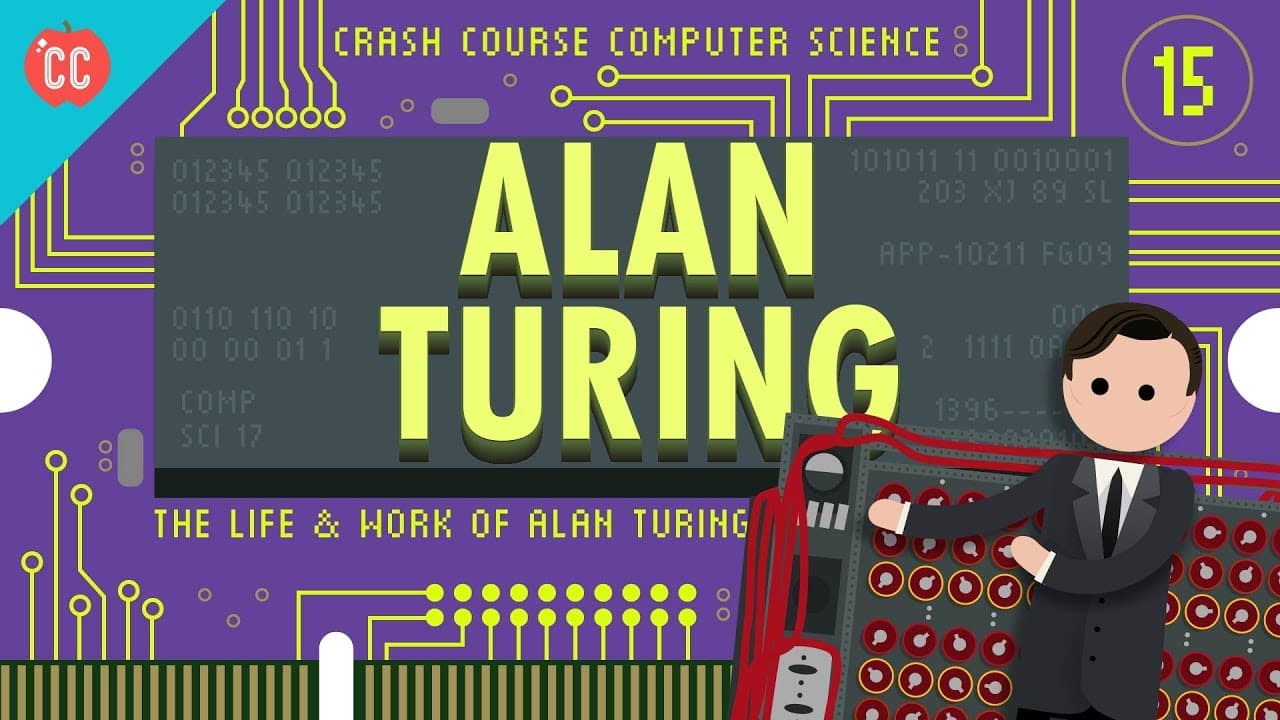
Alan Turing: Crash Course Computer Science #15
TL;DR
Alan Turing's work laid the foundation for modern computing.
Transcript
Hi, I'm Kerry Ann and welcome to Crash Course computer science. Over the past few episodes, we've been building up our understanding of computer science fundamentals, such as functions, algorithms and data structures. Today, we're going to take a step back and look at the person who formulated many of the theoretical concepts that underline modern ... Read More
Key Insights
- Alan Turing formulated many theoretical concepts that underpin modern computation, including the Turing Machine, a model for general-purpose computing.
- The Turing Machine is a theoretical device that can perform any computation given enough time and memory, making it a powerful model in computer science.
- Turing addressed the Entscheidungsproblem and the halting problem, proving that not all computational problems can be solved.
- During World War II, Turing played a crucial role in breaking German codes, particularly those encrypted by the Enigma machine, aiding the Allied war effort.
- Turing's work in artificial intelligence laid the groundwork for future developments, including the Turing Test, which evaluates a machine's ability to exhibit intelligent behavior indistinguishable from a human.
- Despite his immense contributions, Turing's personal life was marked by tragedy due to the criminalization of his homosexuality, leading to his untimely death.
- The Turing Award, named in his honor, is the highest distinction in computer science, recognizing contributions to the field.
- Turing's legacy continues to inspire future generations of computer scientists, highlighting the intersection of theoretical and practical advancements in technology.
Install to Summarize YouTube Videos and Get Transcripts
Explore YouTube Video Summarizer or Get YouTube Transcript Extractor
Questions & Answers
Q: What is the significance of the Turing Machine?
The Turing Machine is a theoretical computing device that serves as a fundamental model for understanding computation. It can simulate any computer algorithm, highlighting the concept of a general-purpose computer. Despite its simplicity, the Turing Machine demonstrates the limits of computation, as some problems cannot be solved even with infinite resources.
Q: How did Turing contribute to the war effort during World War II?
Alan Turing significantly contributed to the war effort by developing the Bombe, an electromechanical device that helped decrypt messages encoded by the German Enigma machine. His work at Bletchley Park was crucial in deciphering enemy communications, providing the Allies with vital intelligence that some historians argue shortened the war by years.
Q: What was the halting problem and Turing's contribution to it?
The halting problem is a computational puzzle that asks whether an algorithm can determine if a given program will eventually halt or run indefinitely. Turing proved that this problem is unsolvable through a logical paradox, demonstrating that there are inherent limits to what can be computed, thus setting boundaries on the capabilities of computational machines.
Q: What is the Turing Test and its relevance to artificial intelligence?
The Turing Test is a measure of a machine's ability to exhibit intelligent behavior indistinguishable from a human. Proposed by Alan Turing, it involves a human interacting with both a machine and another human without knowing which is which. If the human cannot reliably distinguish between them, the machine is considered to have passed the test, reflecting its potential for human-like intelligence.
Q: How did Turing's personal life impact his career and legacy?
Alan Turing's personal life was tragically affected by the legal and social stigmatization of homosexuality during his time. Convicted for his sexual orientation, he faced severe consequences, including hormonal treatment, which affected his mental health. Despite these challenges, Turing's scientific legacy endures, though his personal struggles highlight the societal barriers he faced.
Q: What was the Bombe and how did it work?
The Bombe was an electromechanical device designed by Alan Turing to decrypt messages encoded by the German Enigma machine during World War II. It exploited flaws in the Enigma's encoding process, such as the fact that a letter could not be encoded as itself, to eliminate incorrect settings and narrow down possible configurations, greatly aiding codebreakers in deciphering enemy communications.
Q: What are the implications of Turing's work on modern computing systems?
Turing's work laid the theoretical foundation for modern computing systems, introducing concepts like Turing completeness, which describes the computational power of systems. His ideas underpin the design and functionality of contemporary computers, influencing both hardware and software development. Turing's legacy continues to guide advancements in computing technology and artificial intelligence.
Q: Why is Alan Turing considered a pivotal figure in computer science?
Alan Turing is considered a pivotal figure in computer science due to his groundbreaking theoretical work, such as the development of the Turing Machine, and his practical contributions during World War II. His insights into computation, artificial intelligence, and cryptography have had a lasting impact, inspiring generations of computer scientists and shaping the digital world we live in today.
Summary & Key Takeaways
-
Alan Turing is celebrated as the father of computer science for his foundational work in theoretical computation, including the development of the Turing Machine.
-
His efforts during World War II to decrypt Enigma codes were pivotal, showcasing the practical applications of his theoretical work and significantly aiding the Allied forces.
-
Turing's contributions to artificial intelligence and his personal struggles highlight both his brilliance and the societal challenges he faced, leaving a lasting impact on computer science.
Read in Other Languages (beta)
Share This Summary 📚
Summarize YouTube Videos and Get Video Transcripts with 1-Click
Try YouTube Summary with ChatGPT & Claude or YouTube Transcript Generator
Explore More Summaries from CrashCourse 📚



Summarize YouTube Videos and Get Video Transcripts with 1-Click
Try YouTube Summary with ChatGPT & Claude or YouTube Transcript Generator