What Is the First Law of Thermodynamics and Its Applications?
TL;DR
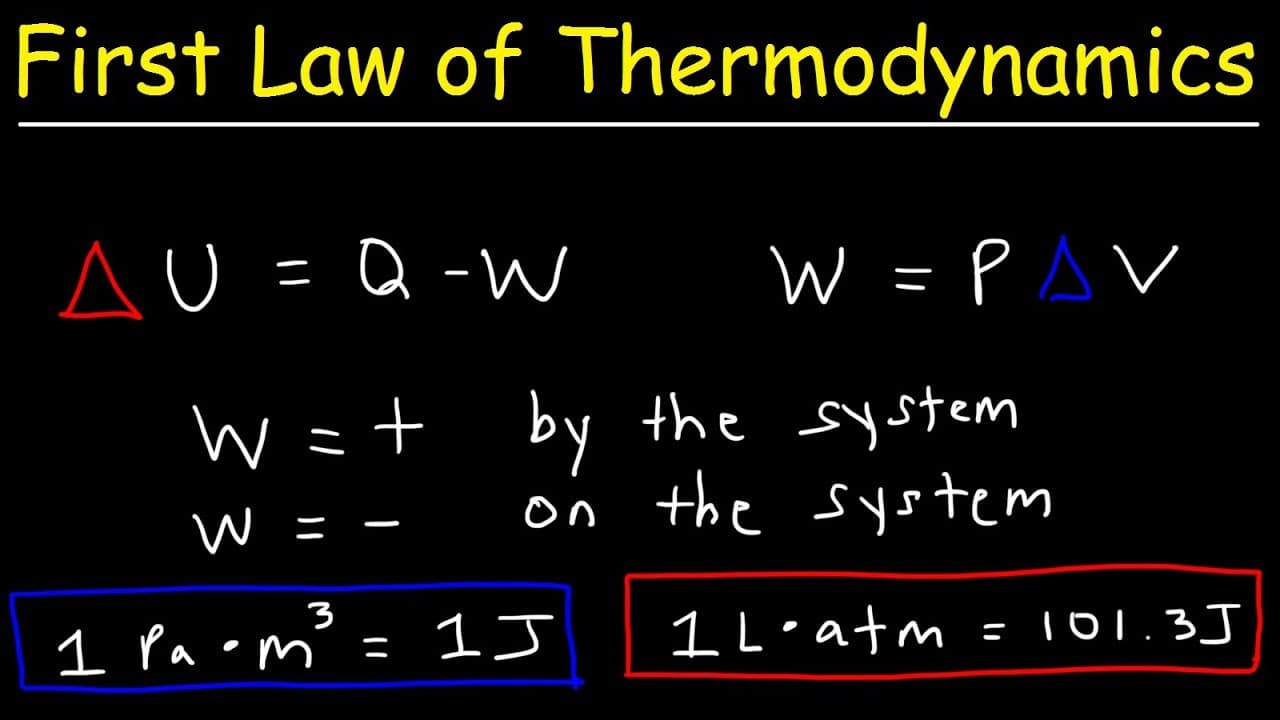
The First Law of Thermodynamics states that the change in internal energy of a system equals the heat added to the system minus the work done by the system. For example, if 300 joules of heat energy is added to a system that performs 200 joules of work, the internal energy increases by 100 joules. Proper sign conventions for heat and work differ between physics and chemistry.
Transcript
let's work on this problem calculate the change in the eternal energy of a system if 300 joules of heat energy is added to it and if the system performs 200 joules of work now to get the answer we need to use this formula delta u which represents the change in the internal energy of the system is equal to q which represents the heat energy flowing ... Read More
Key Insights
- 🎭 The change in internal energy of a system can be calculated by subtracting the work performed from the heat energy added to the system.
- 🥵 Sign conventions for heat energy and work differ between physics and chemistry.
- 💦 The formula to calculate work depends on constant pressure and the change in volume.
- 💦 Positive work in physics indicates work performed by the system, while negative work suggests work done on the system.
- 🎭 Heat energy can be added to or removed from a system, while work can be performed on or by the system.
- 💦 Units for work should match with joules, so conversions may be necessary.
- 💱 The change in internal energy of a system can be positive or negative, indicating an increase or decrease, respectively.
Install to Summarize YouTube Videos and Get Transcripts
Explore YouTube Video Summarizer or Get YouTube Transcript Extractor
Questions & Answers
Q: What is the formula to calculate the change in internal energy of a system in thermodynamics?
The formula is delta u = q - w, where delta u represents the change in internal energy, q represents the heat energy, and w represents the work performed by the system.
Q: How does the sign convention for heat energy differ in physics and chemistry?
In physics, a positive q indicates added heat energy to the system, while in chemistry, a positive q represents heat energy removed from the system.
Q: If 200 joules of work is done by the system, what does it indicate in physics?
In physics, a positive work indicates that the system has performed work, while a negative work would suggest work done on the system.
Q: How can you calculate the work performed by a gas if the pressure is constant?
The formula to calculate work is work = pressure (p) * change in volume (delta v).
Summary & Key Takeaways
-
The content discusses the formula to calculate the change in internal energy of a system using heat energy and work.
-
It explains the sign conventions for heat energy and work in physics and chemistry.
-
Three problem scenarios are presented and solved, demonstrating how to calculate the change in internal energy and the work performed on or by the system.
Read in Other Languages (beta)
Share This Summary 📚
Summarize YouTube Videos and Get Video Transcripts with 1-Click
Try YouTube Summary with ChatGPT & Claude or YouTube Transcript Generator
Explore More Summaries from The Organic Chemistry Tutor 📚



Summarize YouTube Videos and Get Video Transcripts with 1-Click
Try YouTube Summary with ChatGPT & Claude or YouTube Transcript Generator