How to Solve Geometry Problems: Area and Volume Tricks
TL;DR
To solve geometry problems involving area and volume, use formulas like length times width for rectangles and πr² for circles. For cylindrical volumes, apply πr²h, where r is the radius and h is the height, then divide by the volume of each individual measure, such as cups, to find quantities. Mastering these concepts aids in efficiently tackling various geometry challenges.
Transcript
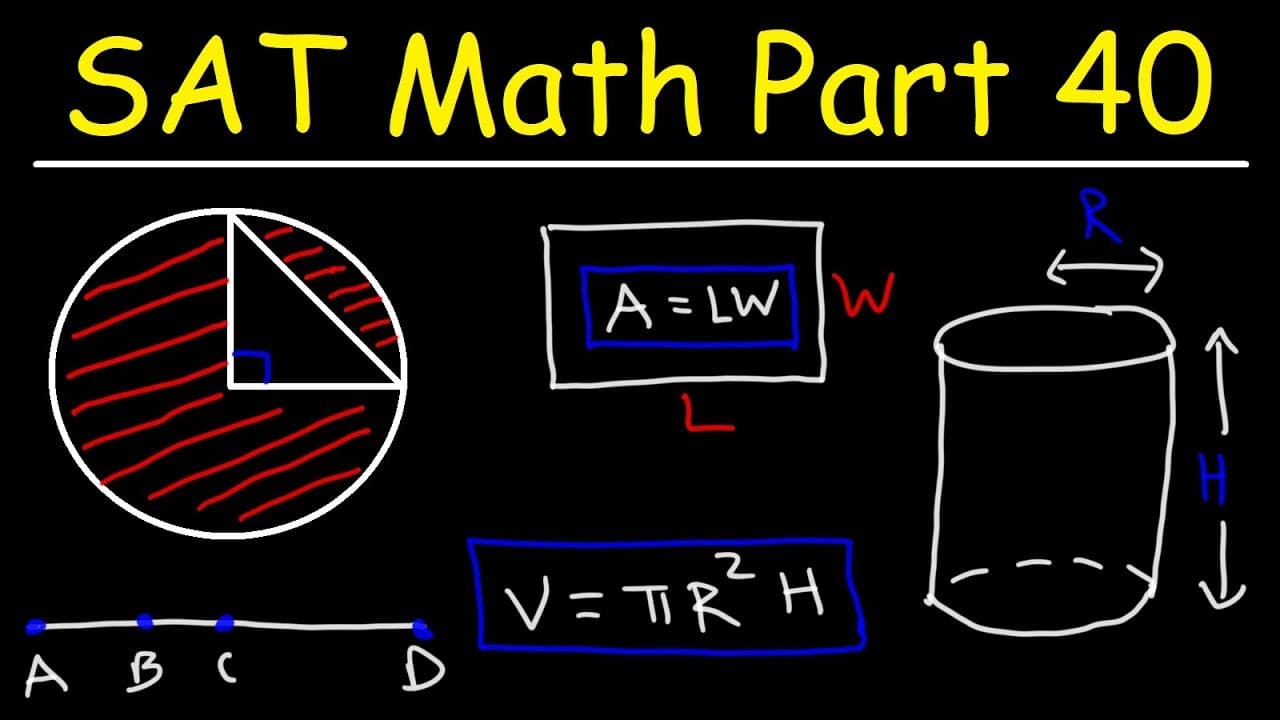
number 140 the left of a rectangle is 7 more than its width if the area of the rectangle is 120 what is the perimeter let's begin with a picture let's draw a rectangle so here's the left and here's the width of the rectangle the area of a rectangle is left times width and the area is 120. now we're told that the left of the rectangle is 7 more than... Read More
Key Insights
- ✖️ The area of a rectangle can be determined by multiplying the length and width.
- 🤨 The area of a circle can be found by using the formula pi times the radius squared.
- ❓ The length of a segment can be determined by using the midpoint property and an equation involving percent increase.
- ⌛ The volume of a cylindrical tank can be calculated using the formula pi times the radius squared times the height.
- 🍳 Math problems involving various geometric shapes can be solved by breaking them down into smaller, more manageable steps.
- ❓ Understanding geometric formulas and properties is essential for solving geometry problems.
- 🔇 Paying attention to units of measurement is crucial when calculating volumes or areas.
Install to Summarize YouTube Videos and Get Transcripts
Explore YouTube Video Summarizer or Get YouTube Transcript Extractor
Questions & Answers
Q: How is the perimeter of a rectangle calculated if the area is known?
The perimeter of a rectangle can be calculated by finding the length and width of the rectangle using the given area, and then using the formula 2(length + width) to find the perimeter.
Q: How is the area of a shaded region in a circle found?
To find the area of a shaded region in a circle, subtract the area of a triangle from the area of the circle. The base and height of the triangle can be replaced by the radius of the circle, and then the formula for circle area can be used.
Q: How can the length of a segment be determined when the midpoint and percent increase are given?
By using the midpoint property, it can be established that the left of segment ad is equal to the length of segment cd. Then, by setting up an equation with the given percent increase, the value of the desired length can be found.
Q: How do you calculate the number of cups that can be filled from a cylindrical tank?
Calculate the volume of the cylindrical tank using the given measurements (height and diameter), and then divide it by the volume of each cup. The result will give the number of cups that can be filled.
Summary & Key Takeaways
-
The content begins by solving a problem involving the area and perimeter of a rectangle, using the given area to find the perimeter.
-
The second problem focuses on finding the area of a shaded region in a circle, using the circumference to calculate the radius and then applying the formula for circle area.
-
The third problem deals with the length of a segment in a figure, using a midpoint and percent increase to find the desired length.
-
The final problem involves calculating the number of cups that can be filled from a cylindrical tank, using the volume of the tank and the volume of each cup.
Read in Other Languages (beta)
Share This Summary 📚
Summarize YouTube Videos and Get Video Transcripts with 1-Click
Try YouTube Summary with ChatGPT & Claude or YouTube Transcript Generator
Explore More Summaries from The Organic Chemistry Tutor 📚




Summarize YouTube Videos and Get Video Transcripts with 1-Click
Try YouTube Summary with ChatGPT & Claude or YouTube Transcript Generator