What Is the Malonic Ester Synthesis Reaction Mechanism?
TL;DR
The malonic ester synthesis reaction is a method for producing substituted carboxylic acids by deprotonating diethyl malonate, reacting it with alkyl halides, and then acidifying the solution to convert esters into carboxylic acids. Decarboxylation occurs upon heating, allowing the formation of diverse carboxylic acids by varying the alkyl halides.
Transcript
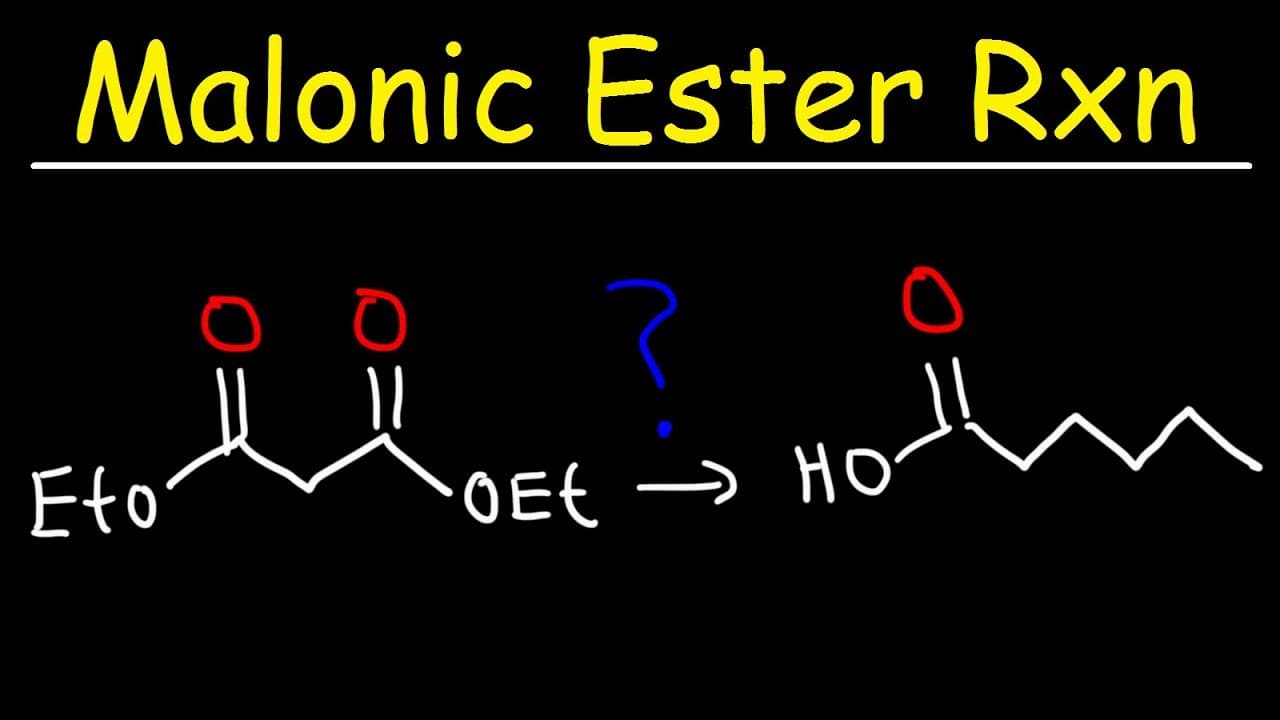
in this video we're going to talk about the malonic ester synthesis reaction and so we're going to start with diethyl malonate which looks like this and this process is very useful for making carboxylic acids so there's two acidic alpha hydrogen atoms on this carbon the first step is to use a strong base like ethoxide to remove one of those two aci... Read More
Key Insights
- 👥 The malonic ester synthesis reaction is a useful method for creating carboxylic acids with substituted groups.
- ❓ The reaction involves deprotonation, alkylation, acidification, and decarboxylation steps.
- 👥 The ester functional groups are converted into carboxylic acids through acidification.
- 👥 By varying the alkyl halides used in the reaction, different substituted groups can be added to the carboxylic acid molecule.
- 🥵 Decarboxylation occurs when the solution is heated, resulting in the loss of one carboxylic acid group.
- ⛓️ The reaction can be used to create carboxylic acids with different carbon chain lengths.
- 🇪🇭 Mechanisms can be used to illustrate the step-by-step process of the malonic ester synthesis reaction.
Install to Summarize YouTube Videos and Get Transcripts
Explore YouTube Video Summarizer or Get YouTube Transcript Extractor
Questions & Answers
Q: What is the first step in the malonic ester synthesis reaction?
The first step involves using a strong base, like ethoxide, to remove one of the two acidic hydrogen atoms from the alpha carbon of diethyl malonate.
Q: How do you convert the ester functional groups into carboxylic acids?
The ester functional groups are converted into carboxylic acids by acidifying the solution using either water plus hydrochloric acid or a mixture of water and hydrochloric acid.
Q: What occurs during decarboxylation in the malonic ester synthesis reaction?
Decarboxylation occurs when the solution is heated, resulting in the loss of one of the two carboxylic acid functional groups and the formation of substituted carboxylic acid molecules.
Q: How can the malonic ester synthesis reaction be used to make carboxylic acids with substituted groups?
By adding different alkyl halides in the reaction, one can introduce one or two substituted groups on the alpha carbon of the carboxylic acid molecule.
Summary & Key Takeaways
-
Malonic ester synthesis reaction involves starting with diethyl malonate, which has two acidic alpha hydrogen atoms on a carbon atom.
-
The reaction proceeds by removing one acidic hydrogen atom and reacting the resulting negative charge with an alkyl halide.
-
Acidifying the solution converts both ester functional groups into carboxylic acid, and heating the solution leads to decarboxylation, resulting in the formation of substituted carboxylic acid molecules.
Read in Other Languages (beta)
Share This Summary 📚
Summarize YouTube Videos and Get Video Transcripts with 1-Click
Try YouTube Summary with ChatGPT & Claude or YouTube Transcript Generator
Explore More Summaries from The Organic Chemistry Tutor 📚




Summarize YouTube Videos and Get Video Transcripts with 1-Click
Try YouTube Summary with ChatGPT & Claude or YouTube Transcript Generator