What Are FLAC and MIDI Formats for Digital Music?
TL;DR
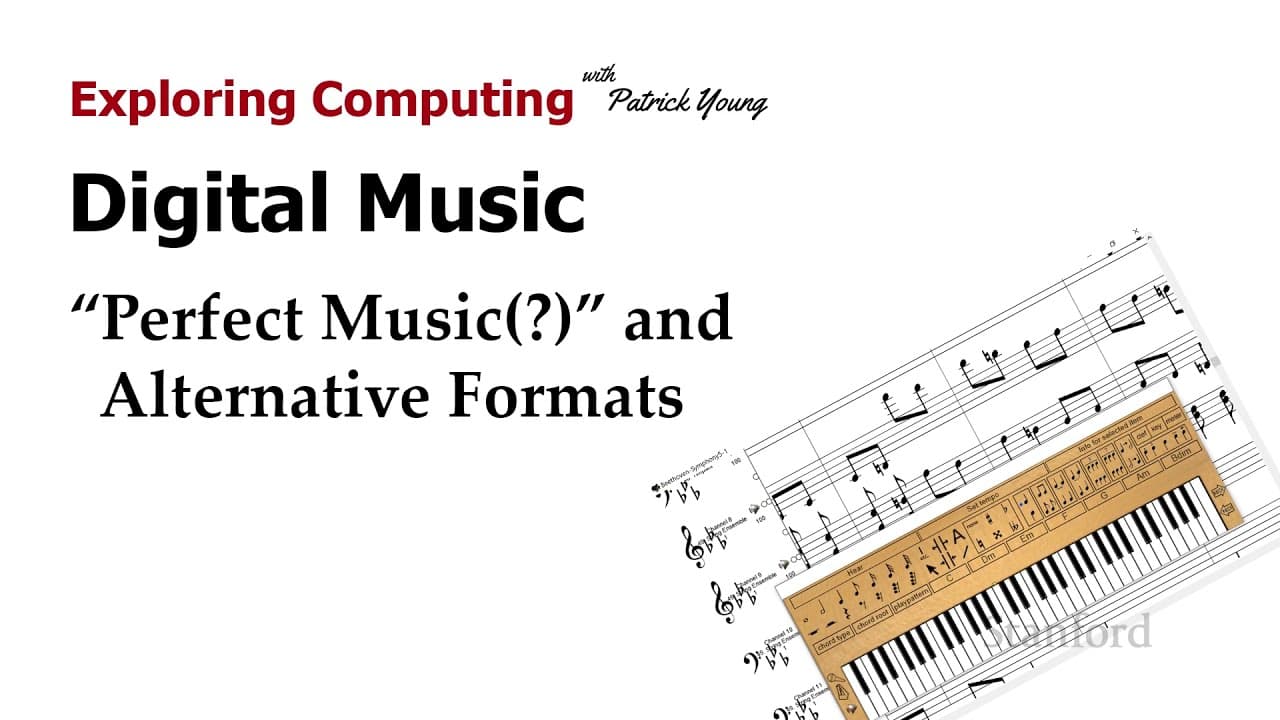
FLAC is a lossless audio format that preserves the original quality of CDs while offering better sound than MP3s, though it takes up more space. MIDI files, on the other hand, store individual musical notes, allowing for greater flexibility in editing and manipulation, making them a favorite among composers.
Transcript
welcome to exploring computing today's video is digital music part 5 perfect music and alternative format so in this video we're going to take a look at some alternative ways of storing your music we've seen that mp3 files and its related cousins like aac and wma lose information is there a way we can store our music and have better sounding files ... Read More
Key Insights
- 💁 FLAC is a lossless audio format that retains the original CD audio quality, making it a preferred choice for digital music storage.
- 📁 FLAC files offer better sound quality compared to MP3 files, but they take up more space.
- 🏪 MIDI files store individual notes and provide greater flexibility for manipulation and editing, benefiting composers and musicians.
- 📁 MIDI files are significantly smaller in size compared to sound files, making them ideal for conserving storage space.
- 👾 The choice between FLAC, MP3, and MIDI depends on the desired sound quality, storage space, and the need for music manipulation.
- 👾 FLAC files are recommended for most digital recordings available today due to their optimal balance of sound quality and space efficiency.
- 📁 Dogs listening to music may benefit from FLAC files, as they preserve high tones that can be lost in MP3 files.
Install to Summarize YouTube Videos and Get Transcripts
Explore YouTube Video Summarizer or Get YouTube Transcript Extractor
Questions & Answers
Q: What is FLAC and how does it differ from MP3?
FLAC (Free Lossless Audio Codec) is a file format that compresses music without losing any quality. Unlike MP3, which sacrifices some sound information, FLAC retains the original CD audio quality.
Q: How does the size of a FLAC file compare to an MP3 file?
FLAC files are larger in size compared to MP3 files but still smaller than CD audio files. The difference in size indicates the amount of compression and the level of sound quality retained.
Q: What are the advantages of using MIDI files for storing music?
MIDI files store individual notes instead of sound waves, allowing composers and musicians to manipulate and edit the music more flexibly. MIDI files also take up significantly less space than sound files.
Q: Can MIDI files produce the same sound quality as CD audio or FLAC?
MIDI files do not directly produce sound but instead provide instructions for synthesizers or computer software to generate music. While they may not have the same audio fidelity as CD audio or FLAC, they offer greater versatility for composers and musicians.
Summary & Key Takeaways
-
FLAC (Free Lossless Audio Codec) is a popular format for storing music that does not lose any information during compression, resulting in high-quality sound comparable to the original CD.
-
FLAC files take up more space than MP3 files but are still smaller than CD audio files.
-
MIDI (Musical Instrument Digital Interface) files store individual notes instead of sound waves, making them ideal for composers and musicians, as they offer greater flexibility in manipulating and editing music.
Read in Other Languages (beta)
Share This Summary 📚
Summarize YouTube Videos and Get Video Transcripts with 1-Click
Try YouTube Summary with ChatGPT & Claude or YouTube Transcript Generator
Explore More Summaries from Stanford Online 📚



Summarize YouTube Videos and Get Video Transcripts with 1-Click
Try YouTube Summary with ChatGPT & Claude or YouTube Transcript Generator