What Are Integrated Rate Laws for Chemical Reactions?
TL;DR
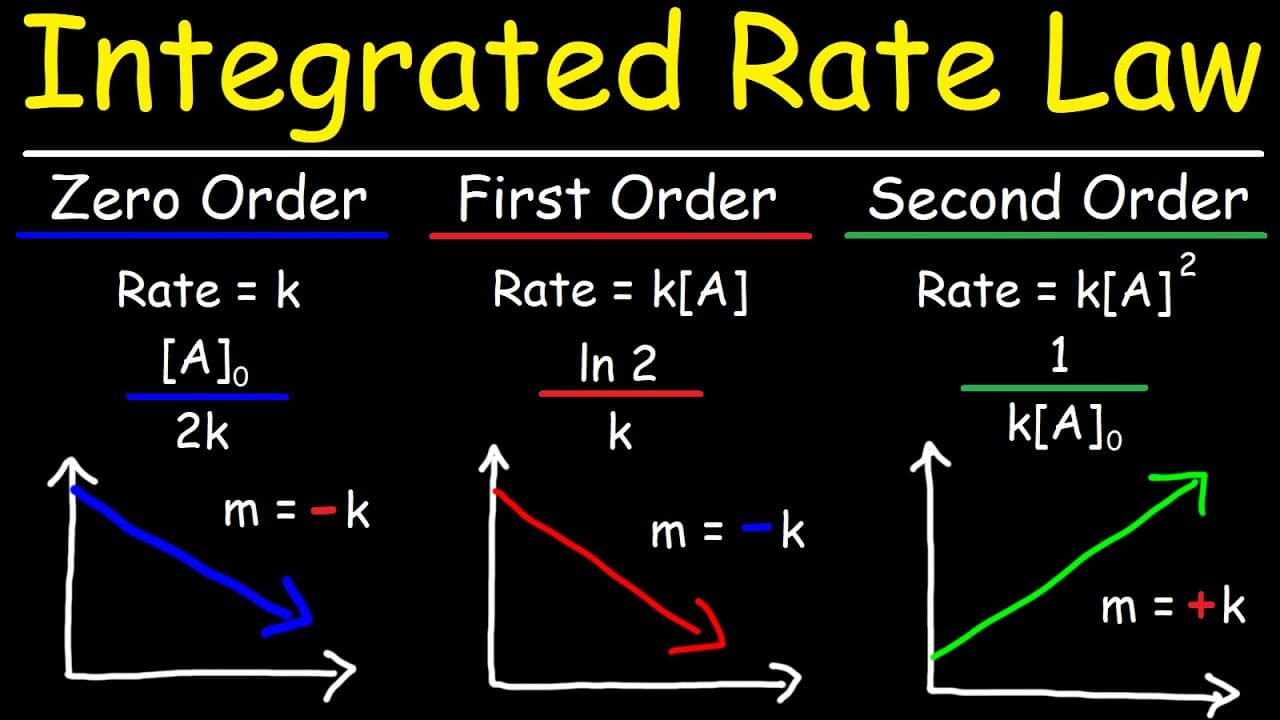
Integrated rate laws describe how the concentration of reactants changes over time for zero, first, and second-order reactions. The rate constant (k) varies with the reaction order, affecting how concentration changes and the half-life of reactants. Zero-order reactions show no concentration dependence, first-order reactions are linearly dependent on concentration, and second-order reactions depend on the square of the concentration.
Transcript
in this video we're going to talk about how to solve integrated rate law problems so if you have a pen and a sheet of paper with you feel free to use them to take down some notes which is going to be useful later on as we work on some problems in this video so let's begin our discussion with the rate law expression for each of these ordered reactio... Read More
Key Insights
- 🪈 The order of a reaction determines how the rate depends on the concentration of the reactant, with zero-order reactions having no dependence, first-order reactions having a linear dependence, and second-order reactions having a squared dependence.
- ☠️ The units of the rate constant (k) vary based on the order of the reaction, with more negative exponents as the order increases.
- ☠️ The half-life of a reaction is the time it takes for the concentration of a reactant to decrease by half of its original amount and depends on the rate constant (k) for first and second-order reactions but not for zero-order reactions.
- 🪈 The integrated rate law equations, such as for zero-order, first-order, and second-order reactions, allow us to determine the concentration changes over time and calculate the initial concentration of a reactant.
- ☠️ Graphs of concentration versus time for different order reactions can be used to determine the order of the reaction and the rate constant (k), as well as the relationship between the initial concentration and the half-life.
Install to Summarize YouTube Videos and Get Transcripts
Explore YouTube Video Summarizer or Get YouTube Transcript Extractor
Questions & Answers
Q: What is the relationship between the rate of a reaction and the concentration of the reactant in a zero-order reaction?
In a zero-order reaction, the rate of the reaction does not depend on the concentration of the reactant. Doubling or tripling the concentration of the reactant will have no effect on the rate.
Q: How do the units of the rate constant (k) change with different orders of the reaction?
For a zero-order reaction, the units of k will be M to the first power times T to the negative one power. For a first-order reaction, the units of k will be T to the negative one power. For a second-order reaction, the units of k will be M to the negative one power times T to the negative one power.
Q: What is the half-life of a first order reaction dependent on?
The half-life of a first-order reaction is independent of the initial concentration of the reactant. It only depends on the rate constant (k).
Q: How can the integrated rate law equations be used to determine the initial concentration of a reactant?
By knowing the rate constant (k), the final concentration, and the time it takes for the reaction to reach that concentration, we can calculate the initial concentration using the integrated rate law equation for the specific order of the reaction.
Summary & Key Takeaways
-
Integrated rate law equations are used to describe the concentration changes over time in different types of reactions, such as zero-order, first-order, and second-order reactions.
-
The rate constant (k) is an important parameter in these equations, representing the rate at which the reactants are consumed and the products are formed.
-
The units of the rate constant vary depending on the order of the reaction, with higher orders resulting in units with more negative exponents.
Read in Other Languages (beta)
Share This Summary 📚
Summarize YouTube Videos and Get Video Transcripts with 1-Click
Try YouTube Summary with ChatGPT & Claude or YouTube Transcript Generator
Explore More Summaries from The Organic Chemistry Tutor 📚




Summarize YouTube Videos and Get Video Transcripts with 1-Click
Try YouTube Summary with ChatGPT & Claude or YouTube Transcript Generator