How to Solve for Displacement in Horizontal Motion
TL;DR
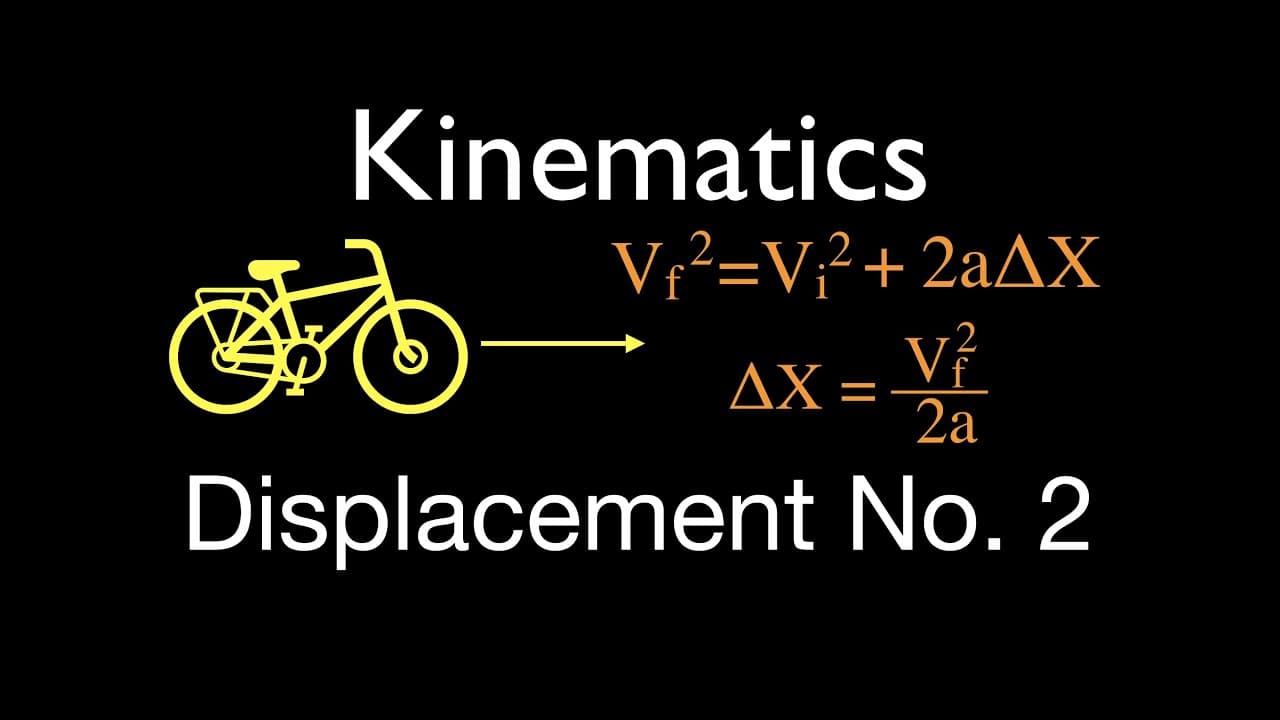
To solve for displacement in one-dimensional horizontal motion, use the kinematic equation that relates initial velocity, final velocity, acceleration, and distance. For a passenger airplane accelerating at 3.35 m/s² to reach a takeoff speed of 83 m/s, the minimum runway length required is 1,280 meters, calculated by rearranging the equation to Delta X = (VF²) / (2a).
Transcript
okay in today's video I am going to go over one example where we use the kinematic equations to solve from onedimensional horizontal motion and in this video the example we're going to go over is we're going to be solving for the displacement or the distance that object travels or the change in position and this is the problem we're going to work o... Read More
Key Insights
- 🚥 Kinematic equations are useful in solving for various unknowns in one-dimensional horizontal motion.
- ❓ Solving for displacement requires knowing three out of the four variables in the kinematic equation.
- ❓ Rearranging the equation for the desired variable simplifies the problem-solving process.
- 💁 Understanding the given information and selecting the appropriate equation is crucial for accurate results.
- ✈️ The example of finding the minimum runway length for an airplane illustrates the practical application of kinematic equations.
- ❓ By following a step-by-step approach and utilizing the correct equation, solving for displacement becomes straightforward.
- 🇦🇪 Thorough understanding of the units involved and ensuring proper units are used is important for the final answer.
Install to Summarize YouTube Videos and Get Transcripts
Explore YouTube Video Summarizer or Get YouTube Transcript Extractor
Questions & Answers
Q: What are the five variables involved in kinematic equations?
The five variables are initial velocity (VI), final velocity (VF), change in position or displacement (Delta X), acceleration (a), and time.
Q: Can the kinematic equation with Delta X be used if the time is unknown?
No, the equation with Delta X cannot be used if the time is unknown because it requires all four variables to be known.
Q: How is the equation rearranged to solve for Delta X?
The equation is rearranged by isolating Delta X on one side. In this case, since the initial velocity (VI) is zero, the equation simplifies to Delta X = VF^2 / (2a).
Q: How is the distance calculated in the example problem?
By plugging in the given values (VF = 83 m/s, a = 3.35 m/s^2) into the equation Delta X = VF^2 / (2a), the distance is calculated to be 1,280 m.
Summary & Key Takeaways
-
This video explains how to solve for the displacement or change in position of an object in one-dimensional horizontal motion using kinematic equations.
-
The example problem involves finding the minimum length of the runway needed for a passenger airplane to reach its takeoff speed.
-
The key steps include writing down all five variables, choosing the correct kinematic equation, rearranging the equation for the variable being solved for, and plugging in the given values to find the answer.
Read in Other Languages (beta)
Share This Summary 📚
Summarize YouTube Videos and Get Video Transcripts with 1-Click
Try YouTube Summary with ChatGPT & Claude or YouTube Transcript Generator
Explore More Summaries from Step by Step Science 📚

Summarize YouTube Videos and Get Video Transcripts with 1-Click
Try YouTube Summary with ChatGPT & Claude or YouTube Transcript Generator