How to Enhance Work Processes with Design Thinking
TL;DR
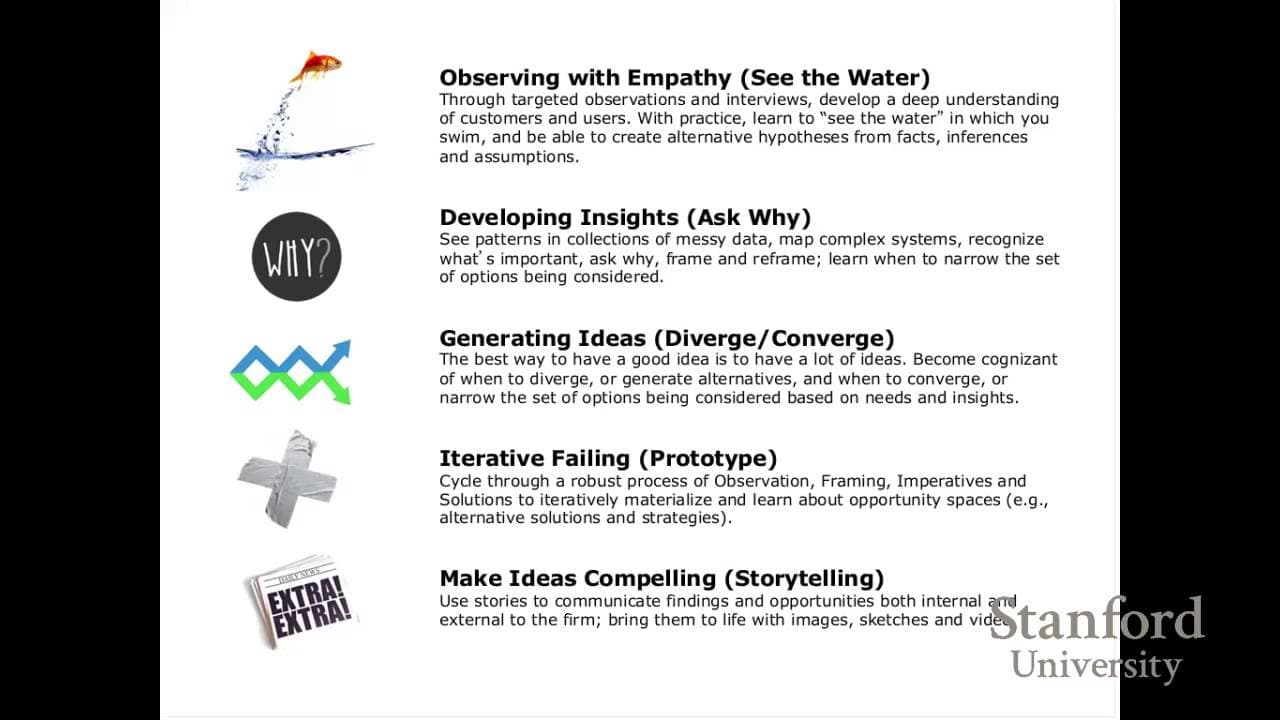
Design Thinking enhances innovation by encouraging empathy, creativity, and collaboration across disciplines. It involves reframing problems, observing with empathy, and iterating solutions. This approach is not limited to designers but applies broadly to various fields, improving work processes by fostering a deeper understanding of user needs and innovative problem-solving.
Transcript
great thank you ryan appreciate it and it's my pleasure today that we have michael berry with us i'm michael is the consultant professor at stanford d school for the design school and uh today's format is maybe a little different from what some of you who attend these sessions may be used to michael and i are going to have a conversation about desi... Read More
Key Insights
- Design Thinking is a method to foster innovation by increasing the likelihood of developing compelling solutions.
- It involves empathy-driven observation, allowing a deeper understanding of users' needs and behaviors.
- Reframing problems is essential to uncovering more solutions and addressing the right issues.
- The iterative process of prototyping and testing is crucial for refining ideas and ensuring solutions meet real-world needs.
- Storytelling is a powerful tool within Design Thinking, aiding in both data collection and the communication of ideas.
- Design Thinking encourages divergent thinking to explore many potential solutions before converging on the best one.
- Collaboration across diverse disciplines enhances the creative process, leveraging different perspectives for better outcomes.
- Design Thinking is applicable beyond product design, benefiting any field where innovation and creativity are needed.
Install to Summarize YouTube Videos and Get Transcripts
Explore YouTube Video Summarizer or Get YouTube Transcript Extractor
Questions & Answers
Q: How does Design Thinking enhance innovation?
Design Thinking enhances innovation by fostering a culture of empathy, creativity, and collaboration. It encourages teams to observe users with empathy, ask probing questions to uncover deeper insights, and iterate solutions through prototyping and testing. This approach helps in reframing problems to explore a broader range of solutions, ultimately leading to more innovative and effective outcomes.
Q: What is the role of empathy in Design Thinking?
Empathy plays a critical role in Design Thinking by allowing teams to deeply understand users' needs, behaviors, and challenges. By observing with empathy, designers and teams can uncover insights that might not be immediately apparent, leading to solutions that are more aligned with real-world needs and preferences. This understanding is foundational to creating meaningful and impactful innovations.
Q: Why is reframing problems important in Design Thinking?
Reframing problems is crucial in Design Thinking because it allows teams to explore different perspectives and uncover more potential solutions. By asking 'why' and challenging initial assumptions, teams can identify the core issues that need addressing, rather than just the symptoms. This process broadens the solution space and increases the chances of finding innovative and effective solutions.
Q: How does storytelling contribute to Design Thinking?
Storytelling is a vital component of Design Thinking as it helps in both understanding and communicating complex ideas. During the data collection phase, stories can reveal deep insights into user experiences and needs. In the later stages, crafting a compelling narrative around a solution helps in gaining buy-in from stakeholders and ensuring the solution is effectively implemented and adopted.
Q: What is the significance of iterative prototyping in Design Thinking?
Iterative prototyping is significant in Design Thinking because it allows teams to test and refine their ideas in real-world contexts. By creating low-resolution prototypes and gathering feedback, teams can identify and address potential issues early in the process. This iterative cycle of testing and refinement ensures that the final solution is both innovative and practical, meeting users' needs effectively.
Q: How does Design Thinking apply to fields beyond product design?
Design Thinking applies to fields beyond product design by offering a framework for innovation that can be adapted to any discipline. Its emphasis on empathy, creativity, and collaboration makes it suitable for addressing complex challenges in areas such as education, healthcare, business processes, and more. By fostering a deeper understanding of user needs and encouraging creative problem-solving, Design Thinking can enhance work processes across various sectors.
Q: What are 'wicked problems' and how does Design Thinking address them?
'Wicked problems' are complex challenges with no clear solution, often involving multiple interconnected elements. Design Thinking addresses these problems by promoting a holistic approach that considers the entire ecosystem. Through empathy-driven observation, reframing, and iterative prototyping, teams can explore creative solutions that address the multifaceted nature of wicked problems, leading to more comprehensive and effective outcomes.
Q: How can organizations overcome resistance to adopting Design Thinking?
Organizations can overcome resistance to adopting Design Thinking by demonstrating its value through small-scale projects and real-world applications. Encouraging teams to experiment with Design Thinking tools and techniques can build credibility and showcase its effectiveness in enhancing innovation and problem-solving. Leadership support and creating an environment that fosters collaboration and creativity are also essential for successful adoption.
Summary & Key Takeaways
-
Design Thinking enhances work processes by fostering innovation through empathy, creativity, and interdisciplinary collaboration. It involves observing with empathy, reframing problems, and iterating solutions to meet real-world needs effectively. This approach is not limited to designers but applies to various fields, improving work processes by fostering a deeper understanding of user needs and innovative problem-solving.
-
The process of Design Thinking includes observing with empathy, asking 'why' to uncover deeper insights, and utilizing storytelling to communicate complex ideas effectively. It emphasizes the importance of divergent thinking to explore multiple solutions and encourages iterative prototyping to refine ideas based on real-world feedback, ensuring solutions are both innovative and practical.
-
Design Thinking's power lies in its ability to reframe problems, leading to more effective solutions across diverse fields. By emphasizing collaboration and creativity, it helps teams address complex, 'wicked' problems that require holistic solutions. This approach not only improves work processes but also enhances the quality and impact of the solutions developed.
Read in Other Languages (beta)
Share This Summary 📚
Summarize YouTube Videos and Get Video Transcripts with 1-Click
Try YouTube Summary with ChatGPT & Claude or YouTube Transcript Generator
Explore More Summaries from Stanford Online 📚






Summarize YouTube Videos and Get Video Transcripts with 1-Click
Try YouTube Summary with ChatGPT & Claude or YouTube Transcript Generator