How does welding harden steel and build skyscrapers
TL;DR
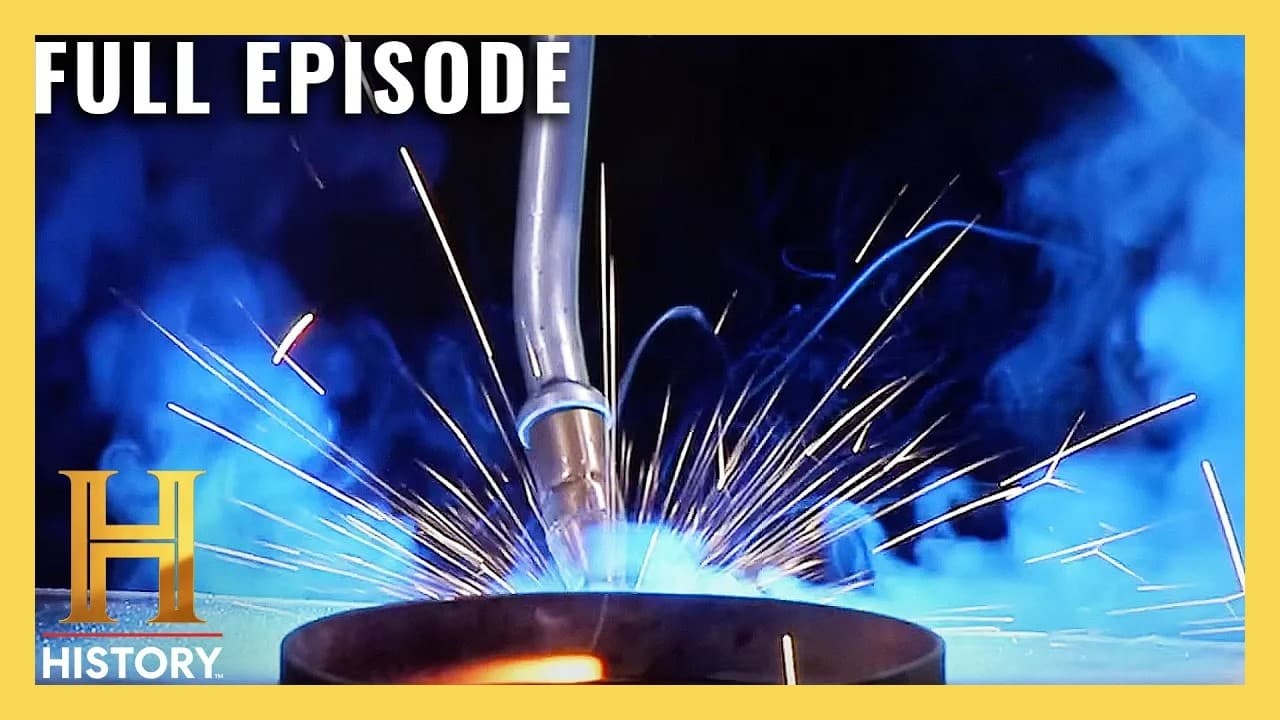
Welding uses heat to fuse metal pieces, creating a bond stronger than the base metal and enabling vast structures to rise. From arc welding origins to underwater and robotic welding, the technique evolved with shielding gases, flux, and continuous beams, transforming construction and manufacturing.
Transcript
NARRATOR: It arcs, explodes and blisters steel. It's used to make 50% of all products, and it puts the power to build a skyscraper in a man's hands. By friction or robot, even under water, these are the tools that the world can't live without. Now Welding on "Modern Marvels." Las Vegas, Nevada. Perhaps nowhere else in the world does the old come do... Read More
Key Insights
- Welding joins two pieces by melting them at the seam to create a strong bond that can be stronger than the materials themselves.
- The arc welding process relies on shielding gases, maintained by a coating on the electrode, to protect the molten metal from the atmosphere.
- Forge welding was the precursor to electric arc welding, using hammering to join heated metals without melting them.
- Electric arc welding uses an electrode and a ground to complete an electrical circuit and create the arc heat.
- Shielding gas and slag protection are essential to prevent holes and weaknesses in the weld bead.
- Riveting limited architectural design and strength, leading to the adoption of continuous welded beams in buildings.
- Lincoln Electric played a pivotal role in proving welding viability in major construction projects.
- Modern welding employs flux core wire and robotic systems to increase efficiency and allow complex shapes.
- More videos from this channel:
- More from this channel: HISTORY
Install to Summarize YouTube Videos and Get Transcripts
Explore YouTube Video Summarizer or Get YouTube Transcript Extractor
Questions & Answers
Q: How does welding create a bond stronger than the base metal?
Welding creates a bond by melting the seam and forming a single molecular bond between the two pieces. When the molten metal cools, the atoms share electrons and solidify as one piece, often resulting in a bond that tears before the weld does, making the joint stronger than the original materials.
Q: What is the basic principle behind electric arc welding?
Electric arc welding uses a current to jump the gap between an electrode and the work metal, forming an arc that generates heat sufficient to melt the metals. The arc heat, typically between 6,000 and 8,000 degrees Fahrenheit, melts the metal and creates a weld bead protected by shielding gases.
Q: Why was there skepticism about welding in construction historically?
Welding faced skepticism because it was new and less understood than rivets, which were familiar and deeply integrated into construction practices. Over time, welding demonstrated advantages like continuous beams and greater design freedom, leading to widespread adoption in major buildings.
Q: What role did shielding gases play in arc welding?
Shielding gases protect the molten weld from air during cooling. The electrode coating evolves to release gases and slag that shield the puddle, while elements from the coating also alloy into the deposit to improve strength, preventing porosity and weak areas.
Q: How did the transition from rivets to welding impact skyscraper design?
The shift to welding allowed continuous beams to span longer distances and be shaped more freely, enabling curved and unique angles in tall buildings. This removed many limits of riveted construction and increased load-bearing efficiency across large structures.
Q: What advancements have modern welding used to improve efficiency in manufacturing?
Modern welding employs flux core welding with wire on a roll, replacing traditional sticks, and uses robotic systems to perform repetitive, precise welds. These innovations reduce manual labor, improve consistency, and enable high-volume production in automotive and other industries.
Q: How does underwater welding extend welding applications?
Underwater welding enables repair and construction in submerged environments, expanding the scope of welding beyond land-based projects. It requires specialized training and equipment to manage high currents, water cooling, and safety risks while ensuring a durable weld under pressure.
Q: What is explosion welding and why is it used?
Explosion welding uses a controlled explosive to force two metal surfaces together at high velocity, creating a strong metallurgical bond. This method allows joining dissimilar metals and fabricating large, robust joints that are difficult with conventional welding, expanding material combinations for specialized applications.
Summary & Key Takeaways
-
Welding connects metal by melting the seam and fusing atoms, producing bonds that can exceed the strength of the base metals and often require protective shielding to prevent air from causing weak or brittle joints.
-
The History Channel episode traces arc welding from forge welding to modern electric arc welding, highlighting the shift from rivets to continuous welded beams and the impact on skyscraper design.
-
The episode also covers advanced welding methods like flux core, explosion welding, underwater welding, robotics in auto manufacturing, and plastic welding approaches, showing a broad view of how welding shapes our built world.
Read in Other Languages (beta)
Share This Summary 📚
Summarize YouTube Videos and Get Video Transcripts with 1-Click
Try YouTube Summary with ChatGPT & Claude or YouTube Transcript Generator
Explore More Summaries from HISTORY 📚






Summarize YouTube Videos and Get Video Transcripts with 1-Click
Try YouTube Summary with ChatGPT & Claude or YouTube Transcript Generator