What Are Nucleic Acids and Their Key Differences?
TL;DR
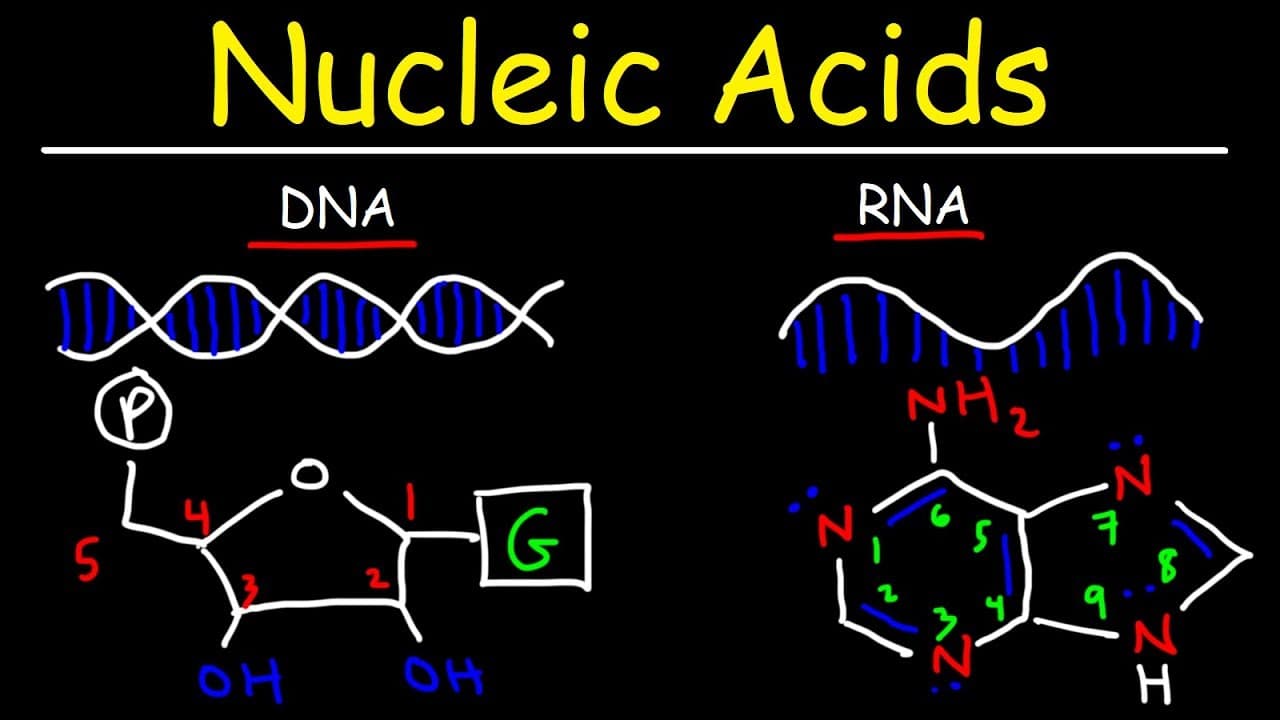
Nucleic acids, DNA and RNA, differ primarily in structure and function. DNA is double-stranded, located in the nucleus, and stores genetic information, while RNA is single-stranded, found outside the nucleus, and plays a role in transferring genetic information and protein synthesis. Both are made up of nucleotides, which contain a sugar, a nitrogenous base, and a phosphate group.
Transcript
one of the topics that are commonly taught in a biochemistry course are nucleic acids now you might be wondering what exactly are nucleic acids and there are two forms of nucleic acids i'm sure you heard of them dna and rna dna stands for deoxyribonucleic acid rna is simply ribonucleic acid but both of these are different types of nucleic acids as ... Read More
Key Insights
- ❓ DNA and RNA are nucleic acids that differ in structure and function.
- 🧬 DNA is double-stranded and mainly found in the nucleus, while RNA is single-stranded and can be found outside the nucleus.
- 💁 DNA stores genetic information and RNA transfers genetic information and synthesizes proteins.
- 👥 Nucleotides are the monomer units that make up DNA and RNA, consisting of a sugar, a nitrogenous base, and a phosphate group.
- 🅰️ RNA consists of different types, including mRNA, tRNA, and rRNA, each with a specific function in protein synthesis.
- 👥 Nucleosides are composed of a sugar and a nitrogenous base, while nucleotides contain an additional phosphate group.
- ❓ The nitrogenous bases in DNA and RNA vary, with DNA containing adenine, guanine, cytosine, and thymine, while RNA replaces thymine with uracil.
- ❓ The nitrogenous bases can be categorized into purines (adenine and guanine) and pyrimidines (cytosine, thymine, and uracil).
- 🧘 The structural differences between nucleosides and nucleotides affect their names, with nucleotides indicating the presence and position of phosphate groups.
Install to Summarize YouTube Videos and Get Transcripts
Explore YouTube Video Summarizer or Get YouTube Transcript Extractor
Questions & Answers
Q: What are the main differences between DNA and RNA?
DNA is double-stranded, while RNA is single-stranded. DNA is mainly located in the nucleus, while RNA can be found outside of the nucleus. DNA stores genetic information, while RNA can transfer genetic information and synthesize proteins.
Q: What are the different types of RNA?
There are three main types of RNA: messenger RNA (mRNA), transfer RNA (tRNA), and ribosomal RNA (rRNA). mRNA carries the genetic information from the DNA to the ribosomes, tRNA helps in the synthesis of proteins, and rRNA forms the structure of ribosomes.
Q: What is the difference between a nucleotide and a nucleoside?
A nucleotide consists of a sugar, a nitrogenous base, and a phosphate group. A nucleoside, on the other hand, consists of only a sugar and a nitrogenous base. Adding a phosphate group to a nucleoside forms a nucleotide.
Q: Can you explain the naming of nucleosides and nucleotides?
Nucleosides are named based on the nitrogenous base they contain. For example, adenine combined with a sugar becomes adenosine. Nucleotides add a phosphate group to a nucleoside, and the name indicates the number and position of the phosphate groups. For example, adenosine with a phosphate group at the 5' position becomes adenosine-5'-monophosphate (AMP).
Summary & Key Takeaways
-
Nucleic acids, specifically DNA and RNA, are commonly taught topics in biochemistry courses.
-
DNA is a double-stranded nucleic acid found mainly in the nucleus of eukaryotes, while RNA is a single-stranded nucleic acid.
-
DNA stores genetic information and functions as the library of the cell, while RNA can transfer genetic information and synthesize proteins.
-
Nucleotides are the monomer units that make up DNA and RNA, consisting of a sugar, a nitrogenous base, and a phosphate group.
Read in Other Languages (beta)
Share This Summary 📚
Summarize YouTube Videos and Get Video Transcripts with 1-Click
Try YouTube Summary with ChatGPT & Claude or YouTube Transcript Generator
Explore More Summaries from The Organic Chemistry Tutor 📚


Summarize YouTube Videos and Get Video Transcripts with 1-Click
Try YouTube Summary with ChatGPT & Claude or YouTube Transcript Generator