Who Is Liable for a Medical Data Breach?
TL;DR
Liability may extend beyond the criminals when weak credential handling, SIM duplication, an authenticated portal vulnerability, and inadequate data protection combine to enable a medical-record breach. The mock court allows the plaintiff’s claim against the blood-testing laboratory to proceed, including a negligence theory that uses HIPAA standards as evidence of the laboratory’s duty rather than asserting a separate HIPAA claim.
Transcript
And h- and how does it work? I just- The green... The big green button. Okay. Press once to see the goals. Right. There we go. Wow, look at this. So I've already told you how to do that. Press this. I've already said, here's the agenda. A light order, summary judgment and argument. There'll be a poll, basically. Then we do fact and expert w- witnes... Read More
Key Insights
- The attack begins with multiple security failures rather than a single technical flaw. A stolen Post-it Note reveals the password and portal location, a business card supplies the doctor’s phone number, and a phone bill helps the criminals impersonate the doctor when contacting the carrier.
- Two-factor authentication is defeated when the carrier duplicates the doctor’s SIM for an impostor. The criminals use the cloned phone with the stolen credentials to enter the laboratory portal, showing how the authentication process depends on both credential security and the carrier’s identity-verification practices.
- The laboratory’s vulnerability is exposed only to authenticated users. Once the criminals pass authentication with the stolen password and cloned phone, they exploit that vulnerability, install ransomware, and encrypt the entire test-results database, disrupting access to information that could be critical for patients.
- The breach causes operational, financial, privacy, and commercial harm. The laboratory pays five hundred thousand dollars in Bitcoin to recover its database, while exfiltrated medical information reveals a corporate leader’s dire condition and contributes to plunging values during major corporate negotiations.
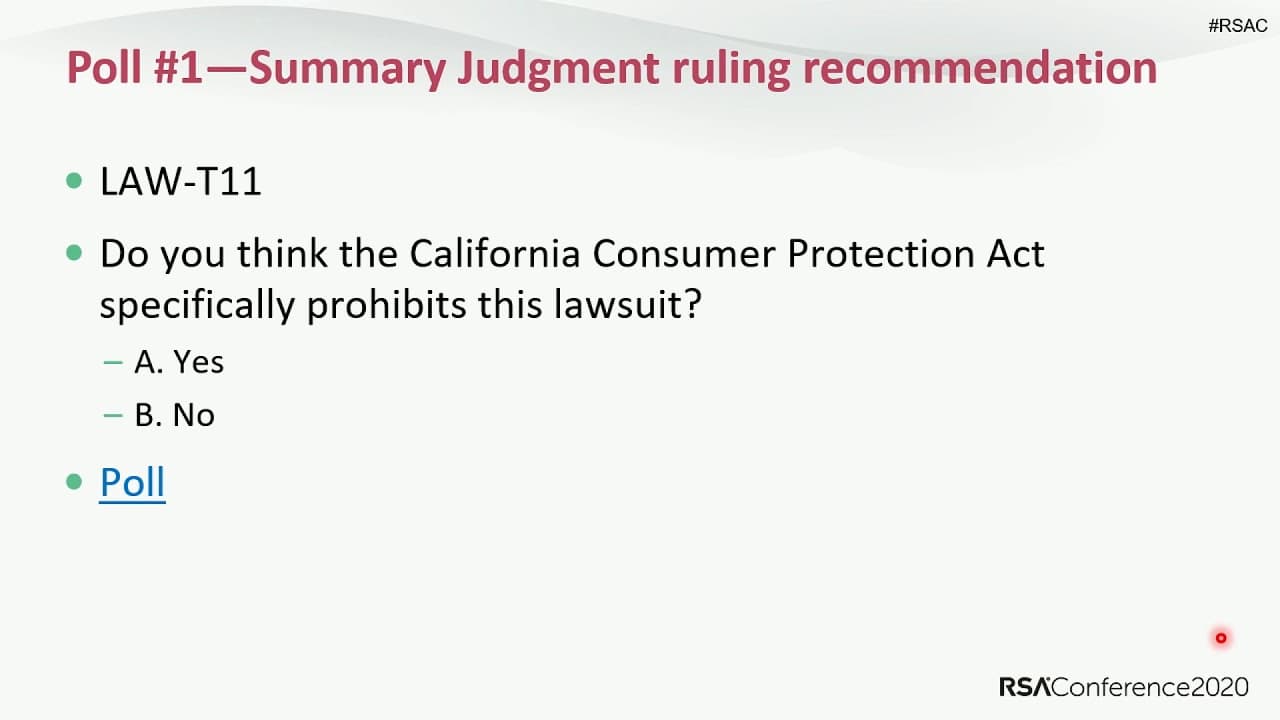
- The CCPA dispute turns on the scope of statutory safe harbors. The defense argues that the laboratory handles protected health information and is governed under HIPAA, while the plaintiff distinguishes protected health information from other personal information collected about the plaintiff.
- HIPAA does not supply the plaintiff’s separate cause of action in the presented argument. Instead, the plaintiff advances a negligence claim and relies on HIPAA standards as evidence of the duty and standard of care that the laboratory allegedly breached.
- The judge allows the claim against the blood-testing laboratory to move forward after hearing the summary-judgment arguments. The ruling does not resolve final liability, because the planned bench trial also includes fact testimony, expert testimony, further legal argument, and judicial commentary.
- The mock trial treats responsibility as potentially distributed among several actors. The scenario includes the criminals, the medical center, the phone carrier, the blood-testing laboratory, the custodial service, and the publication, with cross-claims allowing the parties to assert blame against one another.
Install to Summarize YouTube Videos and Get Transcripts
Explore YouTube Video Summarizer or Get YouTube Transcript Extractor
Questions & Answers
Q: How did the criminals bypass two-factor authentication?
The criminals assembled the information needed for impersonation by stealing a Post-it Note containing the password, portal URL, and instructions, along with the doctor’s business card and a medical center phone bill. After damaging a SIM, one criminal posed as the doctor and convinced the phone carrier to duplicate it. The cloned phone then received the SMS token needed to enter the laboratory portal.
Q: What security failures enabled the medical data breach?
The breach depended on several connected failures. Sensitive login information was kept on a Post-it Note, the doctor’s phone number appeared on business cards, and a medical center phone bill was stolen. The carrier duplicated the doctor’s SIM after an impersonation attempt, and the authenticated laboratory portal contained a vulnerability that allowed the intruders to install ransomware after logging in.
Q: What damage resulted from the laboratory portal intrusion?
The intruders encrypted the entire test-results database, preventing the laboratory from reliably providing blood-test results and creating a risk that patients might not receive critical information. The laboratory paid five hundred thousand dollars in Bitcoin to restore access. The attacker also exfiltrated medical records, sold information to the National Questioner, and exposed a corporate leader’s dire medical condition, after which values plunged.
Q: Why did the laboratory seek summary judgment?
The laboratory argued that the plaintiff lacked standing to pursue a claim under the California Consumer Privacy Act. Its position was that the law contains a safe harbor for certain businesses handling protected health information under HIPAA. Because the dispute arose from medical information in a data breach, the defense maintained that the statutory protection applied and the CCPA claim should be dismissed.
Q: Why did the plaintiff argue that the CCPA claim could proceed?
The plaintiff accepted that the California law contains protections involving HIPAA-covered information, but argued that the statutory language distinguishes protected health information from other patient or personal information. According to the plaintiff, the laboratory collected the plaintiff’s personal information as well as protected health information, and the safe harbor did not cover the full category of information involved in the claimed harm.
Q: How was HIPAA used in the negligence argument?
The plaintiff did not present HIPAA as an independent cause of action. Instead, counsel described the lawsuit as a negligence claim and used HIPAA standards to help establish the duty and standard of care allegedly applicable to the laboratory. Under that theory, HIPAA supplies evidence relevant to whether the laboratory breached a duty, even though the plaintiff did not claim a separate private right of action under HIPAA.
Q: Who could potentially bear responsibility for the breach?
The scenario presents responsibility across a chain of participants. The criminals steal credentials, impersonate the doctor, access the portal, deploy ransomware, and sell medical information. The medical center’s credential practices, the carrier’s SIM-duplication decision, the laboratory’s authenticated-user vulnerability, and the publication’s use of the stolen records all form parts of the dispute. The parties also bring cross-claims against one another.
Q: What did the judge decide about the plaintiff’s claim?
After hearing the competing arguments about California privacy law and HIPAA, the judge declined to end the claim at the summary-judgment stage and allowed it to proceed. That decision was not a final determination that the laboratory was liable. The session was structured as a bench trial with fact and expert testimony, additional legal argument, audience polling, and a later judicial decision and commentary.
Summary & Key Takeaways
-
Criminals steal a doctor’s password, business card, and medical center phone bill. One criminal poses as the doctor and persuades the carrier to duplicate the phone’s SIM. They then use the cloned phone to satisfy two-factor authentication, enter the blood-testing laboratory’s portal, and exploit a vulnerability available to authenticated users.
-
The intrusion produces two separate harms. Ransomware encrypts the laboratory’s test-results database, potentially preventing patients from receiving critical results, and the laboratory pays five hundred thousand dollars in Bitcoin. The attacker also exfiltrates medical records and sells information to the National Questioner, which publishes a corporate leader’s dire medical condition.
-
The legal dispute focuses on whether California’s privacy law permits the plaintiff’s claim and whether HIPAA matters despite lacking a private right of action. The plaintiff argues that statutory protection does not cover all personal information held by the laboratory and invokes HIPAA standards as evidence supporting negligence. The judge lets the claim proceed.
Read in Other Languages (beta)
Share This Summary 📚
Summarize YouTube Videos and Get Video Transcripts with 1-Click
Try YouTube Summary with ChatGPT & Claude or YouTube Transcript Generator
Explore More Summaries from RSAC Cybersecurity 📚




Summarize YouTube Videos and Get Video Transcripts with 1-Click
Try YouTube Summary with ChatGPT & Claude or YouTube Transcript Generator