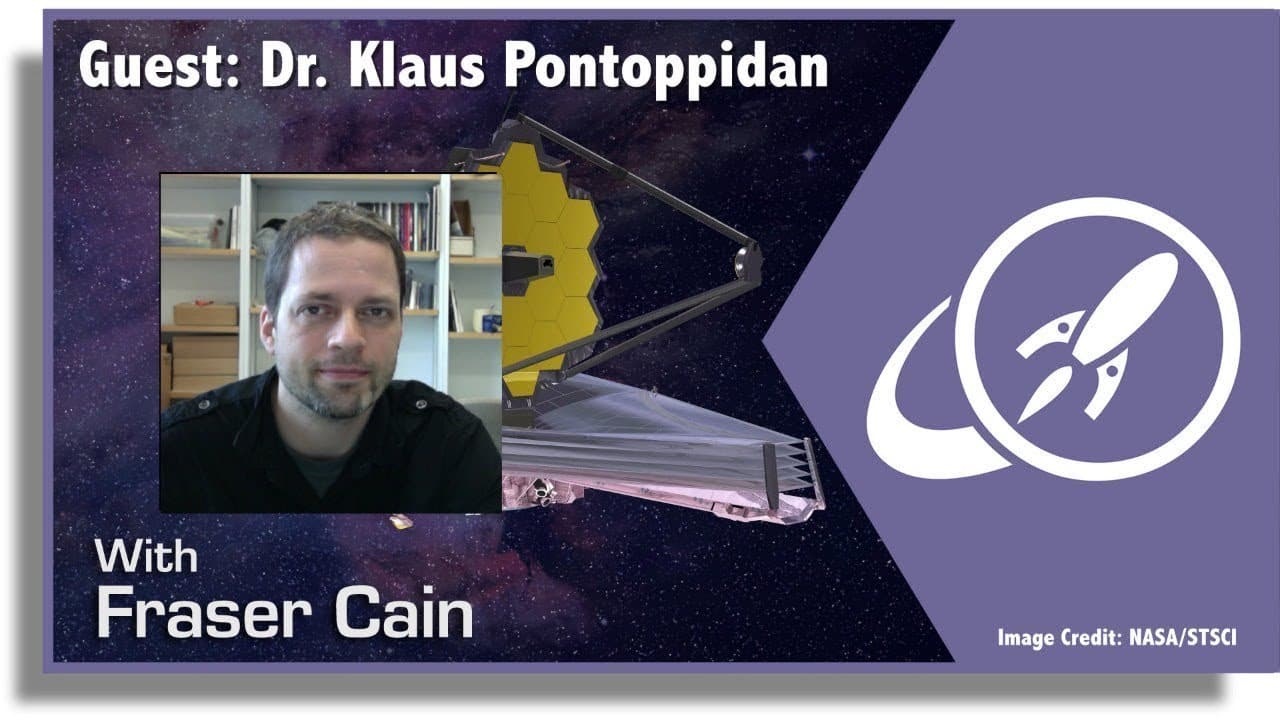
Interview: Dr. Klaus Pontoppidan, Choosing Targets for James Webb
TL;DR
The James Webb Space Telescope (JWST) is set to revolutionize space observation by providing high-resolution images and spectroscopic data for a wide range of astronomical objects.
Transcript
okay so are we so you still uh still set so now we're live um so now we need someone to confirm our existence and then we'll know that we're actually live to the to the youtube audience so generally that take doesn't take too long but but uh who are you what do you do my name is klaus pontoverden and i'm the database d project scientist at the spac... Read More
Key Insights
- 🤩 JWST will perform deep field surveys to observe the earliest galaxies and measure their distance and star formation rates.
- 🌟 The telescope aims to understand the composition of exoplanet atmospheres, particularly those around low-mass stars, to determine their habitability potential.
- 🤩 JWST will also study the origins of heavy elements in the universe by observing kilonovae, a result of neutron star mergers.
- ❓ Observations of objects like Kuiper Belt objects, Pluto, and other solar system bodies will reveal insights into their compositions and dynamics.
- 🖤 The telescope will aid in characterizing black hole jets, monitoring their evolution, and understanding the process of matter accretion into black holes.
- 🇨🇫 Public access to JWST data will be available through an archive managed by the Space Telescope Science Institute, allowing scientists and the public to analyze and discover new insights.
- 🎟️ Extensive collaborations with other observatories and missions are expected, providing multi-messenger astronomy capabilities and maximizing scientific output.
Install to Summarize YouTube Videos and Get Transcripts
Explore YouTube Video Summarizer or Get YouTube Transcript Extractor
Questions & Answers
Q: How does the JWST schedule and allocate observation time for astronomers?
The institute manages the process of deciding who gets observation time, with a competitive, peer-reviewed selection done annually. The access to the telescope is free for astronomers worldwide.
Q: What is the backlog in the JWST schedule? How far in advance are observation slots booked?
The demand for observing time on JWST far exceeds the available slots. There are around 8 times more proposals than can be accepted, leading to significant competition. The schedule is typically filled a year in advance.
Q: How many more telescopes like Hubble would be needed to meet the demand for scientific observations?
Even after 30 years, Hubble is still oversubscribed by a factor of eight. To fully fulfill scientific demand, around eight to ten additional telescopes like Hubble would be required.
Q: How will JWST improve on Hubble's ability to observe exoplanet atmospheres?
JWST will use similar techniques, such as observing planetary transits and eclipses, but with higher precision and sensitivity. It will be able to measure molecular composition, understand atmosphere dynamics, and identify potential biomarkers.
Summary & Key Takeaways
-
The JWST is operated by the Space Telescope Science Institute, contracted by NASA, and will succeed the Hubble Space Telescope.
-
It will improve on the capabilities of Hubble by incorporating lessons learned and enhancing instruments for better observations.
-
JWST will allow astronomers to study deep space objects, observe exoplanet atmospheres, monitor solar system objects, and investigate black holes.
Read in Other Languages (beta)
Share This Summary 📚
Summarize YouTube Videos and Get Video Transcripts with 1-Click
Try YouTube Summary with ChatGPT & Claude or YouTube Transcript Generator
Explore More Summaries from Fraser Cain 📚


Summarize YouTube Videos and Get Video Transcripts with 1-Click
Try YouTube Summary with ChatGPT & Claude or YouTube Transcript Generator