What Is Molecular Orbital Theory and How Does It Work?
TL;DR
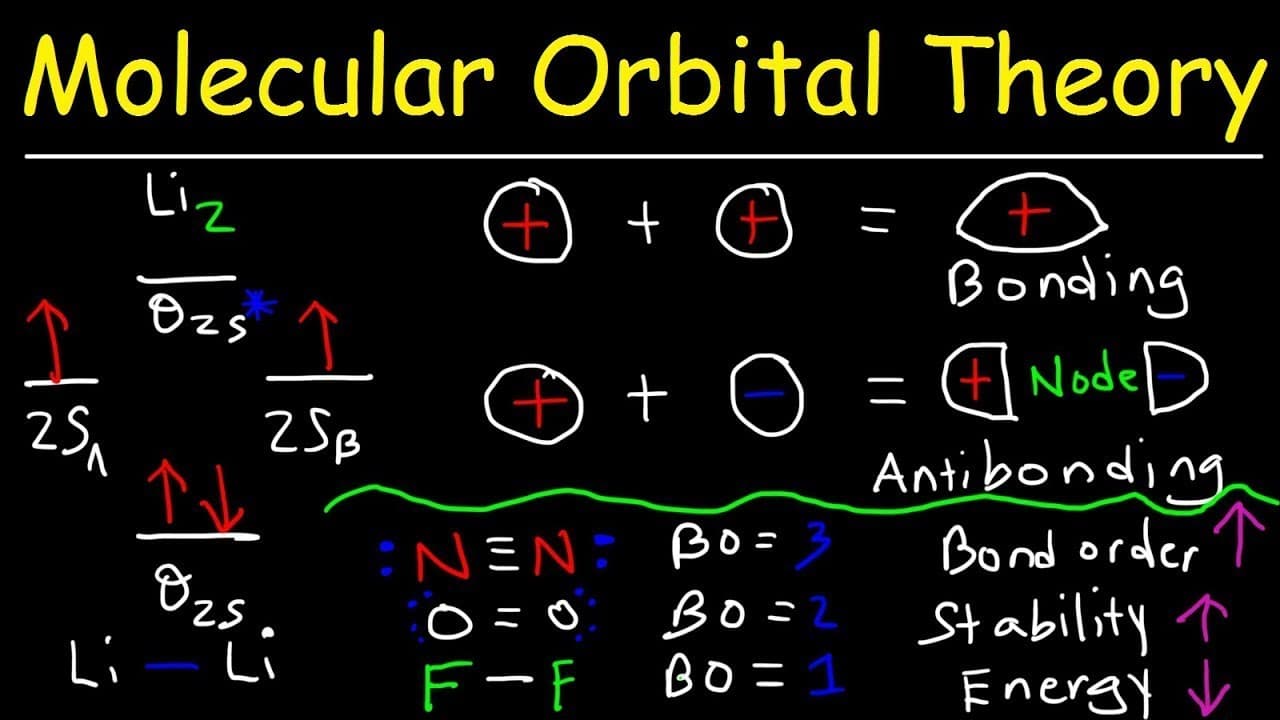
Molecular Orbital Theory explains how atomic orbitals combine to form bonding and antibonding molecular orbitals. Bonding orbitals favor molecule formation due to constructive interference, while antibonding orbitals hinder it through destructive interference. The bond order derived from these orbitals indicates the stability and strength of a bond, with higher values reflecting greater stability.
Transcript
in this video we're going to talk about molecular orbital theory so let's use hydrogen as an example hydrogen has one valence electron and if we mix two hydrogen atoms together these two will combine and form the hydrogen molecule which you can also represent like this now each of these hydrogen atoms has an 1s orbital in which one electron is plac... Read More
Key Insights
- 💁 Molecular orbitals are formed when atomic orbitals mix during bond formation.
- 🫀 Bonding molecular orbitals result from in-phase atomic orbital mixing, favoring bond formation.
- 🫀 Antibonding molecular orbitals result from out-of-phase atomic orbital mixing, hindering bond formation.
- 😘 Bonding molecular orbitals have a high probability of finding electrons between the nuclei, while antibonding molecular orbitals have nodes with low electron probability.
- ❓ Bonding molecular orbitals have an attractive force between the nuclei, while antibonding molecular orbitals have a repulsive force.
- 🫢 The hydrogen gas molecule (H2) is paramagnetic, while the h2- ion is diamagnetic.
- 🪈 The bond order indicates the stability and strength of a bond, with higher bond orders indicating greater stability and shorter bond lengths.
Install to Summarize YouTube Videos and Get Transcripts
Explore YouTube Video Summarizer or Get YouTube Transcript Extractor
Questions & Answers
Q: How are molecular orbitals formed when hydrogen atoms combine?
When two hydrogen atoms combine, their atomic orbitals mix to form bonding and antibonding molecular orbitals. The number of molecular orbitals is equal to the number of atomic orbitals being combined.
Q: What is the difference between bonding and antibonding molecular orbitals?
Bonding molecular orbitals result from constructive interference between in-phase atomic orbitals, creating a high probability of finding electrons between the nuclei. In contrast, antibonding molecular orbitals result from destructive interference between out-of-phase atomic orbitals, creating a node with low electron probability between the nuclei.
Q: How do bonding and antibonding molecular orbitals affect bond formation?
Bonding molecular orbitals favor bond formation, as the forces attracting the nuclei together outweigh the forces pushing them apart. Antibonding molecular orbitals, on the other hand, repel the nuclei and do not favor bond formation.
Q: What is the significance of bond order in molecular orbitals?
Bond order is calculated by subtracting the number of antibonding electrons from the number of bonding electrons, divided by two. Higher bond orders indicate greater stability and stronger bonds, while a bond order of zero signifies no bond formation.
Summary & Key Takeaways
-
Molecular Orbital Theory explains the formation of molecular orbitals when atoms combine, using hydrogen as an example.
-
Bonding molecular orbitals result from constructive interference between in-phase atomic orbitals, favoring bond formation.
-
Antibonding molecular orbitals result from destructive interference between out-of-phase atomic orbitals, preventing bond formation.
Read in Other Languages (beta)
Share This Summary 📚
Summarize YouTube Videos and Get Video Transcripts with 1-Click
Try YouTube Summary with ChatGPT & Claude or YouTube Transcript Generator
Explore More Summaries from The Organic Chemistry Tutor 📚


Summarize YouTube Videos and Get Video Transcripts with 1-Click
Try YouTube Summary with ChatGPT & Claude or YouTube Transcript Generator