How to Find Career Opportunity in the AI Panic
TL;DR
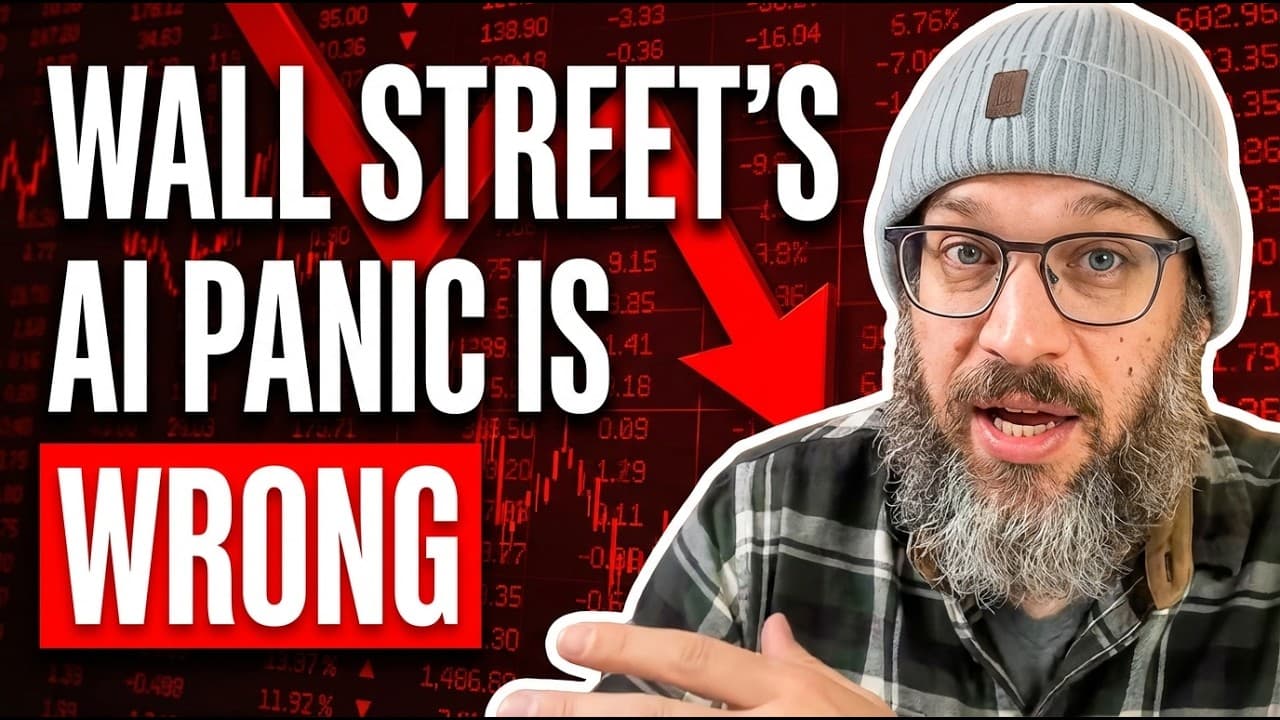
The strongest AI career opportunity is for people who combine industry expertise with AI fluency, helping companies distinguish genuine capability from investor optics. Wall Street’s indiscriminate AI scare trade is pressuring firms into hiring freezes, cost cuts, and rushed partnerships, even when disruption remains years away. People who can guide strategic, business-paced adoption can become especially valuable during this confusion.
Transcript
Wall Street's AI panic is out of control. On Thursday, February 12th, a karaoke company managed to crash the stock market over AI fears. This is a company called Algorithm Holdings, and they put out just a press release claiming their logistics platform could help customers scale freight volumes by 3 to 400% without adding headcounts. Within hours,... Read More
Key Insights
- AI scare trading is affecting multiple industries through the same sell-first reaction. In 10 days, AI announcements contributed to sell-offs across eight sectors, even though the announcements came from different companies, products, and markets with substantially different exposure to near-term disruption.
- Algorithm Holdings was previously called the Singing Machine Company and sold karaoke products. After it claimed its logistics platform could help customers scale freight volumes by 300% to 400% without adding headcount, CH Robinson Worldwide fell 24%, while billions in market value disappeared across global logistics.
- Stock declines can create operational consequences inside affected companies. A severe AI-related sell-off can prompt board discussions, hiring freezes, accelerated cost reductions, reduced headcount plans, rewritten product roadmaps, and budget transfers toward AI projects, regardless of whether the technology currently threatens the core business.
- The AI scare trade can become a self-fulfilling prophecy. Companies that react defensively by weakening product teams and prioritizing conspicuous partnerships may become more vulnerable to competitors that use the same period to invest in genuine AI capabilities and long-term operational improvement.
- AI exposure is not identical across industries. The analysis separates current labor displacement, change that may unfold over three to five years, and situations where market panic greatly exceeds credible operational risk, showing why uniform pricing across all three categories is imprecise.
- Software development is an area where AI is already displacing some labor and changing business assumptions. AI-native enterprise software demand is accelerating, while software companies that depend on selling seats to human users face pressure because software workflows no longer necessarily bottleneck on human labor.
- Wealth management depends on relationships, trust, and behavioral coaching, not only calculation. An AI tax-planning tool can assist with technical work, but it does not immediately reproduce the human role of keeping clients from panic selling or maintaining trusted long-term advisory relationships.
- The emerging career opportunity is the ability to bridge domain expertise and AI fluency. Companies need people who can evaluate actual exposure, identify useful applications, separate strategic investments from investor optics, and help organizations respond on a business time scale instead of a market panic time scale.
Install to Summarize YouTube Videos and Get Transcripts
Explore YouTube Video Summarizer or Get YouTube Transcript Extractor
Questions & Answers
Q: What is the AI scare trade on Wall Street?
The AI scare trade is an aggressive market reaction in which investors sell shares associated with any industry facing a new AI headline before carefully evaluating the actual threat. Over 10 days, the pattern affected eight sectors, including software, private credit, insurance, wealth management, real estate services, logistics, drug distribution, and commercial office space. Each trigger differed, but the response remained largely the same: sell first and analyze later.
Q: How can AI-related stock declines change company behavior?
AI-related stock declines can force companies to behave as though disruption is already an existential threat. Boards may initiate hiring freezes, accelerate cost reductions, lower headcount plans, rewrite product roadmaps, or redirect innovation budgets into visible AI partnerships. These decisions can remain in place for quarters, even if the share price recovers within weeks and the technology is still years away from threatening the core business.
Q: Why can the AI scare trade become self-fulfilling?
The AI scare trade can become self-fulfilling because market pressure encourages defensive decisions that weaken companies. A firm reacting to a 15% stock decline might cut product teams and pursue a conspicuous AI partnership designed to reassure investors. Meanwhile, a competitor may invest in genuine AI capability. The first company then becomes more vulnerable to real disruption, partly because its response to market fear damaged its capacity to compete.
Q: Which industries face immediate AI labor displacement?
Software development is presented as a clear example of an industry where AI is already displacing some labor. Cursor reached $300 million in annualized revenue and later passed $500 million, while demand for AI-native enterprise software continued to accelerate. Software companies built around per-seat pricing face particular pressure because their business models assume human users remain the central bottleneck in software work, an assumption that AI is challenging.
Q: Why is per-seat software pricing vulnerable to AI?
Per-seat software pricing is vulnerable because it ties revenue to the number of human users, while AI can reduce the amount of human labor required for some workflows. The source argues that not all software will disappear because companies still need data systems, accountable vendors, and comparative advantage. However, businesses that assume every software process must bottleneck on human effort will need to adapt their models or risk gradual repricing or sudden disruption.
Q: Why is near-term AI risk overstated in wealth management?
Near-term AI risk is overstated in wealth management because the service provides more than calculations and tax planning. Its value also includes relationships, trust, and behavioral coaching that can prevent clients from panic selling during downturns. An AI tax-planning tool may improve part of the workflow, but it cannot immediately reproduce the full advisory relationship. AI may change the sector over three to five years without replacing advisors by the next earnings season.
Q: Why did the logistics sell-off appear disconnected from operational reality?
The logistics sell-off followed a press release from Algorithm Holdings, a company previously known as the Singing Machine Company, which sold karaoke products. The company had a $6 million market capitalization, less than $2 million in quarterly revenue, and a net loss of nearly $3 million. Its freight-optimization claim did not invalidate CH Robinson’s relationships with 100,000 shippers and carriers, proprietary freight and pricing data, or physical operating capabilities.
Q: What is the biggest AI career opportunity described?
The biggest career opportunity is for people who can bridge domain expertise and AI fluency. Organizations need help distinguishing real disruption from market panic, identifying where AI can produce genuine capability, and avoiding performative partnerships created mainly for investor optics. Such professionals can help leadership allocate resources strategically, respond on a realistic business time scale, and preserve the teams and knowledge required to compete as AI adoption develops.
Summary & Key Takeaways
-
Wall Street reacted to AI announcements with rapid sell-offs across software, private credit, insurance, wealth management, real estate services, logistics, drug distribution, and commercial office space. The repeated pattern was to sell first and investigate later, even when the triggering company or product had limited evidence of immediate industry-wide disruption.
-
Falling share prices can change corporate behavior rather than merely reflect expectations. Boards may impose hiring freezes, accelerate cost reductions, revise headcount plans, redirect innovation budgets, and rewrite roadmaps around AI. These defensive decisions can persist for quarters, even if stock prices recover and the original fears prove excessively broad.
-
AI exposure falls into at least three categories: current labor displacement, meaningful change over a three-to-five-year horizon, and panic that has lost contact with operational reality. The career opportunity belongs to people who can combine domain knowledge with AI fluency and help organizations pursue genuine capability instead of performative partnerships.
Read in Other Languages (beta)
Share This Summary 📚
Summarize YouTube Videos and Get Video Transcripts with 1-Click
Try YouTube Summary with ChatGPT & Claude or YouTube Transcript Generator
Explore More Summaries from AI News & Strategy Daily | Nate B Jones 📚






Summarize YouTube Videos and Get Video Transcripts with 1-Click
Try YouTube Summary with ChatGPT & Claude or YouTube Transcript Generator