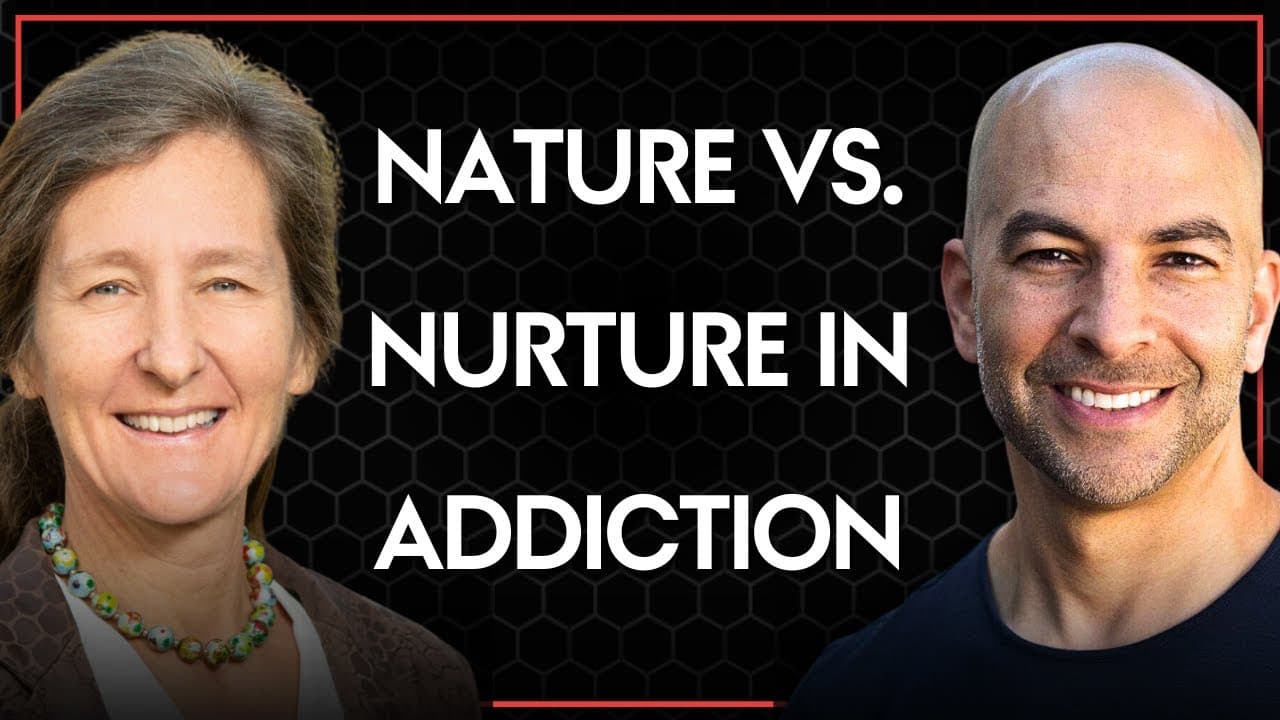
Why Do Some People Get Addicted and Others Don't?
TL;DR
Inherited risk explains about 50 to 60 percent of addiction vulnerability, based on twin and adoption studies, but the substance a person becomes hooked on depends on their innate drug of choice intersecting with access. Peter Attia reached 300mg of Oxycontin daily after a back injury, quit cold turkey, and later took opioids again without becoming addicted, concluding it was luck, not willpower.
Transcript
a big part of what I wanted to to chat about was was actually this idea of why different individuals uh become addicted to very different stimuli even if the final common pathway is comparable right so even if um you could put all of us into whatever it is we use fmri or whatever type of scan that we might use to to pick up on um the areas of the b... Read More
Key Insights
- Inherited or inborn risk for addiction is about 50 to 60 percent, based on twin concordance and family studies showing adopted children with an addicted biological parent or grandparent develop alcohol use disorder at higher rates even when raised outside that home.
- Addiction risk factors fall into three buckets Anna Lembke calls nature, nurture, and neighborhood: inherited vulnerability, early childhood upbringing and attachment, and simple access to a given drug in one's environment or medical care.
- Drug of choice is a real but understudied phenomenon: even poly-substance users, who are now more common than not, report a preference such as opioids, cigarettes, or alcohol, though Lembke found very little science on the concept.
- Access intersecting with drug of choice raises risk for specific individuals: living where drugs are sold on street corners or getting care where opioids and stimulants are prescribed liberally exposes the brain and increases addiction risk.
- Nurture-based risk comes from parents modeling maladaptive addictive behaviors, trauma, negative attachment, or sexual, physical, and emotional abuse. Children raised with healthy coping, good attachment, and no abuse are relatively protected, though nobody is completely protected.
- Peter Attia escalated to 300mg of Oxycontin per day after a debilitating back injury in medical school, quit cold turkey against an anesthesiology resident's advice, and spent the next two weeks in withdrawal he described as hell.
- Physiological dependence is not the same as addiction: Attia was dependent on opioids yet took Percocet years later for a tooth condition and stopped after two days with no issue, concluding he is physiologically not prone to opioid addiction.
- Modern life exposes brains to novel drugs that never existed before, including online shopping, pornography, and drug-ified romance novels. Dr. Finnean's metaphor, that we are cacti living in a rainforest, captures humans being unevolved for this environment.
Install to Summarize YouTube Videos and Get Transcripts
Explore YouTube Video Summarizer or Get YouTube Transcript Extractor
Questions & Answers
Q: What percentage of addiction risk is inherited?
According to Anna Lembke, the inherited or inborn risk for addiction, based on family and twin studies, is about 50 to 60 percent. This comes from carefully done research showing that if you have a biological parent or grandparent addicted to alcohol, you are at increased risk of alcohol addiction than the general population, even if raised outside of that alcohol-using home. High heritability is determined by twin concordance and adoption studies.
Q: What are the three main risk factors for addiction?
Anna Lembke groups addiction risk factors into three buckets she calls nature, nurture, and neighborhood. Nature is the inherited or inborn risk of about 50 to 60 percent, often alongside co-occurring mental health disorders. Nurture covers early childhood development, parental modeling of behaviors, attachment, and trauma. Neighborhood refers to access, one of the biggest risk factors: living where drugs are sold or getting care where they are liberally prescribed raises exposure and risk.
Q: Why do different people become addicted to different substances?
Peter Attia raises this as the central question: why alcohol becomes the problem for one person and opioids for another even if the final common brain pathway is comparable. Anna Lembke points to the concept of drug of choice, where individuals have a preference such as opioids, cigarettes, or alcohol. This intersects with access in their environment, so what a person becomes hooked on depends on both their innate preference and what they can reach.
Q: How did Peter Attia become dependent on opioids?
In medical school, Peter Attia suffered a debilitating back injury. Through errors in the medical system he ended up on very high doses of Oxycodone and Oxycontin, escalating predictably until he reached 300 milligrams a day of Oxycontin, a dose he says would kill you or him if split. After about six months he realized he was taking it not for pain but to escape depression over being debilitated, so he decided to stop.
Q: Is physical dependence the same as addiction?
No. Anna Lembke and Peter Attia distinguish the two. Attia became physiologically dependent on opioids in medical school and assumed he was addicted, but concluded otherwise. About 10 years later he took Percocet for a bad tooth condition when nothing else touched the pain, stopped after two days once the tooth was addressed, and had no issue. He concluded he is not physiologically prone to opioid addiction and that quitting was luck, not willpower.
Q: What is a drug of choice in addiction?
A drug of choice is an individual's preferred substance or behavior. Anna Lembke notes that even poly-substance users, who today are more common than not, will tell you their preference, such as opioids, wanting to smoke a cigarette, or alcohol being their go-to. She found very little science on the concept despite searching hard. It matters because drug of choice intersects with access to increase addiction risk for certain individuals.
Q: How does access affect the risk of addiction?
Access is one of the biggest risk factors for addiction and forms Anna Lembke's neighborhood category. If you live where drugs are sold on the street corner, you are more likely to try them and get addicted. If you receive medical care where clinicians liberally prescribe opioids, benzodiazepines, and stimulants, your brain is exposed to and changes in response to those drugs, raising your risk. In Attia's case, access is what initially got him hooked.
Q: Why does modern life increase addiction risk?
Anna Lembke explains the world today offers more access to more potent forms of traditional drugs plus brand new drugs that did not exist before, including online digital media, online shopping, pornography, and the drug-ification of the romance novel. Attia admits his own online shopping is a true addiction with minimal consequences. Lembke cites Dr. Finnean's metaphor that we are cacti living in a rainforest, meaning humans were not evolved for the world we now live in.
Summary & Key Takeaways
-
Anna Lembke explains that addiction risk splits into three categories she labels nature, nurture, and neighborhood. Inherited risk, measured through twin and adoption studies, accounts for roughly 50 to 60 percent, with adopted children of addicted biological relatives showing higher alcohol use disorder rates even outside the using home.
-
Peter Attia recounts reaching 300mg of Oxycontin daily after a back injury, a dose he says would kill someone splitting it. He quit cold turkey, endured two weeks of withdrawal, later took opioids for a tooth problem without becoming addicted, and concluded his escape was luck and physiology, not moral superiority.
-
The pair discuss why access intersects with an individual's drug of choice to determine what someone becomes hooked on. Attia admits online shopping is a genuine addiction for him with minimal consequences. Lembke notes modern digital drugs make humans cacti living in a rainforest, unevolved for today's environment of potent new stimuli.
Read in Other Languages (beta)
Share This Summary 📚
Summarize YouTube Videos and Get Video Transcripts with 1-Click
Try YouTube Summary with ChatGPT & Claude or YouTube Transcript Generator
Explore More Summaries from Peter Attia MD 📚
Summarize YouTube Videos and Get Video Transcripts with 1-Click
Try YouTube Summary with ChatGPT & Claude or YouTube Transcript Generator