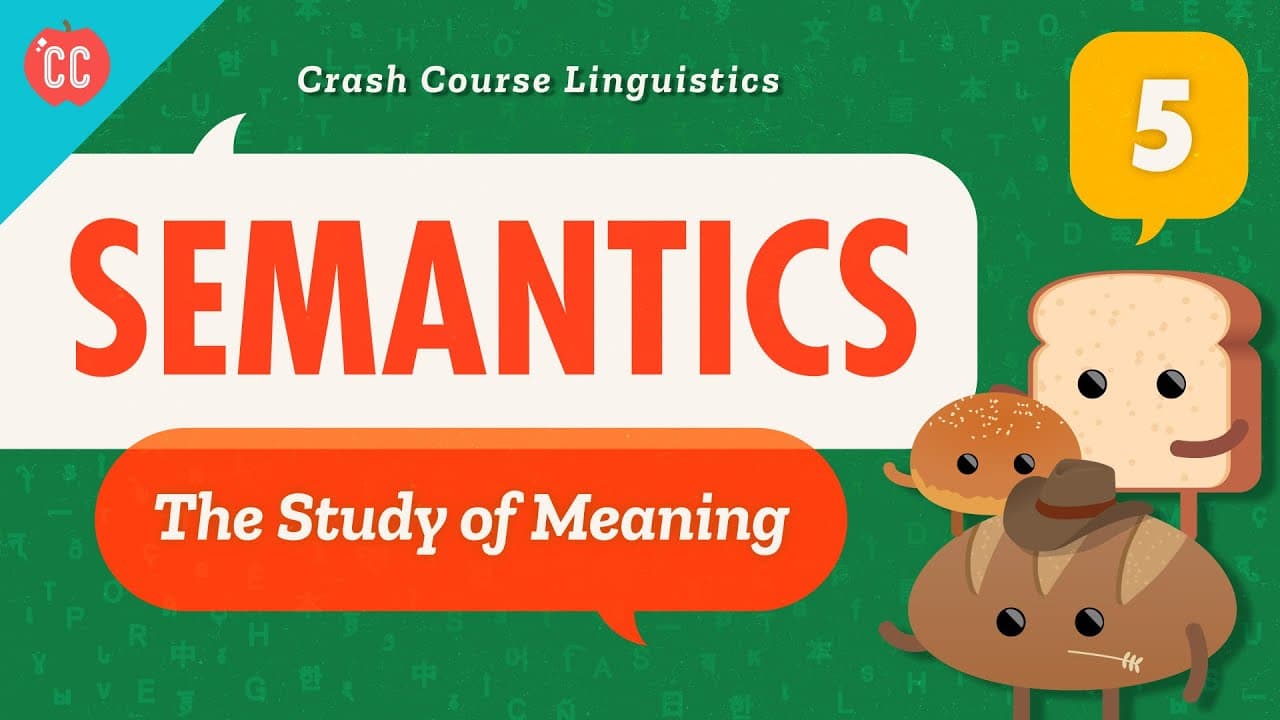
Semantics: Crash Course Linguistics #5
TL;DR
Understanding word meaning through definitions alone is not always effective, as language evolves and words have multiple meanings. Semantic relationships and prototype theory provide alternative ways to understand word meaning.
Transcript
Hi, I'm Taylor and welcome to Crash Course Linguistics! What is the meaning of… life? Or of chair? Or of rabbit? Well, we might not know about life, but we can easily find out what a word means. We just look it up in The Dictionary™. Episode over! Wait a sec... The first problem with relying on a dictionary to give a word meaning is that dictionari... Read More
Key Insights
- 🔑 Dictionaries alone are not sufficient for understanding word meanings, as they don't capture the complexities of language.
- 🔑 Semantic relationships, such as synonyms, antonyms, hyponyms, and hypernyms, help reveal the connections between words.
- 🔑 Different languages may have different semantic divisions and translations of words.
- ⌛ Words can change meaning over time, often driven by taboo and euphemisms.
- 🔑 Prototype theory suggests that words have exemplars or prototypes that represent the most typical members of a category.
- 💨 Predicate calculus and formal semantics offer ways to understand the meanings of function words in sentences.
- 💨 Other approaches to semantics, such as Binary Feature Analysis, Natural Semantic Metalanguage, and Cognitive Semantics, provide alternative ways to analyze word meanings.
Install to Summarize YouTube Videos and Get Transcripts
Explore YouTube Video Summarizer or Get YouTube Transcript Extractor
Questions & Answers
Q: Why can't dictionaries alone determine the meaning of words?
Dictionaries are created by people and may not capture all of the complexities and nuances of word meanings. They serve as a starting point but require additional methods of understanding.
Q: What are some semantic relationships between words?
Some examples of semantic relationships are synonyms (words with similar meanings), antonyms (words with opposite meanings), and hyponyms and hypernyms (specific words within broader categories).
Q: Do all languages draw semantic lines in the same place?
No, different languages may have different semantic divisions and draw lines in different places. For example, English has one word for "know," while Polish has separate words for "knowing a fact" and "knowing a person."
Q: How do words change their meanings over time?
Words can change meaning by becoming broader or narrower in their definitions or by completely changing meanings. Taboo and euphemisms can also drive language change.
Summary & Key Takeaways
-
Dictionaries are not always reliable for determining word meaning as they are created by people who still need other ways to understand word meanings.
-
Definitions in dictionaries help reveal relationships between words, such as synonyms, antonyms, hyponyms, and hypernyms.
-
Different languages may draw semantic lines differently, leading to various translations and interpretations of words.
Read in Other Languages (beta)
Share This Summary 📚
Summarize YouTube Videos and Get Video Transcripts with 1-Click
Try YouTube Summary with ChatGPT & Claude or YouTube Transcript Generator
Explore More Summaries from CrashCourse 📚
Summarize YouTube Videos and Get Video Transcripts with 1-Click
Try YouTube Summary with ChatGPT & Claude or YouTube Transcript Generator