How Can Soft Robots Operate Without Electronics?
TL;DR
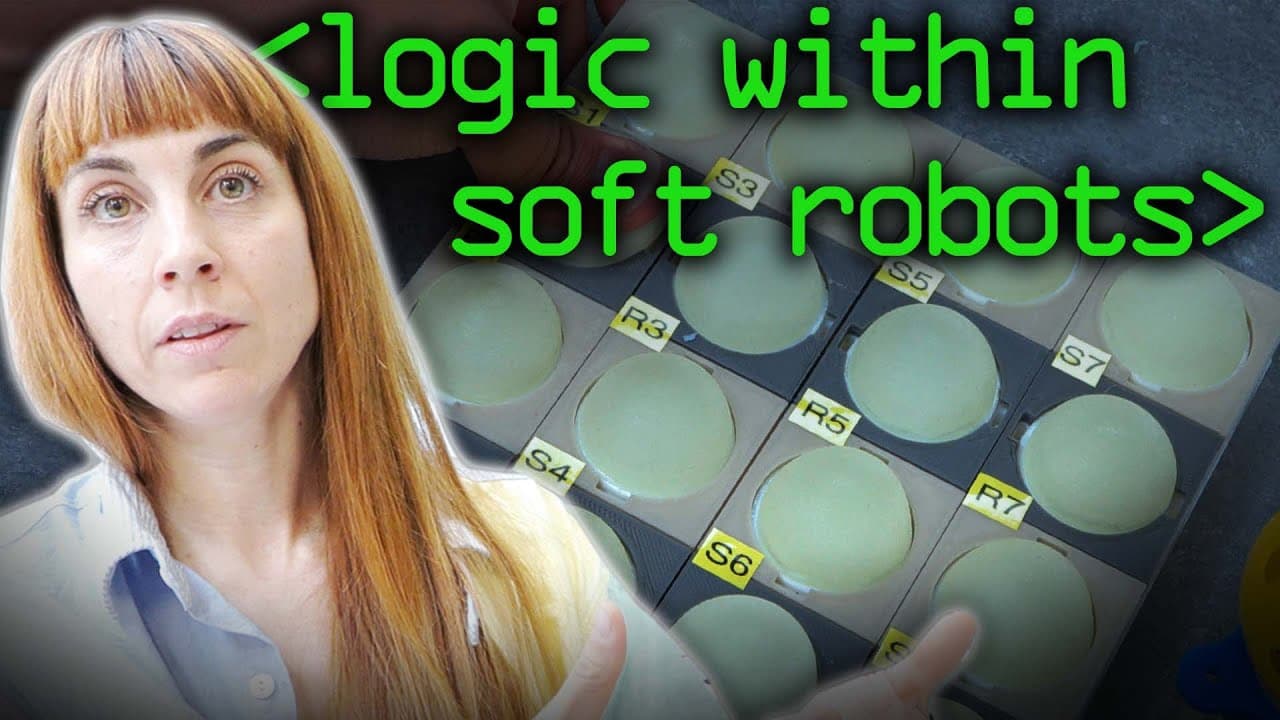
Soft robots typically require electronics for control, which limits their versatility. Researchers are innovating electronic-free controllers that can be 3D printed alongside the robot body, enabling a seamless integration. This advancement promises to enhance the adaptability and safety of soft robots in various applications.
Transcript
soft robots are robots that exploit their compliance to be highly adaptable and be able to deal with the environment that are not structured highly dynamics and they can provide also a safe human robot interaction despite these fantastic advantages they still rely for their control on electronics and so microcontrollers and also some of them can be... Read More
Key Insights
- 🤖 Soft robots are highly adaptable and safe for human-robot interaction but currently rely on electronics for control.
- 🥶 Researchers are developing electronic-free soft controllers that can be 3D printed together with the robot body, achieving a highly integrated solution.
- 🍦 Multi-material 3D printing allows for the fabrication of soft valves with different mechanical properties, enhancing the functionality of soft robots.
- 😋 Soft robots have potential applications in industries such as agriculture and food, where their compliance and adaptability are advantageous.
- 🤖 Soft robots can navigate cluttered environments and interact safely with humans, making them suitable for tasks that require dexterity and safety.
- 🥶 Scaling down the electronic-free soft controllers is the next stage of research, requiring advancements in materials and manufacturing techniques.
Install to Summarize YouTube Videos and Get Transcripts
Explore YouTube Video Summarizer or Get YouTube Transcript Extractor
Questions & Answers
Q: How are soft robots currently controlled?
Soft robots currently rely on electronics and microcontrollers for control, which limits their adaptability and usability.
Q: What is the goal of the research on electronic-free soft controllers?
The goal is to develop soft controllers that can be embodied in the robot body and perform computation without the need for electronic components, such as microcontrollers and valves.
Q: How are the soft controllers being integrated into soft robots?
The researchers are using multi-material 3D printing to print the soft controllers together with the robot body, achieving a highly integrated solution.
Q: What are the potential applications of soft robots?
Soft robots are ideal for manipulation tasks in industries such as agriculture and food, as their compliance allows them to adapt to different objects. They can also navigate cluttered environments and interact safely with humans.
Summary & Key Takeaways
-
Soft robots, made using multi-material 3D printing, are highly adaptable and safe for human-robot interaction.
-
Current soft robots rely on electronics and microcontrollers for control, limiting their usability.
-
Researchers are working on developing electronic-free soft controllers that can be 3D printed together with the robot body, achieving a highly integrated solution.
Read in Other Languages (beta)
Share This Summary 📚
Summarize YouTube Videos and Get Video Transcripts with 1-Click
Try YouTube Summary with ChatGPT & Claude or YouTube Transcript Generator
Explore More Summaries from Computerphile 📚





Summarize YouTube Videos and Get Video Transcripts with 1-Click
Try YouTube Summary with ChatGPT & Claude or YouTube Transcript Generator