How Is AI Transforming the Economy and Society?
TL;DR
AI is advancing rapidly, impacting various sectors of the economy and society. The combination of increased compute power, access to vast data, and improved algorithms is driving this progress. However, challenges remain, such as the need for more data and the potential socioeconomic impacts of AI on the workforce.
Transcript
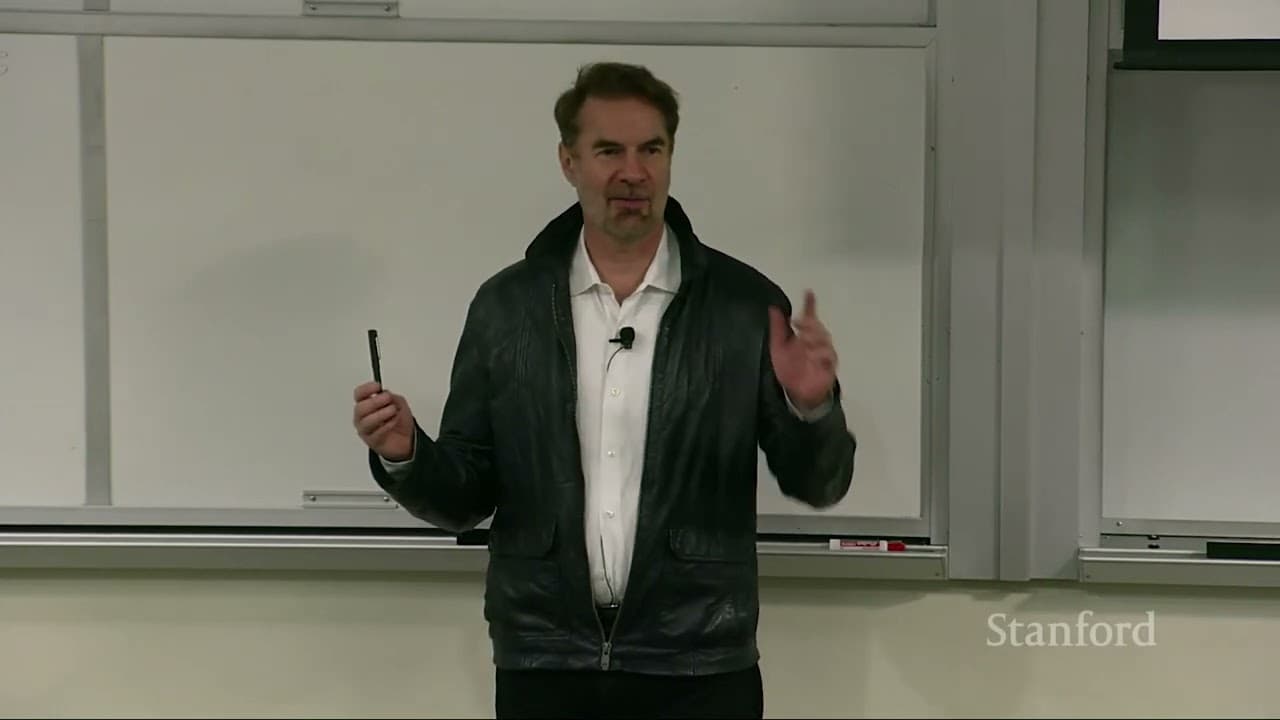
This is the AI Awakening, ECON295 CS2-- what is it-- 323. So I hope you're in the right room. I hope I'm in the right room. My name is Erik Brynjolfsson. I'm the professor for this class. And most importantly, I really see this class as an exercise in cocreation. So I'm looking forward to learning from all of you. You're going to hear from a lot of... Read More
Key Insights
- AI is advancing rapidly due to increased compute power, vast data, and improved algorithms.
- Large language models (LLMs) are a significant part of AI advancements, using self-supervised learning to predict and generate text.
- AI's impact on the economy is lagging behind its technological potential, but it is expected to grow significantly.
- Generative AI is unexpectedly good at tasks like passing exams, indicating its potential in professional fields.
- There is a growing gap between technology's rapid advancement and society's ability to adapt and integrate these changes.
- AI is a general-purpose technology, potentially more transformative than previous technologies like the steam engine or electricity.
- The concept of AI as a substitute for human labor is less beneficial than AI as a complement, which enhances human productivity.
- Challenges include the need for more training data and addressing the socioeconomic impacts on the workforce.
Install to Summarize YouTube Videos and Get Transcripts
Explore YouTube Video Summarizer or Get YouTube Transcript Extractor
Questions & Answers
Q: How is AI transforming the economy?
AI is transforming the economy by significantly increasing productivity through advancements in compute power, access to vast data, and improved algorithms. It enables automation and efficiency in various sectors, from call centers to legal professions, by augmenting human capabilities and facilitating new business models and innovations.
Q: What are the main drivers of AI progress?
The main drivers of AI progress are increased compute power, access to large amounts of data, and improved algorithms. These factors enable the development of advanced models like large language models (LLMs), which can perform complex tasks by learning from large datasets without needing explicit human-labeled data.
Q: What challenges does AI face in terms of data?
AI faces challenges in terms of data availability as models have already been trained on most existing data. The scarcity of new data could hinder further advancements. There is ongoing research into using synthetic data and self-generated data to overcome this limitation, but its effectiveness is still being evaluated.
Q: How does AI impact the workforce?
AI impacts the workforce by automating routine tasks, which can lead to productivity gains but also displace certain jobs. The technology is more effective as a complement to human labor, enhancing workers' capabilities and allowing them to focus on more complex, less repetitive tasks. This requires a shift in workforce skills and roles.
Q: What is the 'bitter lesson' in AI research?
The 'bitter lesson' in AI research, proposed by Richard Sutton, is the realization that progress in AI has been driven more by increased data and compute power than by new algorithms. This suggests that scaling up these resources is often more effective than focusing solely on developing new, specialized techniques.
Q: What is the role of large language models in AI?
Large language models (LLMs) play a crucial role in AI by using self-supervised learning to predict and generate text. They are trained on vast datasets to fill in blanks or predict next words, enabling them to perform a wide range of tasks, from language translation to answering complex questions, exhibiting an understanding of context and knowledge.
Q: Why is AI considered a general-purpose technology?
AI is considered a general-purpose technology because it has the potential to impact a wide range of industries and applications, similar to the steam engine or electricity. Its ability to enhance productivity, foster innovation, and create new economic opportunities makes it a transformative force across multiple sectors.
Q: What are the socioeconomic implications of AI?
The socioeconomic implications of AI include the potential for increased economic disparity if the benefits are not widely distributed. While AI can significantly boost productivity and economic growth, it may also lead to job displacement and require new policies to ensure that the gains are shared equitably, maintaining social stability and workforce relevance.
Summary & Key Takeaways
-
AI's rapid progress is driven by increased compute power, access to vast data, and improved algorithms. Large language models (LLMs) use self-supervised learning to predict and generate text, showcasing their potential in professional tasks. Despite technological advancements, the economic impact is still catching up but is expected to grow significantly.
-
AI is considered a general-purpose technology, potentially more transformative than past innovations like the steam engine or electricity. The focus should be on using AI as a complement to human labor, enhancing productivity rather than merely substituting human tasks, to ensure shared prosperity.
-
Challenges in AI development include the need for more training data and addressing socioeconomic impacts on the workforce. The gap between technology's rapid advancement and society's ability to adapt is growing, highlighting the need for updated economic understanding and business processes.
Read in Other Languages (beta)
Share This Summary 📚
Summarize YouTube Videos and Get Video Transcripts with 1-Click
Try YouTube Summary with ChatGPT & Claude or YouTube Transcript Generator
Explore More Summaries from Stanford Online 📚





Summarize YouTube Videos and Get Video Transcripts with 1-Click
Try YouTube Summary with ChatGPT & Claude or YouTube Transcript Generator