Why Do YouTube Videos All Feel the Same?
TL;DR
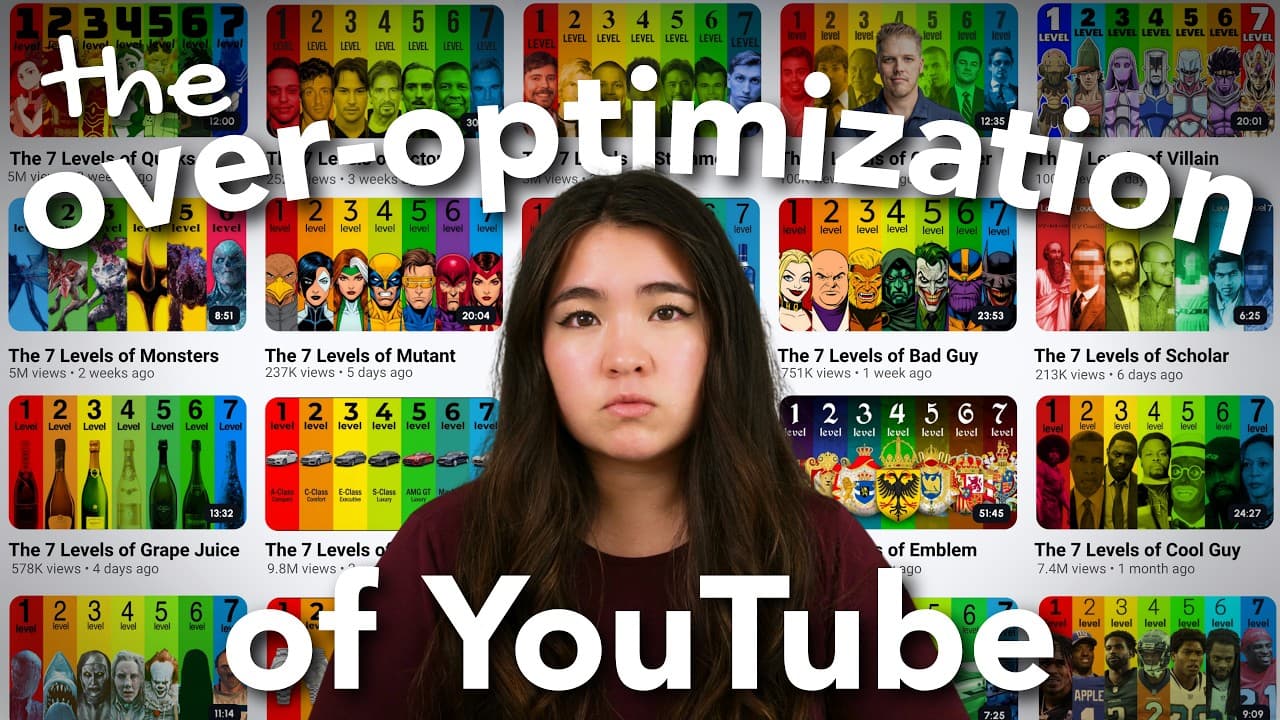
Outlier theory makes YouTube videos feel increasingly similar because creators reuse the topics, titles, thumbnails, and angles of videos that previously overperformed. Although this strategy can reduce risk and stabilize views, relying on it too heavily weakens creative judgment, prevents channels from developing distinctive identities, and discourages the unproven ideas that could produce greater long-term growth.
Transcript
If you're starting to feel like all YouTube videos are beginning to look and feel the same, you're not crazy. It is happening. And there's a reason for it. That reason is called outlier theory. And it's simultaneously one of the best and worst things to ever happen to YouTube. You see, in order to make it as a YouTuber, you need to bring in views. ... Read More
Key Insights
- Outlier theory is a strategy built around identifying videos that substantially outperform a channel's normal view count, then examining what helped them reach a broader audience. A channel averaging 10,000 views would therefore treat a video receiving 100,000 views as an outlier.
- Modern YouTube optimization is increasingly systematic because growing competition created specialized roles such as video editors, thumbnail designers, producers, and strategists. Their analysis transformed earlier tips about tags, facial expressions, and bright colors into repeatable playbooks covering ideas, packaging, and execution.
- Outlier-based ideation works by separating a successful video into components such as its topic, title structure, thumbnail format, and angle. Creators can adapt one or more of those ingredients to another niche without copying the entire work, which the transcript distinguishes from legitimate inspiration.
- Proven concepts can reduce the financial and creative risk of publishing because they provide evidence that a related idea has already attracted viewers. This matters when producing a strong video demands substantial time, money, and energy, particularly for creators supporting teams or attempting to leave regular employment.
- Widespread use of the same outliers produces homogenized content because creators extract similar structures and reuse them across different subjects. Although the resulting videos are technically distinct, their titles, thumbnails, organization, pacing, and anticipated emotional effects can become familiar before viewers even watch them.
- Heavy dependence on outliers weakens creative intuition because creators outsource judgments about an idea's potential to evidence generated by someone else's risk. They may produce polished work, but they do not practice evaluating unproven ideas or understanding independently why a particular concept should resonate.
- Channels built entirely from borrowed formats lack differentiation because familiar titles and thumbnails do not create an overarching identity or signature content. Such channels may earn respectable views, yet viewers have little reason to remember the creator or return specifically for that creator's perspective.
- Exclusive reliance on validated ideas can create a local maximum where creators preserve respectable performance but never pursue potentially larger opportunities. Unproven concepts may perform worse, but a remarkable original concept can also perform much better, with its first creator capturing more attention than subsequent versions.
Install to Summarize YouTube Videos and Get Transcripts
Explore YouTube Video Summarizer or Get YouTube Transcript Extractor
Questions & Answers
Q: What is outlier theory on YouTube?
Outlier theory is the practice of finding a video that performed significantly better than its channel's usual uploads, identifying the elements that may have broadened its appeal, and adapting those elements to another video. The analysis can cover the topic, title structure, thumbnail format, or central angle. For example, a video reaching 100,000 views on a channel that normally receives 10,000 would qualify as an outlier.
Q: Why do so many YouTube videos feel the same?
Many YouTube videos feel similar because creators and strategists study the same pool of unusually successful uploads, extract the same structures, and apply those patterns across different niches. The subjects may differ, but titles, thumbnails, narrative organization, pacing, and intended emotional effects become predictable. The growing use of AI with those same reference videos can make this convergence even more noticeable.
Q: How do creators use outlier videos for new ideas?
Creators break an overperforming video into reusable ingredients instead of copying it in full. Those ingredients can include its subject, title pattern, thumbnail design, and particular approach to the subject. They then transfer one or more components into their own niche. This process can produce an idea that technically has not existed before while still making it feel familiar to viewers.
Q: Why is outlier theory effective for YouTube growth?
Outlier theory is effective because an unusually successful upload provides evidence that something about its concept or presentation reached beyond a channel's normal audience. Using that evidence gives a new upload a validated foundation instead of making it a complete guess. The strategy can reduce risk and stabilize average views when videos require significant investments of time, money, energy, or team support.
Q: What are the risks of relying on YouTube outliers?
Overreliance on outliers can weaken a creator's independent judgment, make every upload dependent on someone else's successful experiment, and leave the channel without a recognizable identity. It can also restrict long-term growth by encouraging only previously validated concepts. The creator may achieve respectable results but miss original ideas capable of attracting substantially more attention than familiar formats.
Q: How does outlier theory weaken creative intuition?
Outlier theory weakens intuition when creators use prior performance as the only basis for judging whether an idea deserves production. Someone else assumes the initial creative risk and discovers what resonates, while the follower practices adaptation instead of evaluation. Over time, the creator may become unable to identify promising unproven concepts without definitive external evidence that a similar idea already worked.
Q: What does a local maximum mean for YouTube creators?
A local maximum describes a respectable performance level that appears optimal because every nearby change initially seems worse. A creator who only follows proven ideas can remain on that smaller peak, avoiding unfamiliar concepts because they look risky. A better opportunity may exist elsewhere, but reaching it requires accepting uncertain or weaker results while searching for a more successful original concept.
Q: Why can original YouTube concepts outperform proven formats?
Original concepts can perform worse because they lack prior validation, but they can also perform much better because novelty gives the first creator an opportunity to capture most of the attention. Later versions may be well executed, yet they are no longer new and may receive only a fraction of the original's views. Finding such a concept requires experimenting beyond ideas already proven by others.
Summary & Key Takeaways
-
YouTube strategy evolved from simple tactics, such as better tags, expressive reactions, and brighter thumbnails, into detailed formulas developed by editors, designers, producers, and strategists. As competition and financial incentives increased, creators began treating view generation less like an artistic gamble and more like an optimization problem supported by proven patterns.
-
Outlier theory identifies videos that significantly exceed a channel's usual performance and breaks them into reusable components, including topics, title structures, thumbnail formats, and angles. Applying those components elsewhere can reduce the uncertainty surrounding expensive uploads, but widespread use causes technically different videos to share predictable packaging, structure, pacing, and emotional effects.
-
Exclusive reliance on outliers can prevent creators from developing independent judgment, a recognizable brand, and original winning concepts. Proven formats may provide respectable results, but they can trap creators at a local maximum. Unvalidated ideas carry greater downside, yet they also offer the possibility of novelty and capturing more attention than later imitations.
Read in Other Languages (beta)
Share This Summary 📚
Summarize YouTube Videos and Get Video Transcripts with 1-Click
Try YouTube Summary with ChatGPT & Claude or YouTube Transcript Generator
Explore More Summaries from Aprilynne Alter 📚



Summarize YouTube Videos and Get Video Transcripts with 1-Click
Try YouTube Summary with ChatGPT & Claude or YouTube Transcript Generator