What Is Integration and How to Find Antiderivatives?
TL;DR
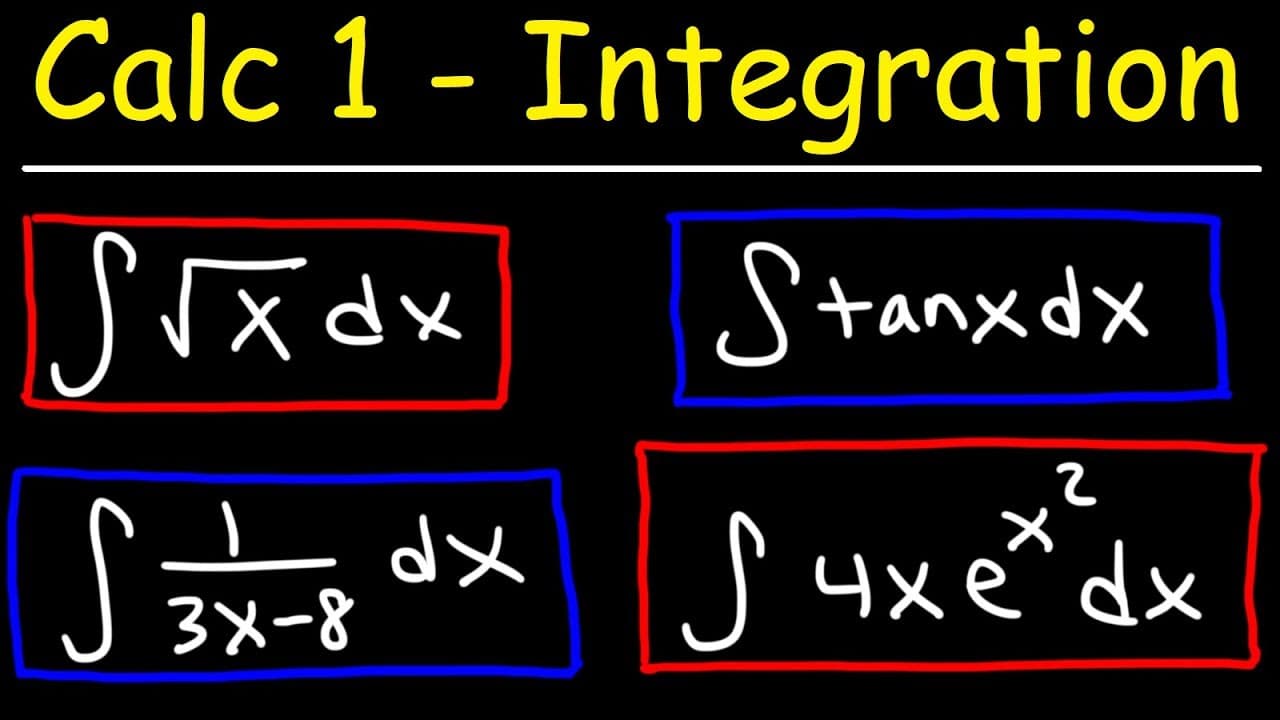
Integration is the process of finding the antiderivative of a function, reversing differentiation. The power rule states that the antiderivative of x raised to n is (x^(n+1))/(n+1), plus a constant of integration. Techniques such as u-substitution and knowing specific formulas for trigonometric and exponential functions are essential for integrating complex expressions.
Transcript
now in this video we're going to go over integration how to find the antiderivative of certain functions and now if you recall according to the power rule the derivative of x raised to the nth power that is a variable raised to a constant is equal to n X raised to the N minus 1 now the power rule when dealing with antiderivatives or integration is ... Read More
Key Insights
- ◀️ Integration involves finding the antiderivative of a function, which is the reverse process of differentiation.
- 😑 The power rule for integration is a useful tool for finding antiderivatives of functions with polynomial expressions.
- 🪡 Trigonometric functions, exponential functions, and rational functions each have specific techniques for integration that need to be memorized.
- 😄 The process of u-substitution can be used for more complex integrals involving exponential or rational expressions.
- 👻 Definite integrals allow us to find the area under a curve between two limits of integration.
- 🪜 The constant of integration is added in antiderivatives because the derivative of a constant is always zero.
Install to Summarize YouTube Videos and Get Transcripts
Explore YouTube Video Summarizer or Get YouTube Transcript Extractor
Questions & Answers
Q: What is the power rule for integration?
The power rule for integration states that the antiderivative of x raised to the power of n is (x^(n+1))/(n+1), with the addition of a constant of integration.
Q: How do you find the antiderivative of trigonometric functions?
The antiderivatives of trigonometric functions, such as sine, cosine, tangent, cosecant, secant, and cotangent, have specific formulas that need to be memorized. For example, the antiderivative of sine x is -cosine x, and the antiderivative of secant squared x is tangent x.
Q: Can exponential functions be integrated using the power rule?
Exponential functions can be integrated using either the power rule or the technique of u-substitution. For example, the antiderivative of e^(3x) can be found using the power rule as (1/3)e^(3x), or using u-substitution as (1/3)e^(u) where u = 3x.
Q: How do you integrate rational functions?
Rational functions can be integrated by rewriting the expression and using the power rule or other techniques. For example, the antiderivative of 1/x^2 is -1/x, and the antiderivative of 7/(x+5) is ln(x+5).
Summary & Key Takeaways
-
Integration involves finding the antiderivative of a function, which is the reverse process of differentiation.
-
The power rule for integration states that the antiderivative of x raised to the power of n is (x^(n+1))/(n+1), with the addition of a constant of integration.
-
Antiderivatives of trigonometric functions, such as sine, cosine, tangent, cosecant, secant, and cotangent, have specific formulas that need to be memorized.
-
Exponential functions can be integrated using either the power rule or the technique of u-substitution.
-
Rational functions, such as fractions with polynomial expressions in the numerator and denominator, can be integrated by rewriting the expression and using the power rule or other techniques.
Read in Other Languages (beta)
Share This Summary 📚
Summarize YouTube Videos and Get Video Transcripts with 1-Click
Try YouTube Summary with ChatGPT & Claude or YouTube Transcript Generator
Explore More Summaries from The Organic Chemistry Tutor 📚


Summarize YouTube Videos and Get Video Transcripts with 1-Click
Try YouTube Summary with ChatGPT & Claude or YouTube Transcript Generator