How to Choose Prompting, RAG, or Fine-Tuning
TL;DR
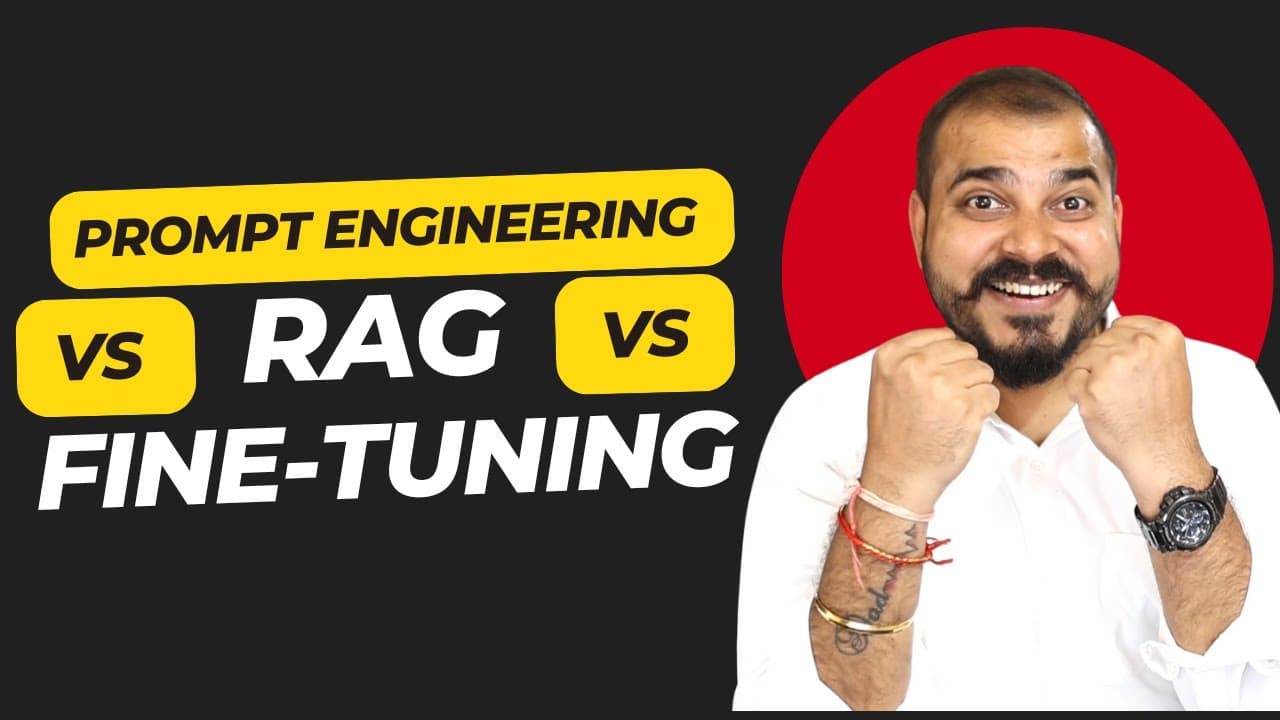
Use prompt engineering when the pretrained model already has the required knowledge, RAG when answers depend on external, proprietary, or frequently updated information, and fine-tuning when the model must adopt specialized behavior using organization-specific data. Prompting is quick and lightweight, RAG retrieves relevant context at runtime, and fine-tuning modifies model weights but requires significant resources.
Transcript
Hello all, my name is Krishna and welcome to my YouTube channel. So guys, today in this particular video, I'm going to discuss about these three important terms and also talk about the differences between them. That is nothing but prompt engineering versus rag versus fine-tuning. Now all these three terms you may have used it, you may have built, y... Read More
Key Insights
- Prompt engineering is the practice of writing clear, detailed instructions that guide a pretrained large language model toward a more useful response. It can specify a role, such as a teacher, request detailed answers, and define a structured or pointwise output format.
- The quality of a prompt affects the quality and specificity of the response. Asking only for information about cats produces a generic answer, while requesting one funny fact and adding contextual suggestions gives the model a clearer direction for generating its response.
- Prompt engineering is suitable when the knowledge required for a task is likely already present in the pretrained model. It supports quick improvements and exploration of model capabilities without changing internal parameters or supplying a separate source of external information.
- RAG is a method for supplementing a large language model with external information retrieved when a query is submitted. The external source acts like a backpack of reference material that the model can consult before producing a more informed and accurate response.
- A vector database supports RAG by storing information as vector embeddings. The user's query is converted into vectors, similarity search identifies relevant material, and the retrieved context is combined with the prompt before the large language model summarizes and returns an answer.
- RAG is appropriate for proprietary or frequently updated information that was not included in the model's training data. Company leave policies are an example because the documents can be stored externally, updated over time, and retrieved by an AI assistant when needed.
- Fine-tuning is the process of taking a pretrained large language model and training it further with selected data. The technique modifies model weights so the resulting model can produce responses aligned with a particular organization, application, audience, or preferred conversational behavior.
- The choice among the three methods depends on what needs improvement. Prompt engineering changes instructions, RAG adds runtime access to external knowledge, and fine-tuning changes model weights for specialization. Prompting is lightweight, RAG supports dynamic knowledge, and fine-tuning requires significant resources.
Install to Summarize YouTube Videos and Get Transcripts
Explore YouTube Video Summarizer or Get YouTube Transcript Extractor
Questions & Answers
Q: How do you choose between prompt engineering, RAG, and fine-tuning?
Choose prompt engineering when the pretrained model probably already contains the required knowledge and mainly needs clearer instructions. Choose RAG when the application must access external, proprietary, or frequently updated information at runtime. Choose fine-tuning when the model needs specialized behavior based on organization-specific or application-specific data and changing its weights is appropriate.
Q: What is prompt engineering in large language models?
Prompt engineering is the practice of designing detailed input instructions that guide a pretrained large language model's response without altering its internal parameters. A prompt can assign the model a role, such as a physics or AI teacher, request detailed explanations, and require a particular structure, including pointwise output. Clearer instructions generally produce more targeted responses.
Q: When should prompt engineering be used?
Prompt engineering should be used when the knowledge needed for the task is likely already available within the pretrained large language model. It is useful for making quick improvements, testing model capabilities, refining the requested tone or detail, and defining an output structure. The method works by improving instructions rather than adding external data or modifying model weights.
Q: What is retrieval-augmented generation and how does it work?
Retrieval-augmented generation, or RAG, connects a large language model to an external information source. When a user submits a query, the system converts it into vectors and performs similarity search against stored vector embeddings. It retrieves relevant context, combines that context with a prompt, and asks the language model to summarize the information into a response.
Q: Why is RAG useful for company policies and proprietary data?
RAG is useful for company policies and proprietary data because a pretrained language model may not contain that information, and the information can change over time. Policy documents can be stored in an external database connected to an AI assistant. When someone asks about a leave policy, the system retrieves the relevant context and uses it to generate the answer.
Q: What role does a vector database play in RAG?
A vector database stores external information in the form of vector embeddings and supports retrieval through vector similarity search. The user's query is also converted into vectors, allowing the system to find related stored content. The retrieved material becomes context that is combined with the prompt, after which the large language model summarizes it and produces a response.
Q: What is fine-tuning a large language model?
Fine-tuning takes a pretrained large language model and trains it further using selected data for a particular organization, application, audience, or desired behavior. Unlike prompt engineering and RAG, fine-tuning modifies the model's weights. The resulting model can respond in a more specialized manner, including using preferred greetings or adapting responses to a defined audience.
Q: What are the main tradeoffs among prompting, RAG, and fine-tuning?
Prompt engineering is quick and lightweight, but it relies on knowledge already available in the pretrained model. RAG adds dynamic access to external, current, or proprietary information by retrieving documents at runtime. Fine-tuning offers the highest level of behavioral customization by changing model weights, but the description states that it requires significant resources compared with the other approaches.
Summary & Key Takeaways
-
Prompt engineering improves responses by giving a pretrained large language model clearer instructions, context, roles, and output requirements. A prompt can ask the model to act as a teacher, answer in detail, or return pointwise output. This method explores existing model capabilities without changing the model's internal parameters.
-
RAG connects a large language model to external information such as policy documents or data stored in a vector database. A query is converted into vectors, similarity search retrieves relevant context, and the context is combined with a prompt. The model then summarizes that retrieved information into its response.
-
Fine-tuning starts with a pretrained large language model and trains it further using data selected for a particular organization, application, audience, or behavior. This changes the model's weights so its responses become more specialized. It provides extensive customization, but the description notes that it also requires significant resources.
Read in Other Languages (beta)
Share This Summary 📚
Summarize YouTube Videos and Get Video Transcripts with 1-Click
Try YouTube Summary with ChatGPT & Claude or YouTube Transcript Generator
Explore More Summaries from Krish Naik 📚




Summarize YouTube Videos and Get Video Transcripts with 1-Click
Try YouTube Summary with ChatGPT & Claude or YouTube Transcript Generator