How Does LLM Quantization Reduce Model Size?
TL;DR
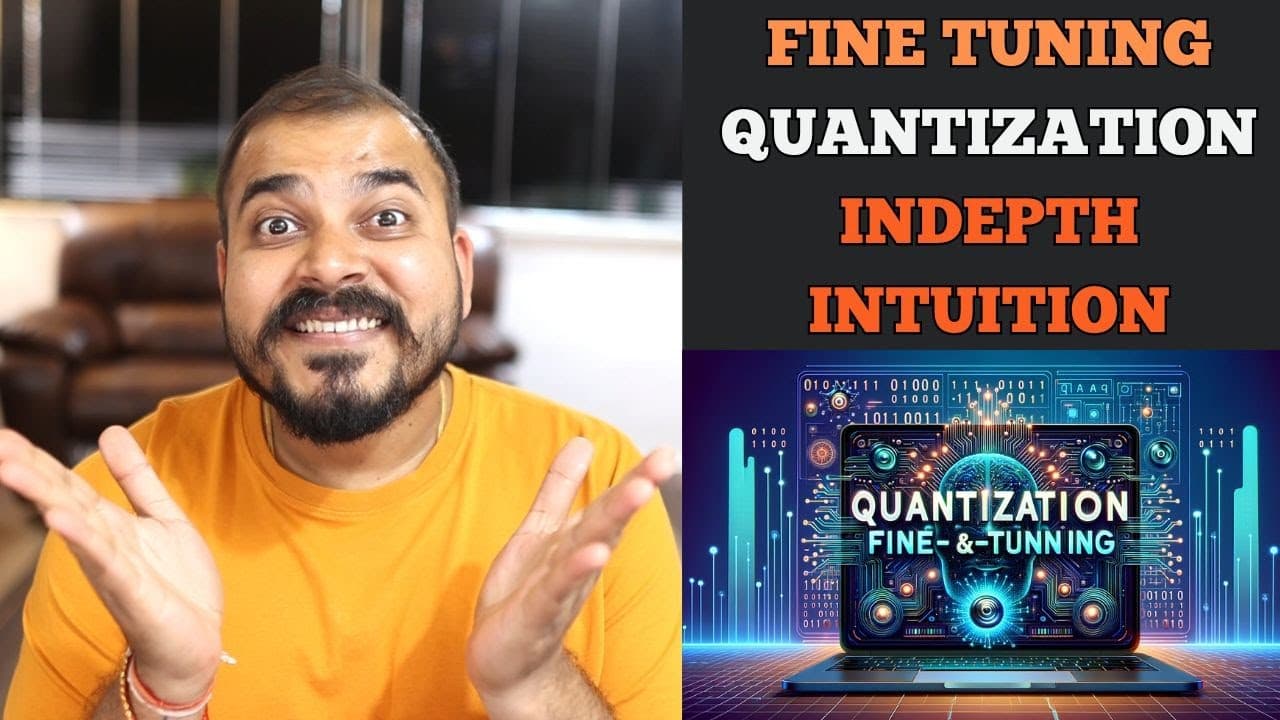
Quantization reduces an LLM's memory requirements by converting weights and biases from a higher-memory format, such as FP32, to a lower-memory format, such as FP16 or INT8. This makes large models easier and faster to run for inference on limited hardware, including mobile phones and edge devices, but the conversion can lose information and reduce accuracy.
Transcript
hello all my name is Kish naak and welcome to my YouTube channel so guys in one of our previous video i' had already shown you how you can actually fine tune Lama 2 model with the with your own custom data set and uh over there we learned about or we saw code that were related to something called as quantization Laura CLA techniques and all right a... Read More
Key Insights
- Quantization is the conversion of model data from a higher-memory format to a lower-memory format. In neural networks and LLMs, the data being converted primarily consists of parameters such as weights and biases stored within the model's layers.
- FP32 is a 32-bit floating-point representation described as full precision or single precision. A model can store each weight value in this format, so models containing billions of parameters can require substantial RAM or GPU memory when loaded.
- FP16 is described as half precision because it uses 16 bits instead of the 32 bits used by FP32. Converting FP32 parameters to FP16 is a form of quantization because it lowers the memory format used to represent model values.
- INT8 quantization converts values stored with 32 bits into 8-bit representations. When model weights use fewer bits, the model consumes less memory and its calculations can complete more quickly, particularly during inference on hardware with limited resources.
- Inference is the process of providing an input to a trained model and receiving an output or response. Quantization supports faster inference because calculations involving lower-bit model weights can be completed more quickly than calculations across a larger full-precision representation.
- Hardware limits are a primary reason to quantize large models. A system with 32 GB of RAM or a GPU with limited memory may be unable to load a large model directly, while a lower-precision representation can make the model more manageable.
- Edge deployment is enabled by reducing the memory footprint of deep learning models. Quantized models can be more practical for mobile phones, smartwatches, and other edge devices where deploying a large model with many full-precision parameters may not be possible.
- Accuracy loss is a potential disadvantage of quantization. Converting model parameters from a 32-bit representation to a lower-bit format can discard information, and this information loss may cause the quantized model to produce less accurate results.
Install to Summarize YouTube Videos and Get Transcripts
Explore YouTube Video Summarizer or Get YouTube Transcript Extractor
Questions & Answers
Q: What is model quantization in large language models?
Model quantization is the conversion of a model's parameters from a higher-memory format to a lower-memory format. In an LLM, those parameters include weights and biases stored throughout its neural network. A typical example is converting values from 32-bit floating-point precision to FP16 or INT8 so the model occupies less memory and can run more efficiently.
Q: Why is quantization important for LLM inference?
Quantization is important for inference because it reduces the number of bits used to store and process model weights. When an input is submitted to an LLM, calculations occur across many parameters before a response is produced. Lower-bit representations reduce the calculation and memory burden, allowing inference to happen more quickly, especially on GPUs with limited capacity.
Q: What is the difference between FP32 and FP16?
FP32 stores a floating-point value with 32 bits and is described as full precision or single precision. FP16 uses 16 bits and is described as half precision. Converting model parameters from FP32 to FP16 is quantization because each value uses a lower-memory format, which reduces the model's memory footprint while potentially discarding some information.
Q: How does INT8 quantization reduce model memory usage?
INT8 quantization reduces memory usage by converting model values that may be stored with 32 bits into 8-bit representations. Each converted weight then requires fewer bits in memory. Across a neural network containing billions of weights and biases, this reduction makes the model smaller and can make it possible to load or run on more limited hardware.
Q: Why can a 70-billion-parameter model be difficult to load?
A 70-billion-parameter model contains approximately 70 billion weights and biases, and every parameter requires memory for storage. If those values are represented with 32 bits, the resulting model may be too large for a system with 32 GB of RAM or for a GPU with limited memory. Quantization lowers the storage required for each parameter.
Q: Where can quantized deep learning models be deployed?
Quantized deep learning models can be deployed on mobile phones, smartwatches, and other edge devices because their parameters require less memory than full-precision versions. The technique is not limited to LLMs. It can also be applied to computer vision and natural language processing models when their numerous weights make direct deployment on constrained hardware impractical.
Q: What is the main disadvantage of model quantization?
The main disadvantage of model quantization is that converting parameters from a higher-bit format to a lower-bit format can cause information loss. For example, changing 32-bit values to INT8 reduces the precision available for representing weights. That loss of precision can lead to reduced model accuracy, creating a tradeoff between efficiency and retained information.
Q: What are post-training quantization and quantization-aware training?
Post-training quantization and quantization-aware training are presented as two modes of model quantization. Post-training quantization applies the conversion after model training, while quantization-aware training applies quantization during the training process. The description states that quantization-aware training is intended to reduce model size without sacrificing accuracy and can typically reduce size by two to four times, sometimes more.
Summary & Key Takeaways
-
Quantization converts model parameters from higher-memory representations to lower-memory representations. For example, weights stored as 32-bit floating-point values can be converted to FP16 or INT8. Because an LLM may contain billions of weights and biases, lowering the storage required for each value can substantially reduce the model's overall memory requirements.
-
The main motivation for quantization is to make large models practical on hardware with limited RAM or GPU memory. A 70-billion-parameter model may be difficult to load on a system with 32 GB of RAM. Reducing parameter precision can enable faster inference while lowering the need for costly cloud computing resources.
-
Quantization is useful beyond large language models because deep learning systems in computer vision and natural language processing can also contain many weights. Smaller representations make deployment more practical on mobile phones, edge devices, and smartwatches. However, converting values to lower precision can discard information and potentially reduce model accuracy.
Read in Other Languages (beta)
Share This Summary 📚
Summarize YouTube Videos and Get Video Transcripts with 1-Click
Try YouTube Summary with ChatGPT & Claude or YouTube Transcript Generator
Explore More Summaries from Krish Naik 📚





Summarize YouTube Videos and Get Video Transcripts with 1-Click
Try YouTube Summary with ChatGPT & Claude or YouTube Transcript Generator