What Will Happen to the Universe in the Future? | Crash Course Pods: The Universe #10
TL;DR
The universe will keep expanding as star formation declines, galaxies become increasingly isolated, and stellar remnants slowly cool. Earth may become uninhabitable in about a billion years as the Sun brightens, while the Milky Way and Andromeda are expected to merge in about 4 billion years. Read on to explore this future from our planet’s fate to the fading visibility of the wider cosmos.
Transcript
walking through the timeline of the universe with Katie has been quite the journey for me it's hard to believe that we started at the very beginning with the big bang and now just 10 episodes later we've finally arrived at the future of the universe and while we don't know exactly what that looks like at least not with unwavering certainty we have ... Read More
Key Insights
- The sun will become a red giant, expanding and potentially engulfing inner planets like Earth.
- In about a billion years, the sun's increased brightness will boil Earth's oceans, drastically affecting habitability.
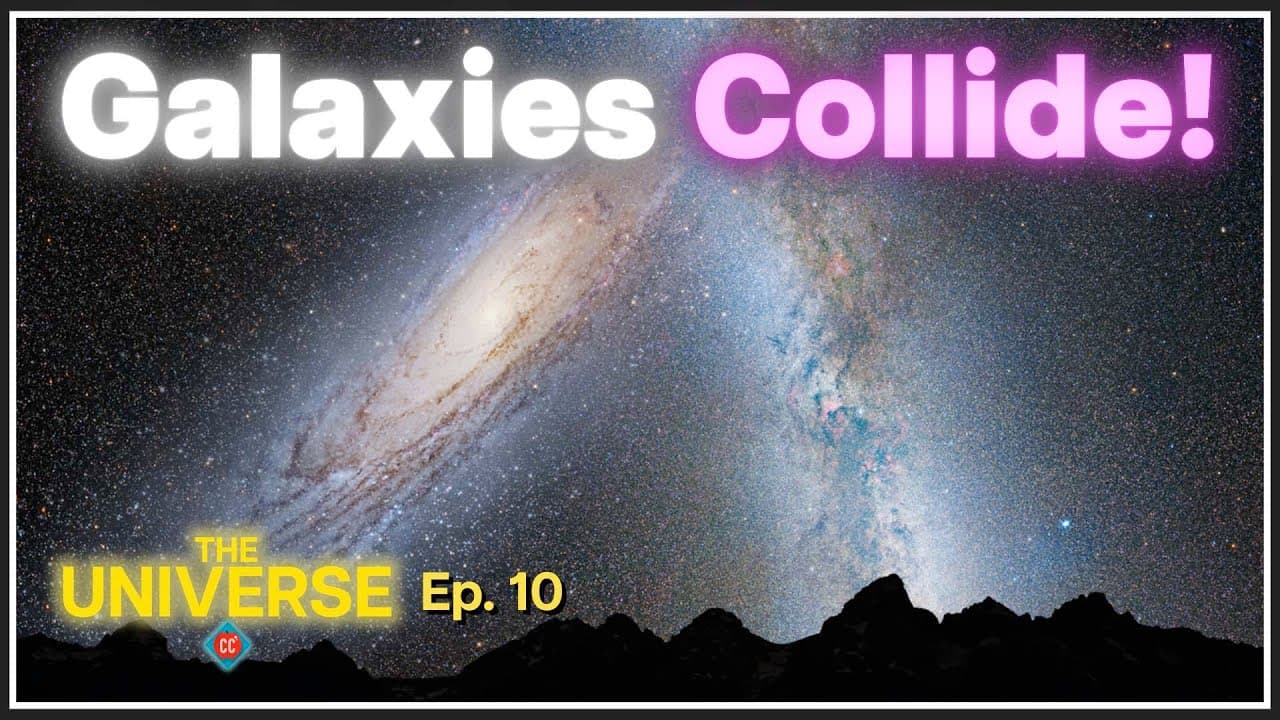
- The Andromeda galaxy is on a collision course with the Milky Way, expected to merge in about 4 billion years.
- Galaxy collisions typically don't result in stellar collisions due to vast interstellar distances.
- The universe's expansion will eventually isolate galaxies, making them invisible to future observers.
- White dwarfs, the remnants of stars like our sun, cool over billions of years and can become black dwarfs.
- Star formation in the universe has peaked, with over 90% of stars already formed.
- Future observers, billions of years from now, may lack evidence of the universe's beginnings and its expansive nature.
Install to Summarize YouTube Videos and Get Transcripts
Explore YouTube Video Summarizer or Get YouTube Transcript Extractor
Questions & Answers
Q: What will happen to the universe in the future?
The universe will continue expanding, causing distant galaxies to move farther apart until their light is redshifted beyond detection. Star formation will decline as galaxies exhaust their gas, leaving fading stars and cooling remnants such as white dwarfs.
Q: How will the Sun’s evolution affect Earth?
The Sun will grow brighter as it ages and will eventually become a red giant. In about a billion years, a 10% increase in its brightness could boil Earth’s oceans and make the planet uninhabitable.
Q: What happens to a star like the Sun after it becomes a red giant?
After its red-giant phase, the Sun will shed its outer layers and form a planetary nebula. Its core will become an Earth-sized white dwarf that cools over billions of years and may eventually become a black dwarf.
Q: When will the Milky Way collide with the Andromeda galaxy?
The Milky Way and Andromeda are expected to collide in about 4 billion years. Their merger will unfold over billions of years and ultimately form a new elliptical galaxy.
Q: Will stars collide when the Milky Way and Andromeda merge?
Direct collisions between individual stars are unlikely because the distances between them are immense. Gravitational interactions will instead redistribute stars, reshape both galaxies, and potentially eject some stars from the merged galaxy.
Q: What is the future of star formation in the universe?
Star formation has already passed its peak, and over 90% of the stars that will ever exist have formed. As galaxies use up their gas supplies, fewer new stars will be born and the universe will gradually become dimmer.
Q: How will cosmic expansion affect future astronomers?
Continued expansion will carry distant galaxies away until their redshifted light is no longer visible. Future observers may therefore see only their local galactic environment and lack evidence of other galaxies, cosmic expansion, and the universe’s beginnings.
Q: Can scientists predict threats to Earth from asteroids and comets?
Scientists can catalog and monitor near-Earth objects, but they cannot predict every future impact or its timing. No currently tracked object is considered a major threat that is very likely to hit Earth, though some potentially hazardous objects remain under observation.
Summary & Key Takeaways
-
The sun will eventually evolve into a red giant, increasing in brightness and size, which could lead to Earth's oceans boiling and the planet becoming uninhabitable. This transformation will occur over the next billion years, marking a significant shift in Earth's environment.
-
The Milky Way will collide with the Andromeda galaxy in about 4 billion years, resulting in a chaotic merging process. While individual star collisions are unlikely, gravitational interactions will reshape the galaxies, forming a new elliptical galaxy over billions of years.
-
As the universe continues to expand, galaxies will drift further apart, eventually becoming invisible to observers due to the redshift of their light. This cosmic isolation will erase evidence of the universe's expansive history, leaving future astronomers with a limited view of the cosmos.
Read in Other Languages (beta)
Share This Summary 📚
Summarize YouTube Videos and Get Video Transcripts with 1-Click
Try YouTube Summary with ChatGPT & Claude or YouTube Transcript Generator
Explore More Summaries from CrashCourse 📚






Summarize YouTube Videos and Get Video Transcripts with 1-Click
Try YouTube Summary with ChatGPT & Claude or YouTube Transcript Generator