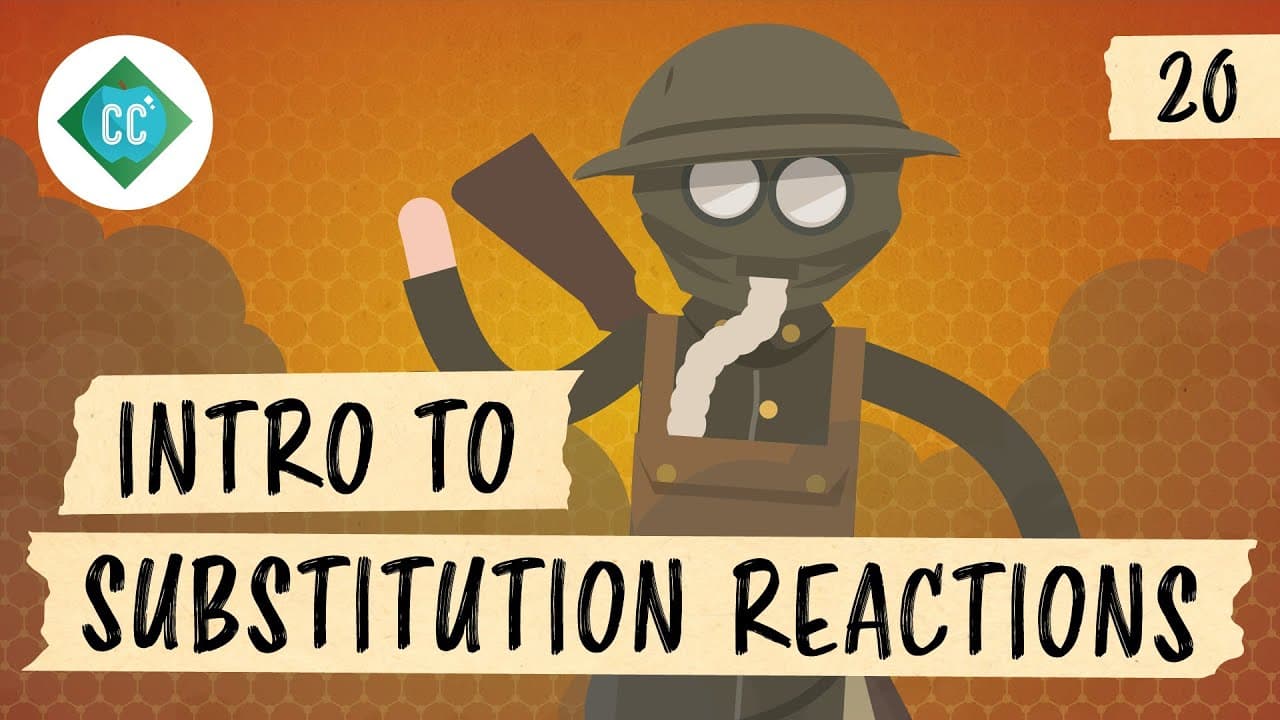
Intro to Substitution Reactions: Crash Course Organic Chemistry #20
TL;DR
Learn about the two pathways, SN1 and SN2, of substitution reactions in organic chemistry and their significance in chemotherapy treatments.
Transcript
You can review content from Crash Course Organic Chemistry with the Crash Course app, available now on Android and iOS devices. Hi! I’m Deboki Chakravarti and welcome to Crash Course Organic Chemistry! World War I has been called the "Chemist's War" because of chemical warfare agents such as phosgene, lewisite, and mustard gas. As bad reputations g... Read More
Key Insights
- 🫢 Mustard gas, used in World War I, led to the discovery of nitrogen mustards with anti-carcinogenic effects.
- 👥 Substitution reactions involve the replacement of one group with another and are essential in organic chemistry.
- ❓ SN1 and SN2 are two different pathways of substitution reactions with distinct mechanisms and stereochemistry outcomes.
- ❓ Tertiary substrates favor SN1 mechanisms, while secondary and primary substrates prefer the SN2 mechanism.
- 😵 Substitution reactions have significant implications in chemotherapy treatments by cross-linking DNA and preventing replication.
- ❓ SN1 reactions occur through a carbocation intermediate, while SN2 reactions proceed through a concerted process.
- 👥 Substitution reactions require an sp3 hybridized carbon, a leaving group, and a nucleophile.
Install to Summarize YouTube Videos and Get Transcripts
Explore YouTube Video Summarizer or Get YouTube Transcript Extractor
Questions & Answers
Q: What is the difference between SN1 and SN2 mechanisms?
SN1 involves a two-step process with the formation of a carbocation intermediate, while SN2 is a one-step process that occurs through a concerted reaction. SN1 reactions can result in the same configuration or inverted stereochemistry, while SN2 reactions always result in inverted stereochemistry.
Q: Why do tertiary substrates favor SN1 mechanisms?
Tertiary substrates have more stable carbocations due to the effects of induction and hyperconjugation. This stability allows them to proceed through the carbocation intermediate of the SN1 mechanism.
Q: How do substitution reactions contribute to chemotherapy treatments?
Substitution reactions involving nitrogen mustards cross-link DNA, preventing it from replicating. This leads to cell death and is the basis of many chemotherapy treatments.
Q: What are the key requirements for a substitution reaction to occur?
A substitution reaction requires an sp3 hybridized carbon as the substrate, a leaving group that can accept electron density, and a nucleophile with a lone pair or pi bond.
Summary & Key Takeaways
-
Mustard gas, used in chemical warfare during World War I, led to the development of nitrogen mustards, which were found to have anti-carcinogenic effects.
-
Substitution reactions in organic chemistry involve the replacement of one group with another, and they require an sp3 hybridized carbon, a leaving group, and a nucleophile.
-
SN1 and SN2 are two pathways of substitution reactions, with SN1 involving a carbocation intermediate and SN2 being a concerted process.
Read in Other Languages (beta)
Share This Summary 📚
Summarize YouTube Videos and Get Video Transcripts with 1-Click
Try YouTube Summary with ChatGPT & Claude or YouTube Transcript Generator
Explore More Summaries from CrashCourse 📚


Summarize YouTube Videos and Get Video Transcripts with 1-Click
Try YouTube Summary with ChatGPT & Claude or YouTube Transcript Generator