What Risks Did Geoffrey Hinton Discuss About AI?
TL;DR
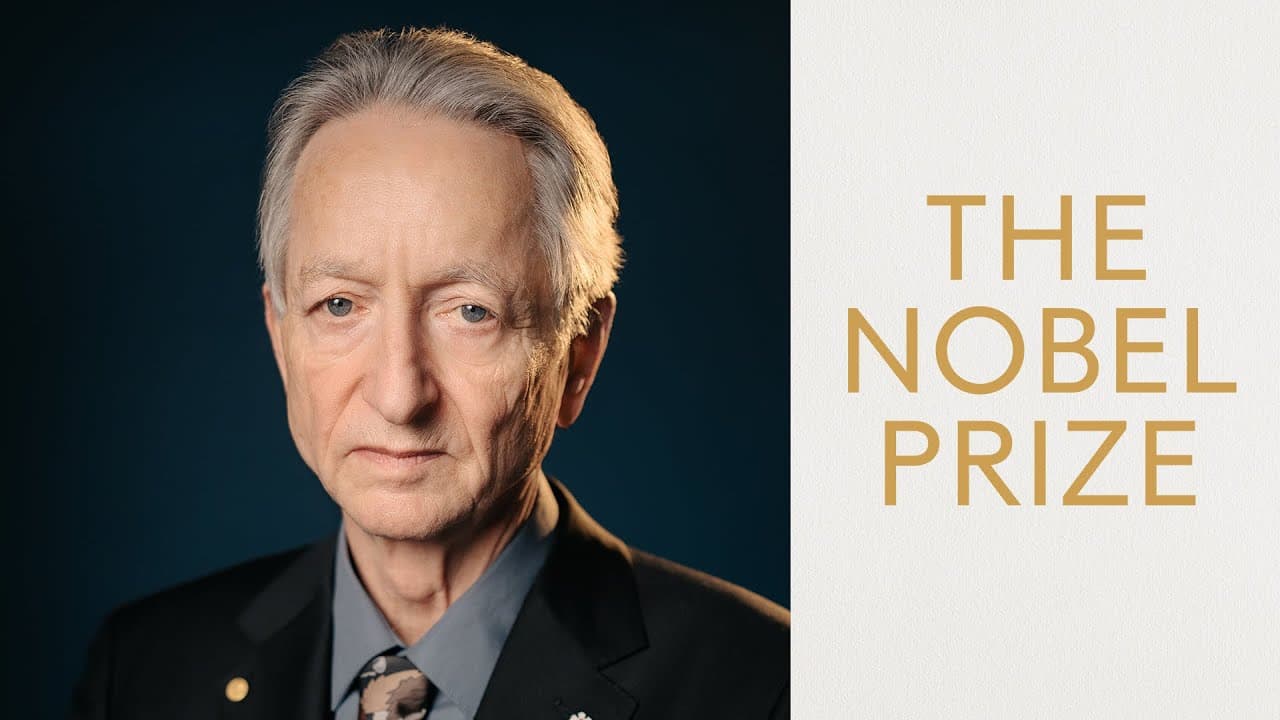
Geoffrey Hinton highlights both short-term and long-term risks associated with AI, including job displacement and the threat of AI surpassing human intelligence. He emphasizes the need for responsible AI training, comparing it to raising a child, and stresses the importance of scientific integrity in addressing these challenges.
Transcript
in between 5 and 20 years from now there's a good chance a 50% chance we'll get AI smarter than us so I was more or less asleep in a hotel room in California and I had my phone upside down on the bedside table with the sound turned off um and I just happened to be sleeping on my side when the phone was in my line of sight and it got... Read More
Key Insights
- Geoffrey Hinton unexpectedly won the Nobel Prize in Physics, despite initially doubting the legitimacy of the news due to his background in psychology rather than physics.
- Hinton's early interest in distributed memory systems and neural networks was sparked by discussions with a high school friend and has driven his career in AI research.
- He identifies two primary risks of AI: short-term risks like job displacement and misinformation, and long-term risks of AI surpassing human intelligence.
- Hinton emphasizes the importance of training AI on positive behavior and warns against using harmful data sources, akin to raising a child with negative influences.
- Despite skepticism, Hinton remained confident in neural networks, drawing parallels between their acceptance and the historical acceptance of continental drift.
- He advises young researchers to persist with unconventional ideas until proven wrong, suggesting that breakthroughs often come from challenging prevailing beliefs.
- Hinton expresses regret for not addressing the existential risks of superintelligent AI sooner, acknowledging the urgency of the issue now.
- He donated his Nobel Prize money to support indigenous communities in Canada and established a prize for young researchers in honor of his collaborator, Terry Sejnowski.
Install to Summarize YouTube Videos and Get Transcripts
Explore YouTube Video Summarizer or Get YouTube Transcript Extractor
Questions & Answers
Q: How did Geoffrey Hinton react to winning the Nobel Prize?
Geoffrey Hinton was initially skeptical upon receiving the call about his Nobel Prize win, doubting its authenticity due to his background in psychology rather than physics. He thought it might be a prank or a dream, given the improbability of a psychologist winning the Nobel Prize in Physics. However, the convincing details from the Swedish callers eventually led him to accept the reality of the award.
Q: What sparked Hinton's interest in AI?
Hinton's interest in AI was sparked by a high school discussion with a friend about distributed memory systems in the brain, inspired by psychologist Karl Lashley's theories. This conversation led him to ponder how memories might be distributed over the brain like holograms, igniting his lifelong interest in understanding brain function and eventually AI.
Q: What are the greatest risks posed by AI, according to Hinton?
According to Hinton, AI presents both short-term and long-term risks. Short-term risks include job displacement, increased inequality, and misuse of AI for misinformation and cyberattacks. Long-term risks involve the potential for AI to surpass human intelligence, raising concerns about control and ethical implications. Hinton stresses the need for proactive research to manage these risks.
Q: How does Hinton suggest AI should be trained?
Hinton suggests that AI should be trained similarly to raising a child, by demonstrating and reinforcing positive behavior. He warns against using harmful data sources, such as the diaries of serial killers, for AI training. Instead, AI systems should be exposed to data that reflects the behavior and values society wishes to see, ensuring ethical development.
Q: What advice does Hinton give to young researchers?
Hinton advises young researchers to persist with their ideas, especially if they differ from mainstream beliefs. He emphasizes the importance of understanding why an unconventional idea might be wrong before abandoning it, as breakthroughs often come from challenging prevailing assumptions. Hinton's own experiences with neural networks and continental drift serve as examples of this persistence.
Q: What does Hinton regret about his career?
Hinton regrets not considering the existential risks of AI sooner, acknowledging that he underestimated the urgency of addressing superintelligent AI. He reflects on the importance of foresight in scientific research and the need to balance innovation with ethical considerations, particularly as AI technology rapidly advances.
Q: How does Hinton view the role of scientists in society?
Hinton believes scientists have a responsibility to understand and communicate the implications of their work, particularly in rapidly advancing fields like AI. He emphasizes the need for scientists to engage with societal issues and contribute to solutions, highlighting the gap in understanding between scientists, politicians, and the general public regarding technological advancements.
Q: What are Hinton's plans for his Nobel Prize money?
Hinton plans to use his Nobel Prize money to support indigenous communities in Canada by funding safe drinking water initiatives. Additionally, he established a prize for young researchers in honor of his collaborator, Terry Sejnowski, to encourage innovative theories on brain function. This reflects Hinton's commitment to societal impact and scientific progress.
Summary & Key Takeaways
-
Geoffrey Hinton shares his disbelief upon receiving the Nobel Prize in Physics, reflecting on his initial skepticism due to his background in psychology rather than physics. He discusses the importance of staying true to one's beliefs, even when faced with widespread skepticism, as demonstrated by his work with neural networks.
-
Hinton highlights the risks associated with AI, including short-term challenges like job displacement and bias, and long-term threats of AI surpassing human intelligence. He stresses the need for responsible AI training, comparing it to raising a child, and warns against using harmful data sources.
-
Reflecting on his career, Hinton regrets not considering the existential risks of AI sooner. He emphasizes the importance of scientific responsibility and uses his Nobel Prize winnings to support indigenous communities and young researchers, honoring his collaborator Terry Sejnowski with a dedicated prize.
Read in Other Languages (beta)
Share This Summary 📚
Summarize YouTube Videos and Get Video Transcripts with 1-Click
Try YouTube Summary with ChatGPT & Claude or YouTube Transcript Generator
Explore More Summaries from Nobel Prize 📚

Summarize YouTube Videos and Get Video Transcripts with 1-Click
Try YouTube Summary with ChatGPT & Claude or YouTube Transcript Generator