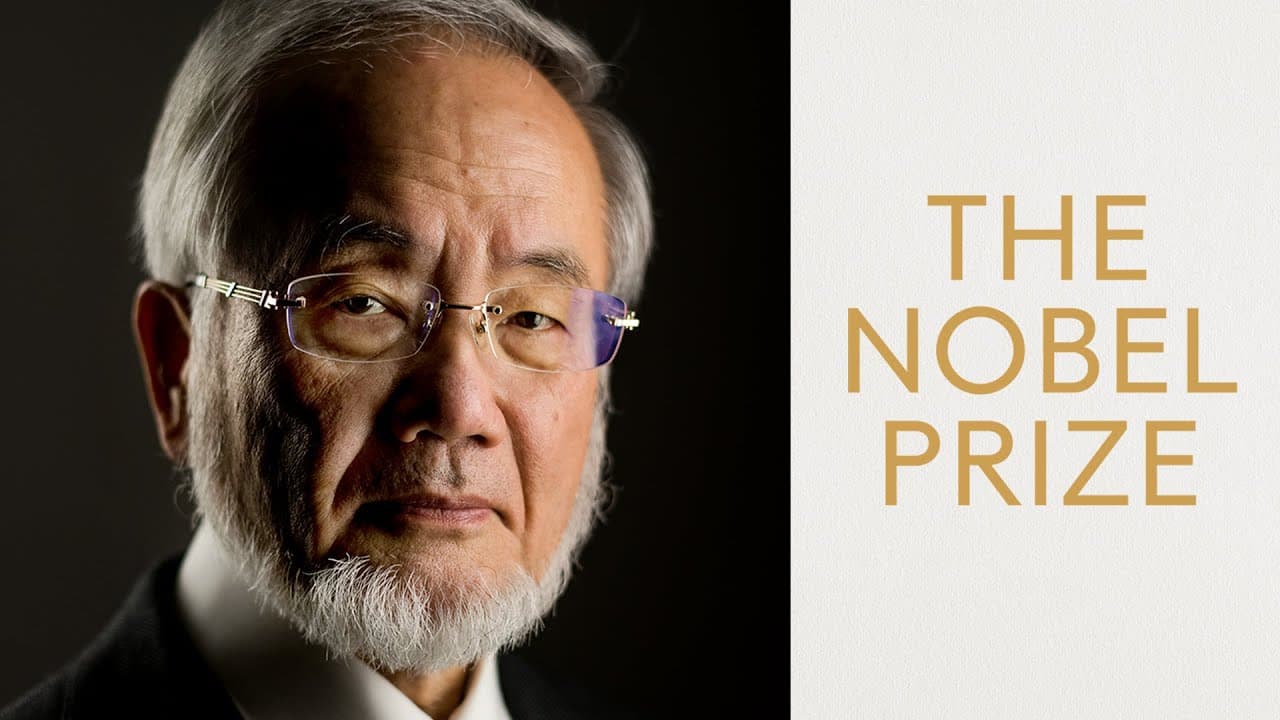
Yoshinori Ohsumi, Nobel Prize in Physiology or Medicine 2016: Official interview
TL;DR
Autophagy helps cells endure starvation by breaking down their own proteins and reusing the resulting material. Nobel laureate Yoshinori Ohsumi investigated this degradation-and-recycling system in yeast, where a large vacuole made internal structures easier to observe. He also explains how autophagy clears harmful proteins and dangerous organelles, and why microscopy launched his research. Read on for the discovery process and its biological significance.
Transcript
you should know assuming yeah welcome to Nobel week Stockholm yeah and all Nobel laureates yeah I were asked to bring a thing an artifact to the Nobel Missy in Stockholm yes so what did you bring yeah I loved these true things yeah I I won't explain now those are gift from my colleagues last year I got this and this is a miniature of 27 years ago o... Read More
Key Insights
- Autophagy is a cellular degradation and recycling process that becomes particularly important during starvation. Cells break down their own proteins and reuse the resulting material, allowing the body to respond when food is unavailable and supporting survival under a common challenge in nature.
- Autophagy is also a quality-control system that removes harmful material from cells. When the process is defective, harmful proteins and dangerous organelles can accumulate, creating serious problems for cellular life in addition to weakening the cell's ability to endure starvation.
- The yeast vacuole is a useful model for studying degradation because Ohsumi regarded it as homologous to the lysosome. Its large size enabled him to observe internal structures and investigate how cellular material crosses a membrane before hydrolytic enzymes attack the enclosed structures.
- Microscopic observation was the starting point of Ohsumi's autophagy research. He saw structures moving and accumulating inside the yeast vacuole under a light microscope, found the phenomenon fascinating, and became convinced that he had encountered a real biological process worth investigating.
- Electron microscopy showed a process resembling the schematic autophagy pathway discussed in the interview. Structures became enclosed within a compartment, entered the vacuole, and were exposed to hydrolytic enzymes that attacked the inner membrane structure, supporting further study of the underlying mechanism.
- A heterogeneous research team is valuable because autophagy requires several complementary approaches. Ohsumi wanted molecular biologists, geneticists, biochemists, and cell biologists in his laboratory, while keeping them focused on the shared problem of resolving how autophagy works.
- Scientific success does not require a single personality type, according to Ohsumi. He described himself as noncompetitive and interested in studying questions that personally fascinated him, while arguing that science and society benefit from people with different characteristics and working styles.
- Molecular biology attracted Ohsumi because the field felt fresh and intellectually exciting during his undergraduate period. Discoveries such as the genetic code stimulated his interest, leading him away from chemistry lectures that had not engaged him and toward research in molecular biology.
Install to Summarize YouTube Videos and Get Transcripts
Explore YouTube Video Summarizer or Get YouTube Transcript Extractor
Questions & Answers
Q: How does autophagy recycle material in cells?
Autophagy delivers cellular components into a compartment containing hydrolytic enzymes, which break down the enclosed structures. The resulting material can then be reused by the cell, making autophagy both a degradation system and a recycling system.
Q: How does autophagy help cells survive starvation?
When food is unavailable, cells break down their own proteins and recycle the resulting material. Ohsumi says that almost every organ activates autophagy during starvation, helping the body respond to a challenge that occurs frequently in nature.
Q: What happens when autophagy is defective?
Cells lose an important recycling mechanism and may become less able to survive starvation. Harmful proteins and dangerous organelles can also accumulate because the cell cannot remove them effectively, creating serious biological problems.
Q: Why did Yoshinori Ohsumi use yeast to study autophagy?
Ohsumi chose yeast because its large vacuole provided a useful model for investigating cellular degradation. He regarded the vacuole as homologous to the lysosome, and its size helped him observe accumulating internal structures and study how material crossed its membrane.
Q: How did microscopy start Yoshinori Ohsumi’s autophagy research?
Under a light microscope, Ohsumi saw structures moving and gradually accumulating inside the yeast vacuole. He considered this direct observation the starting point of his work and described discovering the phenomenon as probably the most exciting moment of his life.
Q: What did electron microscopy reveal about autophagy?
Electron microscopy showed structures becoming enclosed within a compartment and entering the vacuole. Hydrolytic enzymes then attacked the inner membrane structure, producing observations that resembled the schematic autophagy pathway discussed in the interview.
Q: Which research approaches did Ohsumi’s laboratory use to study autophagy?
His laboratory combined molecular biology, genetics, biochemistry, and cell biology. Ohsumi valued a heterogeneous team whose members used complementary methods while remaining focused on the shared problem of understanding autophagy.
Q: Why did Yoshinori Ohsumi become interested in molecular biology?
Ohsumi found his chemistry lectures at the University of Tokyo insufficiently stimulating, while molecular biology felt fresh and fascinating. Developments such as understanding the genetic code excited him during his undergraduate period and motivated him to pursue molecular biology.
Summary
In this video, Nobel laureate Yoshinori Ohsumi is asked about the artifact he brought to the Nobel Ceremony, his research on autophagy, his career, and his personal life. He discusses the significance of autophagy in biology, the importance of a diverse team in research, the characteristics valuable to a scientist, the challenges of studying autophagy, and his advice for young scientists.
Questions & Answers
Q: What artifact did Yoshinori Ohsumi bring to the Nobel Ceremony?
Yoshinori Ohsumi brought two miniature gifts from his colleagues. One was a miniature version of himself from 27 years ago, and the other was a model of the ATG gene, which is related to his research on autophagy.
Q: Why is autophagy important for biology?
Autophagy, the process of self-eating and recycling in cells, is crucial for survival. It helps organisms deal with periods of starvation and protects cells from harmful protein accumulation. Autophagy plays a significant role in our entire body, especially in the brain.
Q: What characteristics are valuable to a scientist?
According to Yoshinori Ohsumi, there isn't a single typical or important way to be a scientist. He believes that heterogeneity is crucial in society, including the scientific community. He emphasizes the need for different types of scientists and diversity in research approaches.
Q: How does Yoshinori Ohsumi ensure diversity within his research group?
Yoshinori Ohsumi aims to have a team with diverse expertise and backgrounds. He believes in focusing on a specific research subject but having a team with researchers specializing in molecular biology, genetics, biochemistry, and cell biology.
Q: Does Yoshinori Ohsumi still do his own experiments?
Although he occasionally tries to do experiments by himself, Yoshinori Ohsumi finds it challenging to continue due to the lack of time and constant demands on his time as a lab leader. However, he continues to be involved in research and guides his team.
Q: Why do cells need a system for recycling, like autophagy?
Autophagy is essential for cells because it helps them survive periods of starvation. It ensures that cells can recycle materials to obtain necessary nutrients. Additionally, autophagy removes harmful or excessive substances from cells, protecting their health.
Q: What happens if a cell has too much or too little autophagy?
Insufficient autophagy can lead to cells being unable to survive under starvation conditions. On the other hand, excessive autophagy can result in the accumulation of harmful proteins or substances in cells, which can be detrimental to their health.
Q: Are there materials in cells that are hard to degrade or recycle?
While lysosomes, cellular organelles responsible for degradation, can break down almost everything, there are diseases known as lysosomal storage disorders where certain proteins or molecules cannot be degraded. However, autophagy-related diseases are less known because autophagy is a more fundamental process.
Q: Why did Yoshinori Ohsumi choose to study autophagy using yeast?
When Yoshinori Ohsumi started studying autophagy, he realized he needed a good model system to understand the molecular mechanisms of autophagy. He chose yeast because it had large vacuoles similar to lysosomes and observed similar structures within them that resembled autophagosomes.
Q: At what point did Yoshinori Ohsumi realize he had made a breakthrough discovery?
Yoshinori Ohsumi realized he had made a breakthrough discovery when he observed the structures of autophagosomes under the microscope. He found the phenomenon fascinating and convincing, leading him to believe he had made a significant discovery in the field of autophagy.
Q: Does Yoshinori Ohsumi have any advice for young scientists?
Yoshinori Ohsumi advises young scientists not to solely focus on publishing papers or working on popular topics. He believes that if they have a genuine interest in a subject and believe they can achieve good results, they should pursue that question and not be in a hurry to move on to the next thing.
Takeaways
Yoshinori Ohsumi's research on autophagy has revealed the importance of this cellular process in biology. Autophagy helps organisms deal with starvation and protects cells from harmful protein accumulation. He emphasizes the need for diversity in the scientific community and believes in giving young scientists the time and freedom to explore their interests. His advice is to stick with a question or phenomena that genuinely interests them, even if it takes years or decades to find answers.
Summary & Key Takeaways
-
Yoshinori Ohsumi describes how seeing structures moving inside the yeast vacuole became the starting point of his autophagy research. He regarded direct observation of biological phenomena as especially important and recalled this microscopic discovery as probably the most exciting moment of his life, because it revealed a compelling process requiring explanation.
-
Autophagy is presented as both a degradation system and a recycling system. During starvation, cells break down their own proteins and reuse the resulting material, helping the body survive without food. The process also protects cells by clearing harmful proteins and dangerous organelles that could accumulate and cause serious biological problems.
-
Ohsumi explains that he chose yeast because its large vacuole offered a useful model for studying cellular degradation and membrane movement. His laboratory combined molecular biology, genetics, biochemistry, and cell biology. He valued heterogeneous research teams and preferred pursuing personally interesting, less competitive questions rather than following already popular fields.
Read in Other Languages (beta)
Share This Summary 📚
Summarize YouTube Videos and Get Video Transcripts with 1-Click
Try YouTube Summary with ChatGPT & Claude or YouTube Transcript Generator
Explore More Summaries from Nobel Prize 📚
Summarize YouTube Videos and Get Video Transcripts with 1-Click
Try YouTube Summary with ChatGPT & Claude or YouTube Transcript Generator