How to Calculate Protons, Neutrons, and Electrons
TL;DR
To calculate protons, neutrons, and electrons in an atom, start with the atomic number, which equals the number of protons. The number of neutrons is found by subtracting the atomic number from the mass number. For neutral atoms, the number of electrons equals the number of protons, while for ions, adjust according to the charge.
Transcript
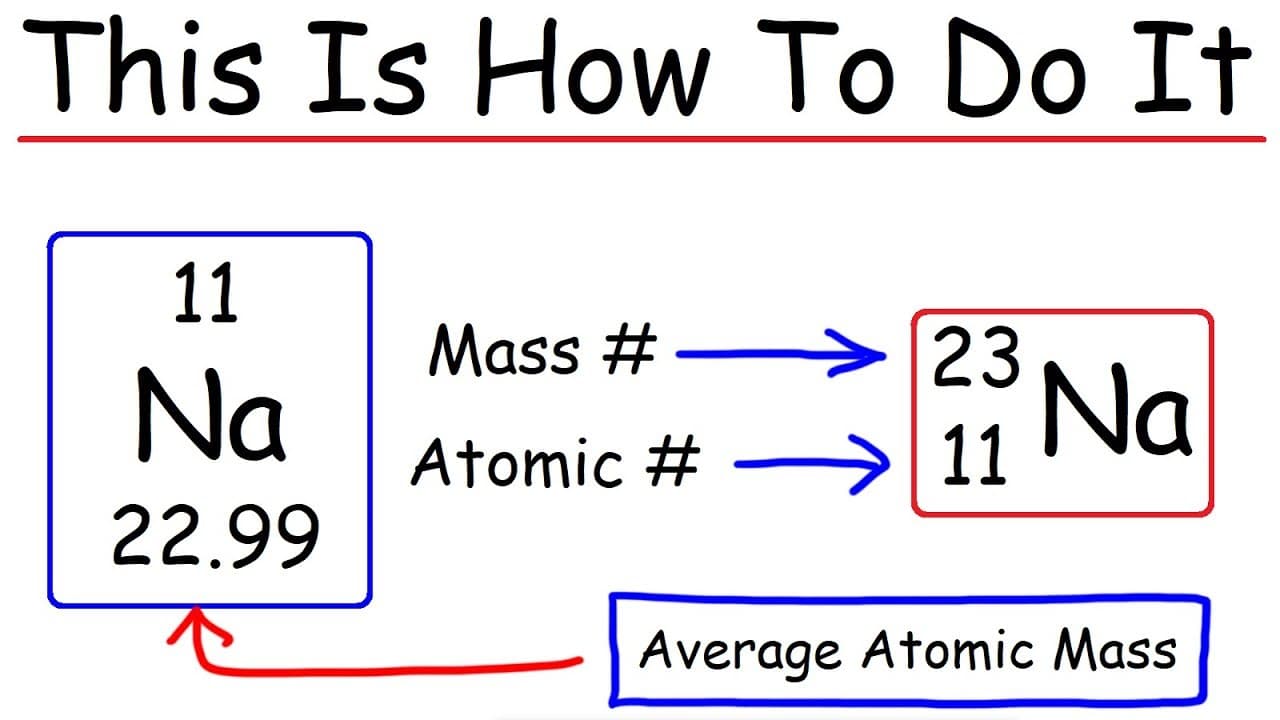
in this lesson we're going to talk about how to calculate the number of protons neutrons and electrons in an atom and in an ion so let's use sodium as an example and on a periodic table you might see something that looks like this the smaller of the two numbers is the atomic number which is also equal to the number of protons the larger of the two ... Read More
Key Insights
- #️⃣ The atomic number determines the identity of an element, while the mass number represents a specific isotope.
- 😐 In neutral atoms, the number of protons and electrons are equal.
- 🍹 Cations have fewer electrons than protons, while anions have more electrons than protons.
- #️⃣ The number of neutrons can be calculated by subtracting the atomic number from the mass number.
- 😑 The charge of an ion affects the number of electrons.
- 🫀 The average atomic mass is the weighted average of all isotopes of an element.
- ❓ Sodium-23 is the most abundant and stable isotope of sodium on Earth.
Install to Summarize YouTube Videos and Get Transcripts
Explore YouTube Video Summarizer or Get YouTube Transcript Extractor
Questions & Answers
Q: How do you calculate the number of protons in an atom?
The number of protons in an atom is equal to the atomic number, which is indicated on the periodic table.
Q: What is the difference between the average atomic mass and the mass number?
The average atomic mass represents the weighted average of all isotopes of an element, while the mass number refers to a specific isotope of an element.
Q: How do you calculate the number of electrons in an ion?
The number of electrons in an ion is equal to the atomic number minus the charge of the ion. For neutral atoms, the number of electrons and protons are the same.
Q: How do you calculate the number of neutrons in an atom?
The number of neutrons in an atom is the difference between the mass number and the atomic number.
Summary & Key Takeaways
-
The atomic number on the periodic table represents the number of protons in an atom, while the average atomic mass is the mass number and represents a specific isotope.
-
For neutral atoms, the number of electrons is equal to the atomic number, and the number of neutrons is the difference between the mass number and atomic number.
-
In ions, the number of electrons and protons differs depending on the charge, with cations having fewer electrons and anions having more electrons.
Read in Other Languages (beta)
Share This Summary 📚
Summarize YouTube Videos and Get Video Transcripts with 1-Click
Try YouTube Summary with ChatGPT & Claude or YouTube Transcript Generator
Explore More Summaries from The Organic Chemistry Tutor 📚



Summarize YouTube Videos and Get Video Transcripts with 1-Click
Try YouTube Summary with ChatGPT & Claude or YouTube Transcript Generator