What Is Ionic Radius and How Does It Change?
TL;DR
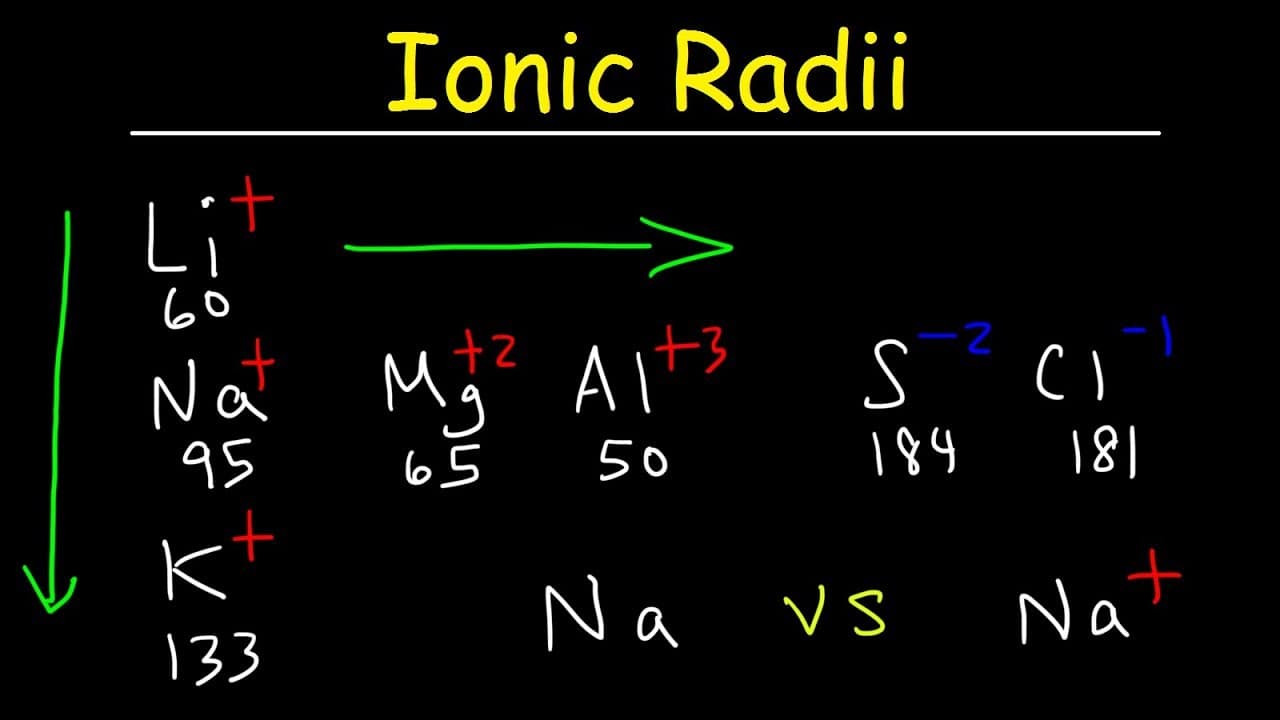
Ionic radius increases down the periodic table, with negatively charged ions larger than positively charged ions. Positively charged ions are generally smaller than their parent atoms, while negatively charged ions are larger due to electron-electron repulsion. For isoelectronic ions, those with higher positive charges are smaller, and those with higher negative charges are larger.
Transcript
in this video we're gonna talk about ionic radii and the sizes of ions and ionic radii follows the same trend as atomic radii that is the ions get bigger as you go down so for example let's draw some ions so here we have the lithium plus ion and then the sodium plus cation and also the potassium cation now the lithium ion is about sixty Pico meters... Read More
Key Insights
- 🫀 Ionic radii follow the trend of atomic radii, increasing as you move down the periodic table.
- 😑 Positively charged ions are smaller than their parent atoms, while negatively charged ions are larger.
- ✋ Comparing ions with the same electron configuration, those with higher positive charges are smaller, and those with higher negative charges are larger.
- 😐 Cations are always smaller than the corresponding parent neutral atom.
- 😑 The more energy levels an ion has, the larger its size.
- 😑 Negatively charged ions have expanded electron clouds due to electron-electron repulsion.
- 🧘 The size of an ion is influenced by its position on the periodic table and the effective nuclear charge.
Install to Summarize YouTube Videos and Get Transcripts
Explore YouTube Video Summarizer or Get YouTube Transcript Extractor
Questions & Answers
Q: Why do ionic radii increase as you go down the periodic table?
Ionic radii increase as you go down the periodic table because the number of energy levels or electron shells increases, causing the electron cloud to be spread out more and making the ions larger.
Q: How does the size of cations compare to their parent neutral atoms?
Cations are smaller than their parent neutral atoms. This is because cations have lost electrons, resulting in a reduced number of energy levels or electron shells.
Q: Why do negatively charged ions tend to be larger than positively charged ions?
Negatively charged ions are larger because they have gained electrons, causing more electron-electron repulsion and making the electron cloud expand.
Q: How does the size of gallium compared to calcium?
Gallium is smaller than calcium. This is because gallium is to the right of calcium on the periodic table, and as you move towards the right, the ionic radii decrease due to the higher effective nuclear charge.
Summary & Key Takeaways
-
Ionic radii increase as you move down the periodic table, with lithium being smaller than sodium and potassium.
-
Positively charged ions are smaller than their parent neutral atoms, while negatively charged ions are larger.
-
When comparing ions with the same electron configuration (isoelectronic ions), those with higher positive charges are smaller, while those with higher negative charges are larger.
Read in Other Languages (beta)
Share This Summary 📚
Summarize YouTube Videos and Get Video Transcripts with 1-Click
Try YouTube Summary with ChatGPT & Claude or YouTube Transcript Generator
Explore More Summaries from The Organic Chemistry Tutor 📚



Summarize YouTube Videos and Get Video Transcripts with 1-Click
Try YouTube Summary with ChatGPT & Claude or YouTube Transcript Generator