How to Calculate Heat Current and Temperature Gradient
TL;DR
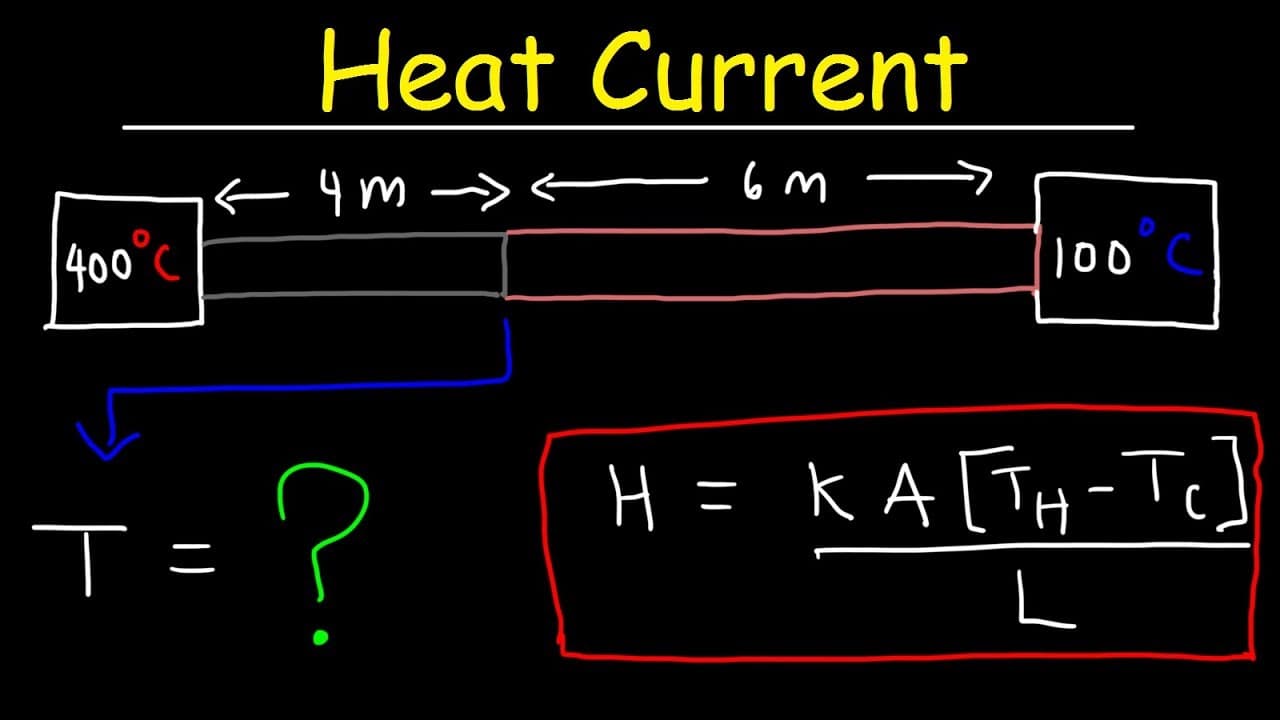
To calculate heat current, use the formula h = k * A * (T_hot - T_cold) / L, where k is thermal conductivity, A is cross-sectional area, T_hot and T_cold are temperatures, and L is length. The temperature gradient is calculated by dividing the temperature change by the length, indicating how temperature varies along a rod. Thermal energy transferred in time can be obtained by multiplying heat current by time.
Transcript
consider this problem we have a long circular cylindrical rod made of copper and it's placed between two other metals a hot metal and a cold metal now the hot metal is at 200 degrees celsius and the cold metal is 100 degrees celsius in temperature now the length of the copper rod it's five meters long how can we calculate the heat current in this m... Read More
Key Insights
- 🥵 Heat current, represented by h, is the rate at which heat energy is transferred in a material and can be calculated using the formula h = k * A * (T_hot - T_cold) / L.
- 🥵 Thermal energy transfer can be calculated by multiplying the heat current by the time.
- 💱 The temperature gradient, found by dividing the change in temperature by the length, indicates how the temperature changes along a metal rod.
- 😅 The steady-state temperature in a metal rod can be determined by considering the temperature gradient and the initial hot temperature.
- 🥵 The thermal conductivity of a material affects its ability to transfer heat.
- 😘 Metals have high thermal conductivity and low thermal resistance, while insulators have low thermal conductivity and high thermal resistance.
- 🥵 Cross-sectional area and length are important factors in heat transfer calculations.
Install to Summarize YouTube Videos and Get Transcripts
Explore YouTube Video Summarizer or Get YouTube Transcript Extractor
Questions & Answers
Q: How can heat current be calculated in a copper rod?
Heat current in a copper rod can be calculated using the formula h = k * A * (T_hot - T_cold) / L, where k is the thermal conductivity, A is the cross-sectional area, T_hot is the temperature of the hot metal, T_cold is the temperature of the cold metal, and L is the length of the rod.
Q: What is the formula for calculating thermal energy transfer in a given time?
The formula is q = h * t, where q is the thermal energy transferred, h is the heat current, and t is the time in seconds.
Q: How can the temperature gradient be determined in a metal rod?
The temperature gradient can be calculated using the formula ΔT / L, where ΔT is the change in temperature and L is the length of the rod.
Q: How can the steady-state temperature at a specific point in a metal rod be calculated?
The steady-state temperature at a specific point can be determined by considering the temperature gradient and subtracting or adding the corresponding temperature changes from the initial hot temperature.
Summary & Key Takeaways
-
The heat current in a copper rod can be calculated using the difference in temperature, thermal conductivity, area, and length of the rod.
-
Thermal energy transferred in a given time can be calculated by multiplying the heat current by the time.
-
The temperature gradient is the change in temperature divided by the length and can be used to determine the temperature at different points in a rod.
Read in Other Languages (beta)
Share This Summary 📚
Summarize YouTube Videos and Get Video Transcripts with 1-Click
Try YouTube Summary with ChatGPT & Claude or YouTube Transcript Generator
Explore More Summaries from The Organic Chemistry Tutor 📚


Summarize YouTube Videos and Get Video Transcripts with 1-Click
Try YouTube Summary with ChatGPT & Claude or YouTube Transcript Generator