How to Improve AI Writing for Business Documents
TL;DR
Better AI business writing starts with explicit intent, concrete quality criteria, decision-focused structure, and clear failure tests, not merely a different model. Organizations should encode their business logic in prompts, use AI for first-pass evaluation, and replace vague revision requests with specific diagnoses of what the document must accomplish and where the draft failed.
Transcript
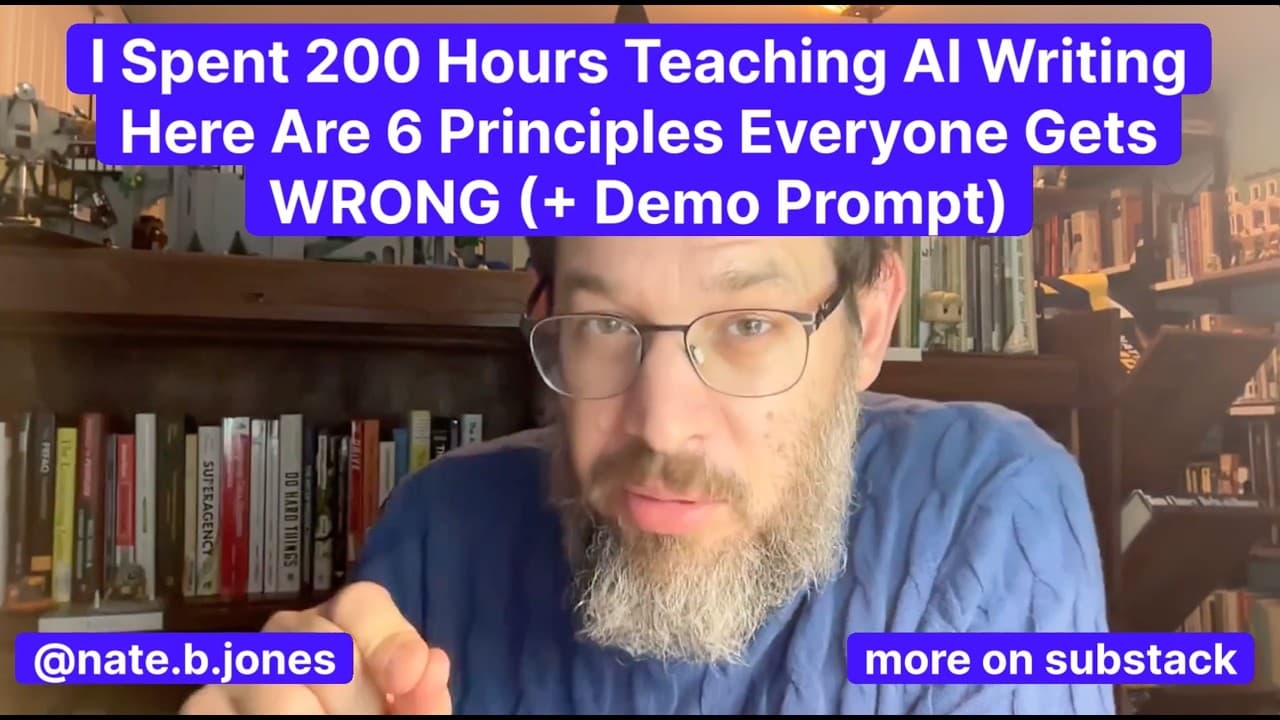
AI has dropped the cost of business writing to nearly zero. And most of the businesses I work with or know about are drowning in AI documents and have huge issues with AI business writing. This video is how you troubleshoot those. What the principles are for using AI well in business writing situations. And then I'm going to walk through an actual ... Read More
Key Insights
- The primary bottleneck in AI-assisted business writing is organizational specification, not model capability. Businesses must convert tacit judgments about quality into explicit standards that an AI system can follow, test, and verify rather than relying on employees to recognize good work intuitively.
- Ambiguity in document requirements is amplified during AI generation. Added detail may make an unclear request more elaborate without resolving its underlying uncertainty, so successful organizations clearly articulate their requirements and encode those requirements into prompts, frameworks, or structured document instructions.
- AI can support evaluation as well as generation. Because businesses may lack time to review every AI-produced document manually, they can give AI clear quality requirements and use it for a first-pass assessment before a person conducts any necessary higher-level review.
- A document's structure represents business logic, not merely formatting. Templates identify boxes to complete, but effective prompts also explain the document's goal, the reasoning connecting its sections, and the decision or action that the finished document is intended to enable.
- Failure tests help AI distinguish acceptable writing from recurring organizational problems. Five to seven examples of common defects, such as excessive product hype, vague executive summaries, or technical specifications based on an unsuitable architecture, can make quality expectations more concrete.
- Default AI voice can cause information loss in business communication. Diplomatically hedged, bland, and superficially comprehensive prose may obscure conviction, specificity, uncertainty, and the relative importance of different facts, reducing the informational signal needed for sound decisions.
- Iteration works best when users diagnose a draft's specific failure. A vague instruction such as "make it better" does not communicate intent, while identifying missing specificity, inappropriate tone, unsupported confidence, or weak decision support gives the system actionable revision criteria.
- Intent becomes more valuable as the cost of generating information approaches zero. Without clearly defined purposes and standards, growing document volume can degrade informational signal, make decisions harder, and leave organizations feeling overwhelmed by low-quality business writing.
Install to Summarize YouTube Videos and Get Transcripts
Explore YouTube Video Summarizer or Get YouTube Transcript Extractor
Questions & Answers
Q: What is the main bottleneck in AI business writing?
The main bottleneck is an organization's ability to articulate what good work looks like, not the AI model's capacity to generate text. Businesses have often depended on individuals' tacit instincts instead of documented standards. AI cannot infer those hidden judgments reliably, so every important quality criterion must become concrete enough to specify in a prompt, test during evaluation, and verify in the finished document.
Q: How can businesses define quality standards for AI writing?
Businesses can define quality by stating the document's purpose, intended audience, required decision, logical structure, and verifiable success criteria. They should replace judgments such as "I know it when I see it" with explicit requirements. They should also record recurring communication failures, including vagueness, excessive hype, and unsuitable assumptions, so prompts and evaluations can distinguish strong output from familiar defects.
Q: Why does ambiguity make AI-generated documents worse?
Ambiguity is amplified because an AI system generates details within the unclear boundaries it receives. Those details can make the result appear complete while preserving or expanding the original uncertainty. A prompt should therefore clarify what the document must accomplish, which information matters, what decision it supports, and how quality will be judged before asking the system to produce polished prose.
Q: How should AI be used to evaluate business writing?
AI can take a first pass at evaluation when it receives the same clear requirements used to guide generation. It can compare a draft against defined goals, quality criteria, structural expectations, and known failure patterns. This approach helps businesses scale review when they cannot manually inspect every generated document, while keeping the evaluation tied to explicit organizational standards rather than generic preferences.
Q: Why is a document template insufficient for prompting AI?
A template provides sections or boxes to complete, but it may omit the reasoning that makes the document useful. AI needs the underlying business logic, including the document's intent, how its sections relate, and which decision it should enable. Without that information, the system can fill every field correctly yet still produce writing that is generic, poorly reasoned, or irrelevant to the intended outcome.
Q: What are failure tests in AI writing prompts?
Failure tests describe recognizable ways a document can go wrong. Examples include a press release that exaggerates product capabilities, an executive memo that lacks specificity, or a technical specification that assumes an architecture the organization does not use. Providing five to seven such examples helps the AI identify unacceptable patterns and gives both generation and evaluation a more concrete standard.
Q: Why does default AI voice reduce business information quality?
Default AI prose tends to be diplomatically hedged, bland, and superficially comprehensive. That voice may weaken conviction, blur uncertainty, and make important facts difficult to distinguish from secondary details. Strong business writing needs enough range to state a firm bet, provide precise support, and openly identify areas that remain uncertain. Generic voice can suppress these distinctions and reduce useful informational signal.
Q: How should users revise weak AI-generated business documents?
Users should diagnose the precise failure instead of entering a vague request such as "make it better." They can identify missing specificity, excessive hype, weak reasoning, inappropriate assumptions, unclear uncertainty, or failure to support the intended decision. The revised prompt should then state the relevant intent and correction explicitly, giving the AI an actionable target and improving the organization's reusable writing standards.
Summary & Key Takeaways
-
AI has made business writing inexpensive to generate, but the resulting volume can overwhelm organizations. The central constraint is an organization's ability to define good work explicitly. Quality criteria must be specific enough to include in prompts, evaluate consistently, and verify instead of depending on individual instinct or an undefined sense of quality.
-
Effective documents should serve identifiable goals and decisions. A template supplies sections, but it does not necessarily convey the business logic connecting those sections. Prompts therefore need the document's purpose, intended decision, logical structure, and relevant context. Without these elements, AI can complete every requested field while still producing an ineffective document.
-
Improvement requires systematic evaluation and diagnosis. AI can conduct a first review when given explicit standards, while failure examples clarify unacceptable outcomes such as hype, vagueness, or inappropriate technical assumptions. Users should identify the specific defect in a draft and revise the instructions accordingly instead of asking the system only to make the writing better.
Read in Other Languages (beta)
Share This Summary 📚
Summarize YouTube Videos and Get Video Transcripts with 1-Click
Try YouTube Summary with ChatGPT & Claude or YouTube Transcript Generator
Explore More Summaries from AI News & Strategy Daily | Nate B Jones 📚






Summarize YouTube Videos and Get Video Transcripts with 1-Click
Try YouTube Summary with ChatGPT & Claude or YouTube Transcript Generator