What Are Integrated Circuits and Moore's Law?
TL;DR
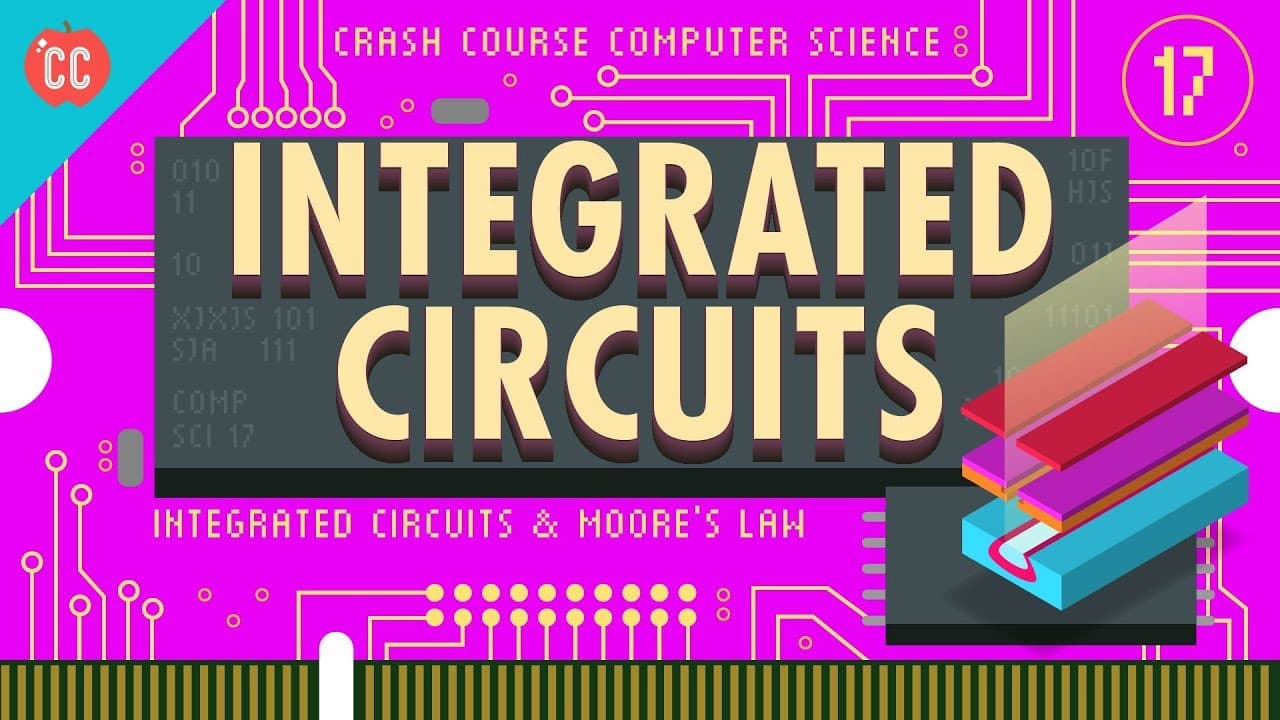
Integrated circuits (ICs) revolutionized computing by consolidating many discrete components into a single unit, drastically reducing complexity and cost. This innovation, alongside printed circuit boards (PCBs), enabled the miniaturization of electronics, leading to the exponential growth described by Moore's Law. Photolithography further advanced IC manufacturing, allowing for billions of transistors on a single chip.
Transcript
This episode is brought to you by Curiosity Stream. Hi, I’m Carrie Anne, and welcome to CrashCourse Computer Science! Over the past six episodes, we delved into software, from early programming efforts to modern software engineering practices. Within about 50 years, software grew in complexity from machine code punched by hand onto paper tape, to o... Read More
Key Insights
- Integrated circuits (ICs) are single components containing multiple electronic parts, reducing complexity and cost.
- Photolithography is a process using light to etch complex patterns onto semiconductors, essential for IC manufacturing.
- Moore's Law predicts a doubling of transistors in the same space approximately every two years, driving technological advancement.
- Printed circuit boards (PCBs) integrate metal wires to connect components, enhancing reliability and manufacturability.
- Transistors have evolved from vacuum tubes to silicon-based components, significantly increasing computing speed and efficiency.
- The Intel 4004 was the first microprocessor IC, marking a milestone in computing with 2,300 transistors.
- VLSI software automates chip design, enabling the creation of complex circuits beyond manual capabilities.
- Challenges to further miniaturization include photolithography limits and quantum tunneling in small transistors.
Install to Summarize YouTube Videos and Get Transcripts
Explore YouTube Video Summarizer or Get YouTube Transcript Extractor
Questions & Answers
Q: What are integrated circuits?
Integrated circuits (ICs) are electronic components that consolidate multiple discrete parts, such as transistors, resistors, and capacitors, into a single unit. This integration reduces complexity, cost, and physical size, enabling the development of more compact and efficient electronic devices. The invention of ICs marked a significant advancement in computing technology.
Q: How does photolithography work in IC manufacturing?
Photolithography is a process used in IC manufacturing to transfer complex patterns onto semiconductor materials like silicon. It involves coating a silicon wafer with photoresist, exposing it to light through a photomask, and then using chemicals to etch the desired circuit patterns. This technique allows for the creation of intricate electronic circuits on a microscopic scale.
Q: What is Moore's Law?
Moore's Law is an observation made by Gordon Moore, co-founder of Intel, stating that the number of transistors on a microchip doubles approximately every two years, leading to increased computing power and decreased relative cost. Although not a physical law, this trend has driven the rapid advancement of technology over the past several decades.
Q: Why are printed circuit boards important?
Printed circuit boards (PCBs) are crucial in electronics as they provide a stable and reliable platform to connect electronic components. PCBs integrate metal traces to form circuits, eliminating the need for manual wiring and reducing the potential for errors. This innovation allows for mass production, increased reliability, and reduced manufacturing costs.
Q: How did the Intel 4004 impact computing?
The Intel 4004, released in 1971, was the first microprocessor to be manufactured as an integrated circuit. It contained 2,300 transistors and marked a significant milestone in computing by demonstrating the feasibility of packing an entire CPU into a single chip. This innovation paved the way for modern microprocessors and the rapid development of personal computing.
Q: What challenges exist for further miniaturization of transistors?
Further miniaturization of transistors faces challenges such as the limitations of photolithography in creating smaller features and the phenomenon of quantum tunneling, where electrons can cross tiny gaps between electrodes. These issues affect the efficiency and reliability of transistors, complicating efforts to continue the trend predicted by Moore's Law.
Q: How has VLSI software changed chip design?
Very-large-scale integration (VLSI) software has transformed chip design by automating the layout of complex circuits. This software uses techniques like logic synthesis to efficiently design intricate components such as memory caches, which would be impractical to create manually. VLSI has enabled the production of highly sophisticated microchips, contributing to the development of fourth-generation computers.
Q: What role do transistors play in modern electronics?
Transistors are fundamental components in modern electronics, acting as switches or amplifiers to control electrical signals. They enable the functionality of integrated circuits, which are essential in all digital devices, from computers to smartphones. The evolution of transistors from large vacuum tubes to tiny silicon components has been pivotal in the miniaturization and advancement of technology.
Summary & Key Takeaways
-
Integrated circuits (ICs) revolutionized computing by packaging multiple components into a single unit, overcoming the 'Tyranny of Numbers' faced by discrete components. This innovation, alongside printed circuit boards (PCBs), reduced complexity and costs, leading to the exponential growth described by Moore's Law.
-
Photolithography, a process using light to etch patterns onto semiconductors, enabled the creation of increasingly complex ICs. This advancement allowed for the miniaturization of electronics, with modern ICs containing billions of transistors, a feat unimaginable with earlier technologies.
-
Moore's Law, though not a true law, has accurately predicted the trend of doubling transistor count approximately every two years. This trend has driven significant technological advancements, though challenges like quantum tunneling and photolithography limits may impact future progress.
Read in Other Languages (beta)
Share This Summary 📚
Summarize YouTube Videos and Get Video Transcripts with 1-Click
Try YouTube Summary with ChatGPT & Claude or YouTube Transcript Generator
Explore More Summaries from CrashCourse 📚





Summarize YouTube Videos and Get Video Transcripts with 1-Click
Try YouTube Summary with ChatGPT & Claude or YouTube Transcript Generator