How Do Embodied Foundation Models Enhance Robotics?
TL;DR
Embodied foundation models integrate reinforcement learning and language models to enhance robotic navigation and autonomy. They address challenges in sim-to-real transfer, focusing on diversity, adaptation, and generalization. These models aim to improve robotic capabilities in diverse environments, making them more effective in complex tasks like disaster response and exploration.
Transcript
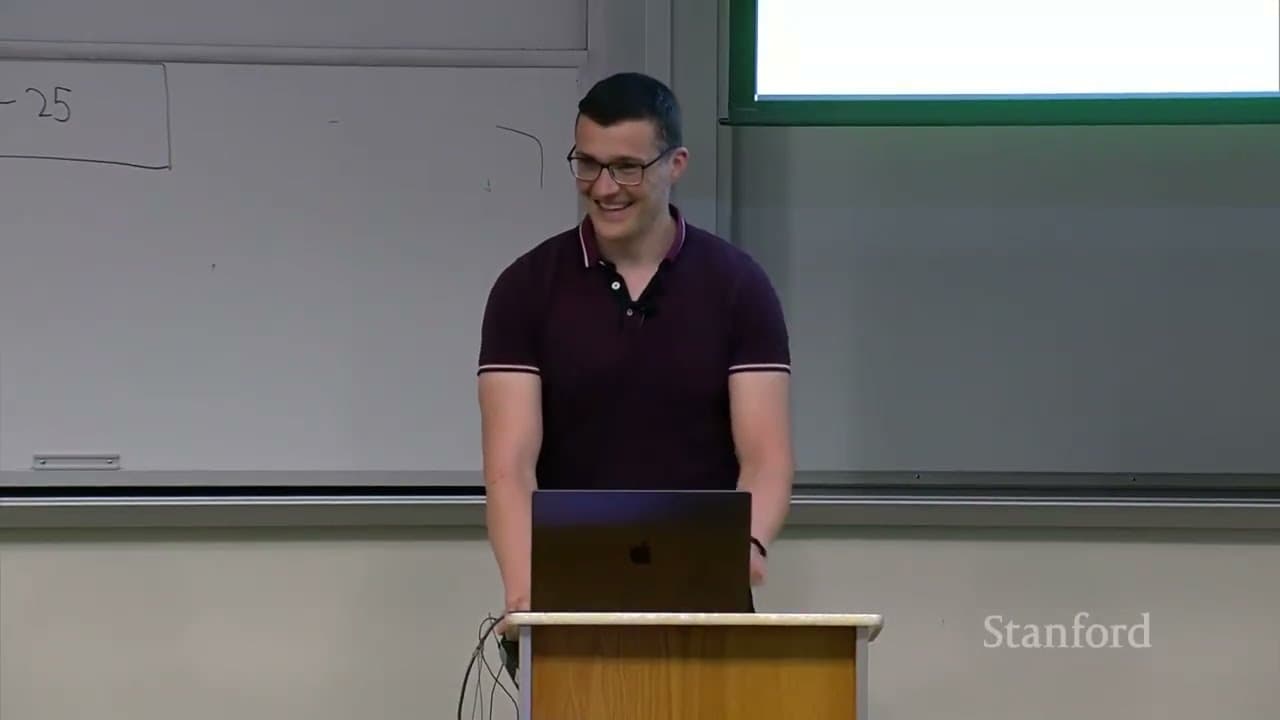
So thanks a lot for inviting me here to give a talk. I'm not here since like nine years, seven years uh just like two months. Uh so I will be sharing a little bit of the work that we have done at ETH sur on quadripedal robots but also what we're doing here between UC Berkeley and Stanford. So the talk is titled embodied foundation models. But befor... Read More
Key Insights
- Embodied foundation models combine reinforcement learning with language models to improve robotic navigation and autonomy.
- Robotic autonomy involves independently perceiving, understanding, and acting in diverse environments.
- Sim-to-real transfer is crucial for deploying learned policies from simulations to real-world robots effectively.
- Diversity in training environments and data is essential for robust robotic learning and adaptation.
- Adaptation allows robots to adjust policies based on real-time environmental feedback, enhancing performance.
- Vision is a critical component for robotic navigation, enabling better decision-making in complex terrains.
- Language models can guide robots in navigation tasks by interpreting natural language instructions.
- Challenges in sim-to-real transfer for manipulation include accurate force prediction and limited solution spaces.
Install to Summarize YouTube Videos and Get Transcripts
Explore YouTube Video Summarizer or Get YouTube Transcript Extractor
Questions & Answers
Q: How do embodied foundation models improve robotic navigation?
Embodied foundation models enhance robotic navigation by integrating reinforcement learning and language models, allowing robots to understand and execute complex tasks in diverse environments. These models focus on increasing training diversity and enabling real-time adaptation, which improves the robots' ability to navigate autonomously and handle various terrains effectively.
Q: What is the significance of sim-to-real transfer in robotics?
Sim-to-real transfer is crucial in robotics as it involves deploying policies learned in simulations to real-world robots. Effective sim-to-real transfer ensures that robots can perform tasks accurately outside the controlled simulation environment. Challenges include ensuring accurate force predictions and dealing with the limited solution spaces, especially in manipulation tasks.
Q: Why is diversity important in robotic training environments?
Diversity in training environments is essential for developing robust robotic systems capable of adapting to a wide range of real-world scenarios. By exposing robots to varied conditions during training, they learn to handle unexpected situations and perform tasks effectively across different terrains and environments, improving their overall autonomy and reliability.
Q: How does vision contribute to robotic navigation?
Vision is a critical component for robotic navigation, providing essential information about the environment that aids in decision-making. Visual data helps robots identify obstacles, understand terrain features, and navigate complex environments more effectively. Using vision, robots can adapt to new scenarios and perform tasks with greater precision and autonomy.
Q: What challenges exist in sim-to-real transfer for manipulation tasks?
Sim-to-real transfer for manipulation tasks faces challenges such as accurate force prediction and limited solution spaces. Unlike locomotion, manipulation requires precise force application, making it difficult to replicate in simulations. These challenges necessitate advanced simulation techniques and real-world fine-tuning to ensure effective policy transfer and task execution.
Q: How do language models assist in robotic navigation?
Language models assist in robotic navigation by interpreting natural language instructions and guiding robots to execute tasks accordingly. They enable robots to understand complex commands and plan navigation paths. However, challenges remain in aligning model outputs with human preferences and accurately identifying navigation goals in diverse scenarios.
Q: What role does adaptation play in robotic learning?
Adaptation allows robots to adjust their learning policies based on real-time feedback from the environment, enhancing their performance and autonomy. By continuously updating their understanding of the surroundings, robots can improve their decision-making and task execution capabilities, making them more effective in dynamic and unpredictable environments.
Q: How do embodied foundation models address generalization in robotics?
Embodied foundation models address generalization by leveraging diverse data and advanced learning techniques to ensure robots can perform a wide range of tasks in different environments. These models focus on developing policies that are effective across various scenarios, enabling robots to handle new challenges and execute open-world navigation tasks autonomously.
Summary & Key Takeaways
-
Embodied foundation models aim to enhance robotic navigation by integrating reinforcement learning and language models. These models focus on improving diversity in training environments, enabling robots to adapt to real-time feedback and perform complex tasks autonomously. Vision is emphasized as a crucial component for navigation, allowing robots to traverse diverse terrains effectively.
-
Sim-to-real transfer is a key challenge in robotics, particularly for manipulation tasks. Accurate force prediction and limited solution spaces hinder the transfer of learned policies from simulations to real-world scenarios. Embodied foundation models address these challenges by leveraging diverse data sources and advanced simulation techniques.
-
Language models play a significant role in guiding robotic navigation by interpreting natural language instructions. However, challenges remain in aligning model predictions with human preferences and understanding navigation goals. Ongoing research aims to improve the generalization and adaptability of these models for broader applications in robotics.
Read in Other Languages (beta)
Share This Summary 📚
Summarize YouTube Videos and Get Video Transcripts with 1-Click
Try YouTube Summary with ChatGPT & Claude or YouTube Transcript Generator
Explore More Summaries from Stanford Online 📚



Summarize YouTube Videos and Get Video Transcripts with 1-Click
Try YouTube Summary with ChatGPT & Claude or YouTube Transcript Generator